A Beginning That Changed the Centuries
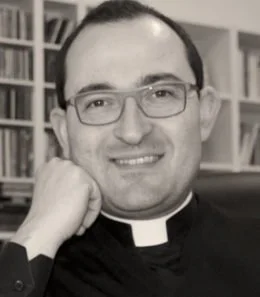
Simone Riva - The Prologue to the Gospel of John represents the bedrock of Christianity. It is not a mere abstraction, but the lived experience of a love that continues to transform us today.
There are certain texts that, once read, leave us wondering: what kind of encounter must the authors have had to find such words? The Prologue to the Gospel of John is undoubtedly one of them. We can envision the "beloved disciple," now in his twilight years, sitting by the shore on an evening where the only sound is the rhythmic ebb and flow of the tide.
The Historical Context of St. John in Ephesus
He is savoring a new chapter of his life in Ephesus alongside Mary. His days are a tapestry of stories and silence, and the sea—which he once braved as a fisherman—has become a companion to his memory. Whenever he finds himself alone, watching the light dance upon the water, it is as if he is reliving his days with the Master.
He resolved to set everything down in writing, as others had, but in his own singular voice. He retraces the details of the man he first met alongside Andrew at four o’clock in the afternoon—on a day that appeared unremarkable but was, in truth, the dawn of a new era. It all began with a question that took root in his heart forever: “What are you looking for?” (Jn 1:38).
He would never have had the audacity to ask himself such a thing, but that young Galilean cut to the chase with a piercing question addressed directly to him. Jesus touched the most vulnerable part of John’s heart at that "tenth hour" by the Jordan; in that moment, John felt as if he had finally come home to his true self, to his very origin.
The Theological Meaning of John 1:1: The Word Made Flesh
And so, he began to write: “In the beginning was the Word, and the Word was with God, and the Word was God. He was with God in the beginning; through him all things were made, and without him nothing was made that has been made” (Jn 1:1-3).
When his pen traced the word "all" on the papyrus, he might just as well have written his own name. It was his own foundation and existence hanging in the balance, not a theory or a mental exercise. He went so far as to define God—a bold departure from other New Testament authors—rather than simply describing His actions: “God is love” (1 Jn 4:8, 16), “God is Spirit” (Jn 4:24), “God is light” (1 Jn 1:5).
Christianity as an Experiential Reality
Ultimately, he had been struck by a love that was, for him, a present reality.
As evening faded into night, he penned the sentence that would become the ultimate, breathtaking synthesis of everything: “And the Word became flesh and dwelt among us, and we beheld his glory, glory as of the only begotten of the Father, full of grace and truth” (Jn 1:14).
That evening has left an indelible mark on our daily lives, shaping our rhythms and our moments. It became the stillness and the peeling of bells; it became both a prayer and a living memory of the beginning of all things.
“That which was from the beginning, which we have heard, which we have seen with our eyes, which we have looked upon and touched with our hands, concerning the Word of life... what we have seen and heard, we also proclaim to you, so that you too may be in communion with us” (1 Jn 1:1-3).
This is the encounter the beloved disciple had to experience to write as he did. It is the same experience we can have today, becoming a "living text" for the world through the witness of our lives. As Luigi Giussani wrote: “Christianity, being a present Reality, has as its instrument of knowledge the evidence of an experience” (Event of Freedom, Marietti 1820, Genoa 2002, p. 190).
📘 Deep Dive: Understanding the Johannine PrologueFrequently Asked Questions
Q: What is the main message of the Prologue of John? A: The main message is the Incarnation: the belief that the eternal Word of God (the Logos) became a human being in Jesus Christ. This bridge between the divine and the physical world is the "bedrock" of Christian theology.
Q: Why does the author mention the "tenth hour" (4:00 p.m.)? A: Mentioning the specific time highlights that the author's faith is based on a historical encounter. It wasn't a vague feeling; it was a specific event at a specific time that left an "indelible mark" on his memory.
Q: How does Luigi Giussani’s "Event of Freedom" relate to St. John? A: Giussani argues that faith is verified through experience. Just as John "touched with his hands" the Word of Life, modern believers are invited to recognize Christianity as a "present reality" happening in their lives today, rather than a museum piece of history.
🏷️ Explore More Topics
Theology: The Word became flesh.
History : A living legacy Nicea’s unseen power.
Philosophy: Newman belongs to the great teachers of the Church.