Don’t Change the Method
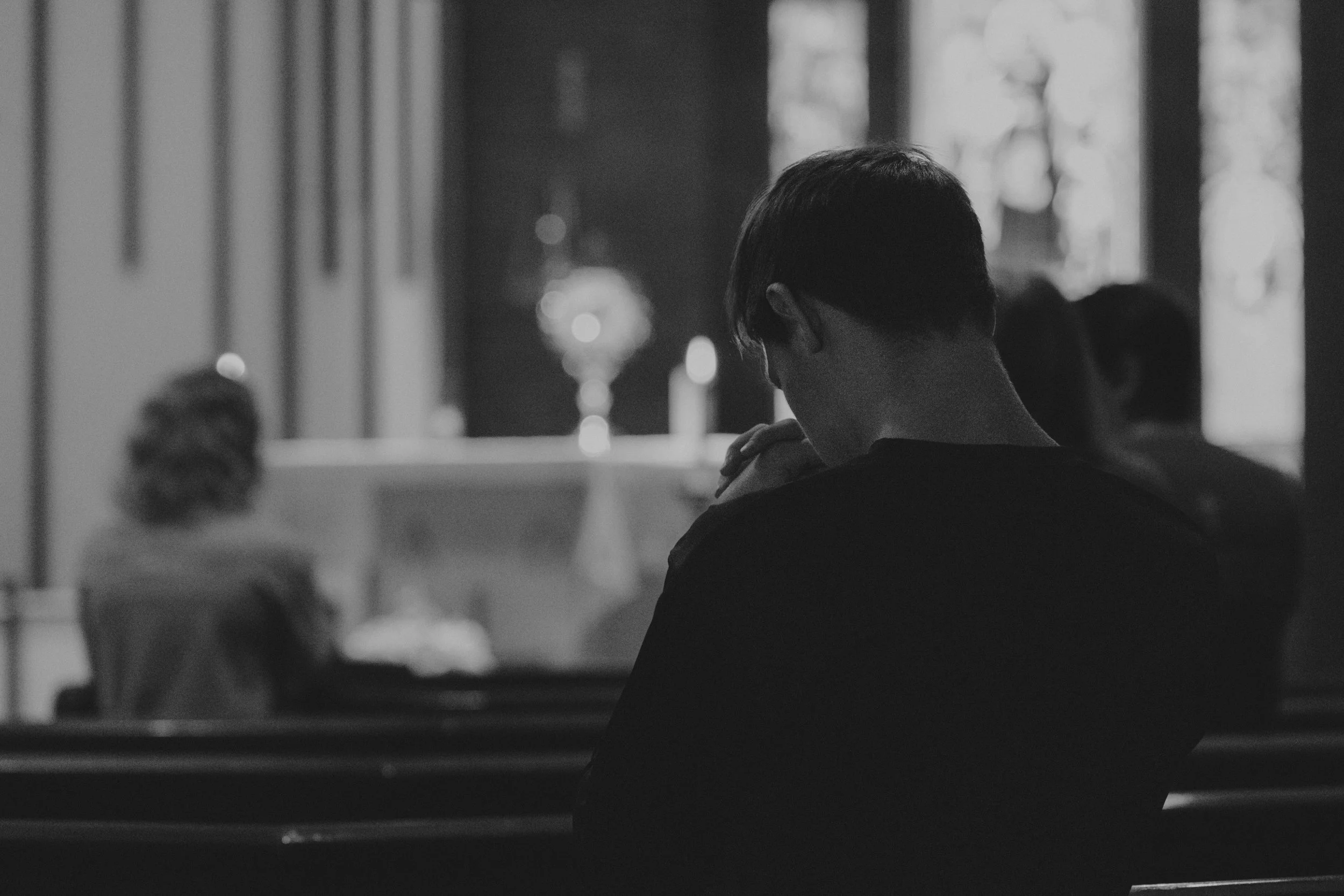
A black-and-white photograph of a person seated in a church pew, head bowed in prayer, with a softly blurred altar and candlelight in the background. The image evokes silence, humility, listening, and the spiritual responsibility of governance within ecclesial movements.
“The Governance of Movements: On Not Changing the Method reflects on Pope Leo XIV’s teaching to ecclesial movements, arguing that authority in the Church must never possess the charism but serve the original encounter with Christ. Governance becomes fruitful when it protects freedom, recognizes authority as a gift, listens to difference, and remains obedient to the Spirit’s unpredictable initiative.”
Giuseppe Foletti - The governance of movements: of not changing the method.
Ecclesial movements are passing through a decisive moment. In his address to the moderators of associations of the faithful, Leo XIV offers reflections on governance that deserve careful attention. A diocesan priest offers his reading: the charism belongs to no one, and to govern means to serve the Event from which everything began.
We can enter into that moment when, on the shores of the Sea of Galilee, Jesus met the first disciples and called them to himself. We can sense the impact his gaze, his words, his gestures, his very person had on them. And we can do so because that same encounter is happening even today. The charisms from which so many ecclesial movements and communities have been born in recent decades are recognized by the Church as particular ways in which the Spirit tirelessly proposes anew, even today and in an existentially persuasive way, the grace of the encounter with the Lord. When, in June 2025, Pope Leo XIV met for the first time with the moderators of these groups, he told them that God raises up charisms “so that they may reawaken in hearts the desire for an encounter with Christ, the thirst for the divine life that He offers us—in a word, grace!”
A few weeks ago, in May 2026, on the same occasion, the Pope chose to go deeper into the theme of the governance of associations of the faithful and movements. I do not intend to offer an exhaustive analysis of his address, much less a theological evaluation—a matter in which I do not consider myself particularly competent. But as a member of one of the groups in question, and as someone answerable to the call to new life that reached me, I would like to offer a few reflections, with the desire to listen to the Pope’s words and to let myself be challenged by them.
In recent years it has become clear that the Church’s understanding of what the movements are is still taking shape. Precisely for this reason, I believe we are passing through a decisive moment of verification for the movements and for the Church. The Pope himself enters the subject without claiming to settle the question, offering instead “a few reflections” and thereby contributing to the “reflecting together” to which the Dicastery for Laity, Family and Life invites the movements.
What strikes me first is how the Pope identifies the task of those who hold a responsibility of governance in these contexts: given the specific nature of the Church, whoever exercises governance within her has, above all, the task of serving that Event by which the first disciples were reached—that encounter which continues to cross time down to our own day. If governing “refers to the action of ‘steering the helm,’” in the Church this is entirely at the service of, and in function of, the initiative by which Christ moved to bring salvation to humanity. Since the Church was established by Christ as an “effective sign” of his saving will for all people, this also defines the nature of governance in the Church: “These distinctive characteristics of the Church are necessarily present in her governance as well.” The governance of these realities must therefore serve the impact of this newness, fostering the space in which the work of an Other—who, by grace, never ceases to make himself present—can show itself.
We must therefore become aware of the nature of the initial Event so as to leave it all the room it needs to define even the institutional forms, and let ourselves be guided by the Spirit to continue on the journey—without changing the method—while continuing to pursue and deepen the fascination of the gift we have received. The movements have the responsibility to look and to discern, in communion with the ecclesiastical hierarchy, what constitutes the originality of a specific charism. Here, too, lies all the beauty of being able to exercise one’s own responsibility—which is always, first of all, personal—toward that Event full of promise that has touched one’s life and that continually happens again, tearing us away from our reductions and our heaviness. One might say that those who exercise a responsibility of governance will do so all the more fruitfully the more they live this responsibility toward themselves.
In words, we can all agree that the Christian event is the permanent origin of the service of ecclesial governance. In fact, though, this can easily remain a declaration of intent—words, a discourse that has already relegated that impact to a premise that no longer cuts into life. In pointing out this risk, Don Giussani was relentless. I recently came across one of his especially effective formulations:
“We all recognize that Christ is reality; but this does not penetrate our existence. It is not a true judgment; it is an idea on which an ideology is built, and a practice to match. […] Judgment [by contrast] is something that has energy and substance, that challenges the rest of life. […] Whereas when you say, ‘Christ is reality,’ nothing stirs inside you; you do not hear the ‘thump-thump’ of the miners setting off their charges, or of the battering ram trying to breach your wall.”²
When you let the battering ram breach your wall, you begin to breathe again. If everything that belongs to the journey, with all its complexities, enters into the sphere of that initial, persuasive, and fascinating impact with the exceptional humanity of Jesus, then everything becomes interesting, and setting out on the journey becomes desirable. Giussani also said that “the impact with a human diversity, the wonder born of it, is destined to be the initial and original phenomenon of every moment of development. Because there is no development if that initial impact is not repeated—if, that is, the event does not remain contemporary.”³
If, then, as Leo XIV recalls in his address, in continuity with the recent magisterium, a certain institutionalization belongs to the historical development of charisms, it is legitimate to hope that this will not take the form of a crystallization—of forms with any purpose other than to serve and foster the action of the Spirit, the continual wellspring of every true newness.
Governance, too, in fact, “is a special gift of the Holy Spirit, which the members of a community recognize as present in some of their brothers and sisters in the faith.” From this the Pope draws three simple but significant consequences regarding the task and the identification of authority: first, that it must be for the benefit of all and never exploited for personal interests or a project of power; second, “that it can never be imposed from above, but must be a gift recognizable within the community and freely accepted—hence the importance of free elections to make it effective”; finally, the Pope reaffirms the need to remain open to the discernment of the Pastors.
What strikes me in this concise passage, central to the Pope’s message, is the certainty with which he insists on the capacity and the responsibility of everyone within a community to identify authority. These observations clearly take up one of the two main elements of the 2021 Decree issued by the Dicastery for Laity, Family and Life. Alongside term limits for the central governing body came the request for greater representation of all the members of the association in electing that body. In this regard, the Pope’s conviction is genuinely interesting: authority “must be a gift recognizable within the community and freely accepted,” and everyone has the capacity to carry out this recognition. It brings to mind what Julián Carrón wrote to the members of the Fraternity of CL after the Decree’s publication:
“To face this circumstance to which the Church calls us, nothing is more important than becoming aware of the nature of our true need. This clear consciousness of ourselves will make it easier for us to recognize what we need in order to live, and thus to identify in whom we see the grace of the charism shining today—that attraction that won us over in the encounter and that changed our life at the root.”
I confess that at the time I had not fully grasped the meaning of such an invitation. Today it is crystal clear, and stamped in my memory as a gesture of true fatherhood. Each of us will be able to play our part with authentic responsibility to the extent that we take seriously the true need of our own heart; this seems to me the most decisive work for bringing about that recognition of authority to which the Pope calls everyone.
One last element that emerges is the reminder of the vital importance of communion and, bound to it, the capacity to listen to and welcome even differing opinions. In recent years—not easy ones for many of the communities in question—the call to communion, or to unity, has resounded abundantly. It seems to me that, in the desire we all share to live this gift of grace, it is right to look at how it actually happens.
A quick glance at the world is enough, in fact, to realize that human beings are not capable of living communion; though it is generally recognized as a value, that does not mean it is normally lived as a reality that goes deeper than a certain outward courtesy.
The contemporary phenomenologist Jean-Luc Marion, who places the overcoming of nihilism at the center of his research, holds that the voluntaristic affirmation of values is one of the ways we normally make the situation worse: “For what is a value? Strictly speaking, only financial value exists—which is valued and devalued. In short, value has no value”⁴ apart from what the subject grants it. Understood this way, a value is nothing more than the substance we concede to something—which, precisely because it needs our will in order to have value, remains empty in itself.
What we set out to affirm by our own will—what appears possible to us—will always be a contribution too short of breath, incapable of reproducing that profound unity and communion which, in reality, is always given as a miracle that never ceases to surprise us and fill us with emotion and gratitude.
If we think of Pentecost—not out of place when looking at the charisms in the Church—we see that unity does not come about through uniformity; the day of Pentecost reveals its exceptionality precisely in the unity the Spirit brings about among the diverse: this is what astonished the pilgrims in Jerusalem. Where does this possibility of unity among the diverse come from? It is always something unforeseen that happens, not a project. Looking at my own experience, it is clear that for me, too, it has always happened this way. It can seem uncomfortable and dizzying—and in fact it is—but the alternative is to remain with the meager product of our own hands.
And if this is so, the desire to listen also becomes clear, because the other—different from me—presents himself as a good for me. Listening is not democratization but a tension toward truth, understood as an event that continually happens anew. The problem is not gathering a hodgepodge of opinions, but being open to the possibility that, through what happens in the other’s life, that newness may arise which renews communion. It is, once again, a readiness to follow the path traced by the Holy Spirit—as Pope Francis, for that matter, often insisted, to keep the synodal journey he proposed to the whole Church from being reduced in meaning and scope.
Perhaps we could say, in short, that the position emerging as the foundation of the Pope’s entire address is that the charism is no one’s possession; it is a gift to be continually recognized and welcomed anew in its novelty and unpredictability. Hence the calls to everyone’s co-responsibility in recognizing authority, to the capacity for listening in recognizing the good represented by those who are different, and the reference to the discernment of the Pastors not as an extrinsic duty but as an essential factor present in personal experience from the very beginning.
In recent years, the relationship between the ecclesiastical hierarchy and the movements and new communities has not always appeared entirely peaceful. This is partly understandable, given the novelty they represent—which takes time to be understood—and also because of the bewildering cases of grave abuse of various kinds that have come to light within some of these communities.
For this reason it is all the more surprising, and a source of great gratitude, to see the esteem with which the Pope fearlessly brings everything back to people’s experience and to what everyone can freely recognize as true. This is no small risk, because nothing guarantees in advance that freedom will actually move toward what is true. But it is a real gesture of fatherhood, one that points to the fatherhood of the Father, who awaits with trembling anticipation the move of his creature’s freedom.
We all share—each according to what is asked of us—the responsibility to recognize and follow the action of the Spirit who “blows where he wills” (Jn 3:8), and to beg to be able to keep our gaze fixed on the One who makes all things new. Otherwise, we run out of breath.
NOTES
Giuseppe Foletti is a diocesan priest of the Diocese of Lausanne, Geneva, and Fribourg, currently a doctoral candidate at San Damaso University in Madrid.
² Quoted in J. Carrón, “The Urgency of Judgment.”
³ L. Giussani, “Something That Comes First,” address to the CL Leaders’ Assembly, January 26, 1993.
⁴ J.-L. Marion, Paroles données. Quarante entretiens (Cerf, Paris 2021), 130. Our translation.