
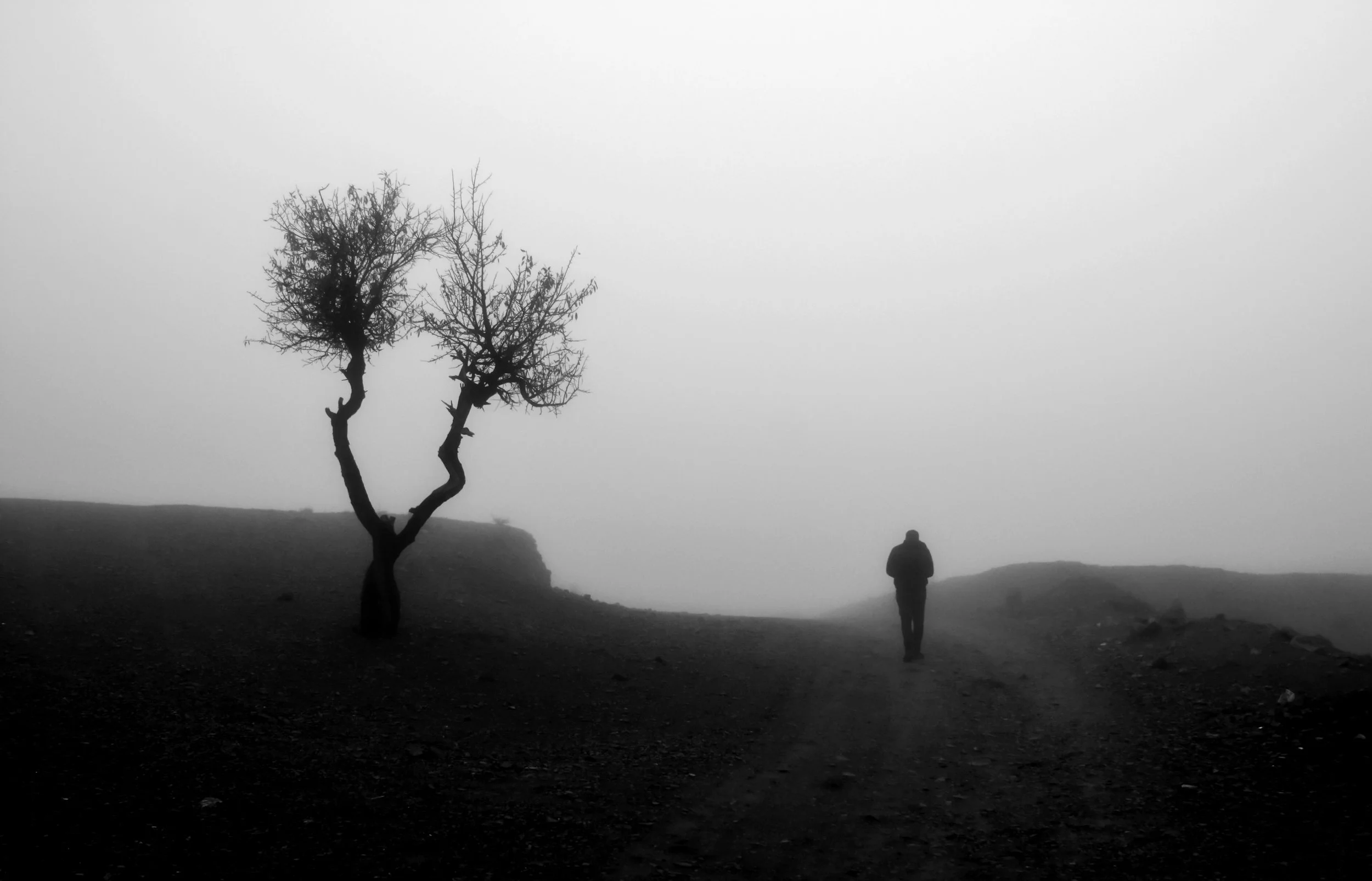
A solitary traveler walks out of the mist toward the brightening horizon—evoking Emily Dickinson’s meditation on expectation and the journey toward the Day. Photo by Javad Esmaeili via Unsplash.
“No more to do have I. Till His best step approaching”
Emily Dickinson and the song that keeps the darkness away.
I sing to use the WaitingMy Bonnet but to tieAnd shut the Door unto my HouseNo more to do have ITill His best step approachingWe journey to the DayAnd tell each other how We sungTo Keep the Dark away.
There is a house in Amherst at dusk. A woman ties the ribbons of her bonnet. She closes the door behind her. Nothing else is left to do. And so she sings.
I sing to use the Waiting My Bonnet But to tie And shut the Door upon my House I have No more to do.
Emily Dickinson penned these words circa 1864, about a life many have deemed small: a bedroom, a garden, a writing desk beside the window. Yet within a mere eight lines, she asserts something immense. A person is constituted by waiting.
Not the waiting of the airport lounge or the doctor's office, that dead time we fill by scrolling. Another kind. The waiting that is the very shape of the heart. Man i is awaiting. Dickinson's poem is not about killing time. It is about what time is for.
The issue is not about whether we are waiting. We all are. The issue is about what we are waiting for.
And then: where does the song come from?
There is a song that is nothing but noise against the night. We know that song well. It is the music we play to keep ourselves from hearing the silence. It does not last. Sooner or later the darkness returns and finds us weary.
But there is another song, a song that is not drawn from effort but from certainty: "Till His best step approaching." Someone is coming, someone already seen, already heard on the stairs of my memory. This song does not disavow the dark. It simply knows that the dark is not the last word. It is the song of readiness.
See what she accomplishes while she waits. She braids a bonnet. She closes a door. No big deal. Nothing newsworthy. So little, and so much, is required by readiness: a freedom held open as a door left unlatched. Speaking about the parable of the ten virgins, Carron said this month, "All ten virgins fell asleep. Only the unexpected showed which ones had brought oil." The oil is not a spectacle. It is the quiet act multiplied during the ordinary hours.
And who is He? Dickinson capitalizes the pronoun and never tells us. A lover? God? She leaves the door ajar, and perhaps rightly so. Each of us, waiting for a "you," harbors within us, like a seed, a waiting for Another. To love someone is to learn that our hunger is greater than the person. This is not a betrayal. It is a promise.
But then, the poem takes a turn.
We journey to the Day, recounting to one another the songs we sang to keep darkness at bay.
Not me. Us. The waiting culminates in companionship, and the companionship becomes the memory. They walk toward the light and relate to each other the tale of the night. This is how faith has always been transmitted: not as a theory, but as a story told by one who was there to one who walks beside him.
Darkness was real. Songs were real. And the morning, when it breaks, belongs to those who have been singing all along.
J.M.
-
Emily Dickinson e la canzone che tiene lontana l’oscurità.
Canto per occuparmi
Di allacciarmi il cappellino
E chiudere la porta di casa mia
Non ho altro da fare
Finché i Suoi passi non si avvicinano
E ci incamminiamo verso il Giorno
E ci raccontiamo come abbiamo cantato
Per tenere lontana l’oscurità.
C’è una casa ad Amherst al crepuscolo. Una donna allaccia i nastri del suo cappellino. Chiude la porta dietro di sé. Non c’è nient’altro da fare. E così lei canta.
Canto per usare l’attesa del mio cappellino, ma per allacciarlo e chiudere la porta della mia casa, non ho altro da fare
Emily Dickinson scrisse queste parole intorno al 1864, parlando di una vita che molti hanno ritenuto modesta: una camera da letto, un giardino, una scrivania accanto alla finestra. Eppure, in sole otto righe, afferma qualcosa di immenso. Una persona è costituita dall’attesa.
Non l’attesa della sala d’attesa dell’aeroporto o dello studio del medico, quel tempo morto che riempiamo scorrendo lo schermo. Un altro tipo di attesa. L’attesa che è la forma stessa del cuore. L’uomo è attesa. La poesia della Dickinson non parla di ammazzare il tempo. Parla di ciò a cui serve il tempo.
La questione non è se stiamo aspettando. Lo stiamo facendo tutti. La questione è cosa stiamo aspettando.
E poi: da dove viene la canzone?
C’è una canzone che non è altro che rumore contro la notte. Conosciamo bene quella canzone. È la musica che suoniamo per impedirci di sentire il silenzio. Non dura a lungo. Prima o poi l’oscurità ritorna e ci trova stanchi.
Ma c’è un’altra canzone, una canzone che non nasce dallo sforzo ma dalla certezza: «Finché il Suo passo migliore si avvicina». Qualcuno sta arrivando, qualcuno già visto, già udito sulle scale della mia memoria. Questa canzone non rinnega l’oscurità. Sa semplicemente che l’oscurità non è l’ultima parola. È la canzone della prontezza.
Guardate cosa fa mentre aspetta. Intreccia una cuffietta. Chiude una porta. Niente di che. Niente di degno di nota. La prontezza richiede così poco, eppure così tanto: una libertà tenuta aperta come una porta lasciata sganciata. Parlando della parabola delle dieci vergini, Carron ha detto questo mese: «Tutte e dieci le vergini si sono addormentate. Solo l’imprevisto ha rivelato quali avessero portato l’olio». L’olio non è uno spettacolo. È l’atto silenzioso moltiplicato durante le ore ordinarie.
E chi è Lui? Dickinson scrive il pronome con la maiuscola e non ce lo dice mai. Un amante? Dio? Lascia la porta socchiusa, e forse fa bene. Ognuno di noi, in attesa di un «tu», custodisce dentro di sé, come un seme, l’attesa di un Altro. Amare qualcuno significa imparare che la nostra fame è più grande della persona stessa. Questo non è un tradimento. È una promessa.
Ma poi, la poesia prende una svolta.
Camminiamo verso il Giorno, raccontandoci a vicenda le canzoni che abbiamo cantato per tenere a bada l’oscurità.
Non io. Noi. L’attesa culmina nella compagnia, e la compagnia diventa il ricordo. Camminano verso la luce e si raccontano a vicenda la storia della notte. È così che la fede è sempre stata trasmessa: non come una teoria, ma come una storia raccontata da chi c’era a chi cammina al suo fianco.
L’oscurità era reale. Le canzoni erano reali. E il mattino, quando spunta, appartiene a coloro che hanno cantato per tutto il tempo.
J.M.
-
Emily Dickinson y la canción que ahuyenta la oscuridad.
Canto para atarme
la cinta de mi sombrero
y cerrar la puerta de mi casa
No tengo nada más que hacer
hasta que sus pasos se acerquen
y partamos hacia el día
y nos contemos cómo cantamos
para ahuyentar la oscuridad.
Hay una casa en Amherst al atardecer. Una mujer se ata las cintas de su sombrero. Cierra la puerta tras de sí. No queda nada más por hacer. Y así, ella canta.
Canto para ponerme el sombrero de la espera, pero atarlo y cerrar la puerta de mi casa es todo lo que me queda por hacer
Emily Dickinson escribió estas palabras hacia 1864, sobre una vida que muchos han considerado insignificante: un dormitorio, un jardín, un escritorio junto a la ventana. Sin embargo, en tan solo ocho versos, afirma algo inmenso. Una persona se define por la espera.
No es la espera de la sala de espera del aeropuerto o de la consulta del médico, ese tiempo muerto que llenamos desplazándonos por la pantalla. Es otro tipo de espera. La espera que es la forma misma del corazón. El ser humano es espera. El poema de Dickinson no trata de matar el tiempo. Trata de para qué sirve el tiempo.
La cuestión no es si estamos esperando. Todos lo estamos. La cuestión es qué estamos esperando.
Y entonces: ¿de dónde viene la canción?
Hay una canción que no es más que ruido contra la noche. Conocemos bien esa canción. Es la música que ponemos para no oír el silencio. No dura. Tarde o temprano, la oscuridad vuelve y nos encuentra agotados.
Pero hay otra canción, una canción que no nace del esfuerzo, sino de la certeza: «Hasta que se acerque Su paso más firme». Alguien viene, alguien a quien ya he visto, a quien ya he oído en las escaleras de mi memoria. Esta canción no niega la oscuridad. Simplemente sabe que la oscuridad no es la última palabra. Es la canción de la preparación.
Mira lo que ella hace mientras espera. Trenza una cofia. Cierra una puerta. No es gran cosa. Nada digno de nota. La preparación exige tan poco, y a la vez tanto: una libertad que se mantiene abierta como una puerta sin cerrar con pestillo. Hablando de la parábola de las diez vírgenes, Carron dijo este mes: «Las diez vírgenes se quedaron dormidas. Solo lo inesperado reveló cuáles habían traído aceite». El aceite no es un espectáculo. Es el acto silencioso multiplicado durante las horas cotidianas.
¿Y quién es Él? Dickinson escribe el pronombre con mayúscula y nunca nos lo dice. ¿Un amante? ¿Dios? Deja la puerta entreabierta, y quizá con razón. Cada uno de nosotros, a la espera de un «tú», alberga en su interior, como una semilla, la espera de Otro. Amar a alguien es aprender que nuestra sed es mayor que la persona. Esto no es una traición. Es una promesa.
Pero entonces, el poema da un giro.
Viajamos hacia el Día, contándonos unos a otros las canciones que cantábamos para mantener a raya la oscuridad.
Yo no. Nosotros. La espera culmina en compañía, y la compañía se convierte en recuerdo. Caminan hacia la luz y se cuentan la historia de la noche. Así es como siempre se ha transmitido la fe: no como una teoría, sino como una historia contada por quien estuvo allí a quien camina a su lado.
La oscuridad era real. Las canciones eran reales. Y la mañana, cuando amanece, pertenece a quienes han estado cantando todo este tiempo.
J.M.
-
Emily Dickinson et la chanson qui éloigne les ténèbres.
Je chante pour m’occuper
Je n’ai qu’à nouer mon bonnet
Et fermer la porte de ma maison
Je n’ai rien d’autre à faire
Jusqu’à ce que Ses pas se rapprochent
Nous cheminons vers le jour
Et nous nous racontons comment Nous avons chanté
Pour éloigner les ténèbres.
Il y a une maison à Amherst au crépuscule. Une femme noue les rubans de son bonnet. Elle ferme la porte derrière elle. Il ne lui reste plus rien d’autre à faire. Et alors, elle chante.
Je chante pour attacher mon bonnet, mais pour nouer et fermer la porte de ma maison, je n’ai plus rien d’autre à faire
Emily Dickinson a écrit ces mots vers 1864, à propos d’une vie que beaucoup ont jugée insignifiante : une chambre, un jardin, un bureau près de la fenêtre. Pourtant, en à peine huit vers, elle affirme quelque chose d’immense. Une personne se construit par l’attente.
Pas l’attente du salon d’aéroport ou du cabinet médical, ce temps mort que l’on comble en faisant défiler son écran. Une autre sorte d’attente. L’attente qui est la forme même du cœur. L’être humain est attente. Le poème de Dickinson ne parle pas de tuer le temps. Il parle de la raison d’être du temps.
La question n’est pas de savoir si nous attendons. Nous attendons tous. La question est de savoir ce que nous attendons.
Et puis : d’où vient la chanson ?
Il y a un chant qui n’est rien d’autre qu’un bruit dans la nuit. Nous connaissons bien ce chant. C’est la musique que nous jouons pour nous empêcher d’entendre le silence. Elle ne dure pas. Tôt ou tard, l’obscurité revient et nous trouve épuisés.
Mais il y a un autre chant, un chant qui ne naît pas de l’effort mais de la certitude : « Jusqu’à ce que ses pas se rapprochent. » Quelqu’un arrive, quelqu’un que j’ai déjà vu, déjà entendu dans les escaliers de ma mémoire. Cette chanson ne renie pas les ténèbres. Elle sait simplement que les ténèbres n’ont pas le dernier mot. C’est le chant de la préparation.
Regardez ce qu’elle accomplit pendant qu’elle attend. Elle tresse un bonnet. Elle ferme une porte. Rien d’extraordinaire. Rien qui mérite de faire la une. La préparation exige si peu, et pourtant tant : une liberté maintenue ouverte, comme une porte laissée déverrouillée. À propos de la parabole des dix vierges, Carron a déclaré ce mois-ci : « Les dix vierges se sont toutes endormies. Seul l’imprévu a révélé lesquelles avaient apporté de l’huile. » L’huile n’est pas un spectacle. C’est l’acte discret multiplié au fil des heures ordinaires.
Et qui est-Il ? Dickinson écrit le pronom avec une majuscule et ne nous le dit jamais. Un amant ? Dieu ? Elle laisse la porte entrouverte, et peut-être à juste titre. Chacun de nous, dans l’attente d’un « toi », porte en soi, comme une graine, l’attente d’un Autre. Aimer quelqu’un, c’est apprendre que notre soif est plus grande que la personne elle-même. Ce n’est pas une trahison. C’est une promesse.
Mais alors, le poème prend un tournant.
Nous cheminons vers le Jour, en nous racontant les chants que nous avons entonnés pour tenir les ténèbres à distance.
Pas moi. Nous. L’attente culmine dans la compagnie, et la compagnie devient le souvenir. Ils marchent vers la lumière et se racontent l’histoire de la nuit. C’est ainsi que la foi s’est toujours transmise : non pas comme une théorie, mais comme un récit raconté par celui qui était là à celui qui marche à ses côtés.
Les ténèbres étaient bien réelles. Les chants étaient bien réels. Et le matin, lorsqu’il se lève, appartient à ceux qui n’ont cessé de chanter.
J.M.