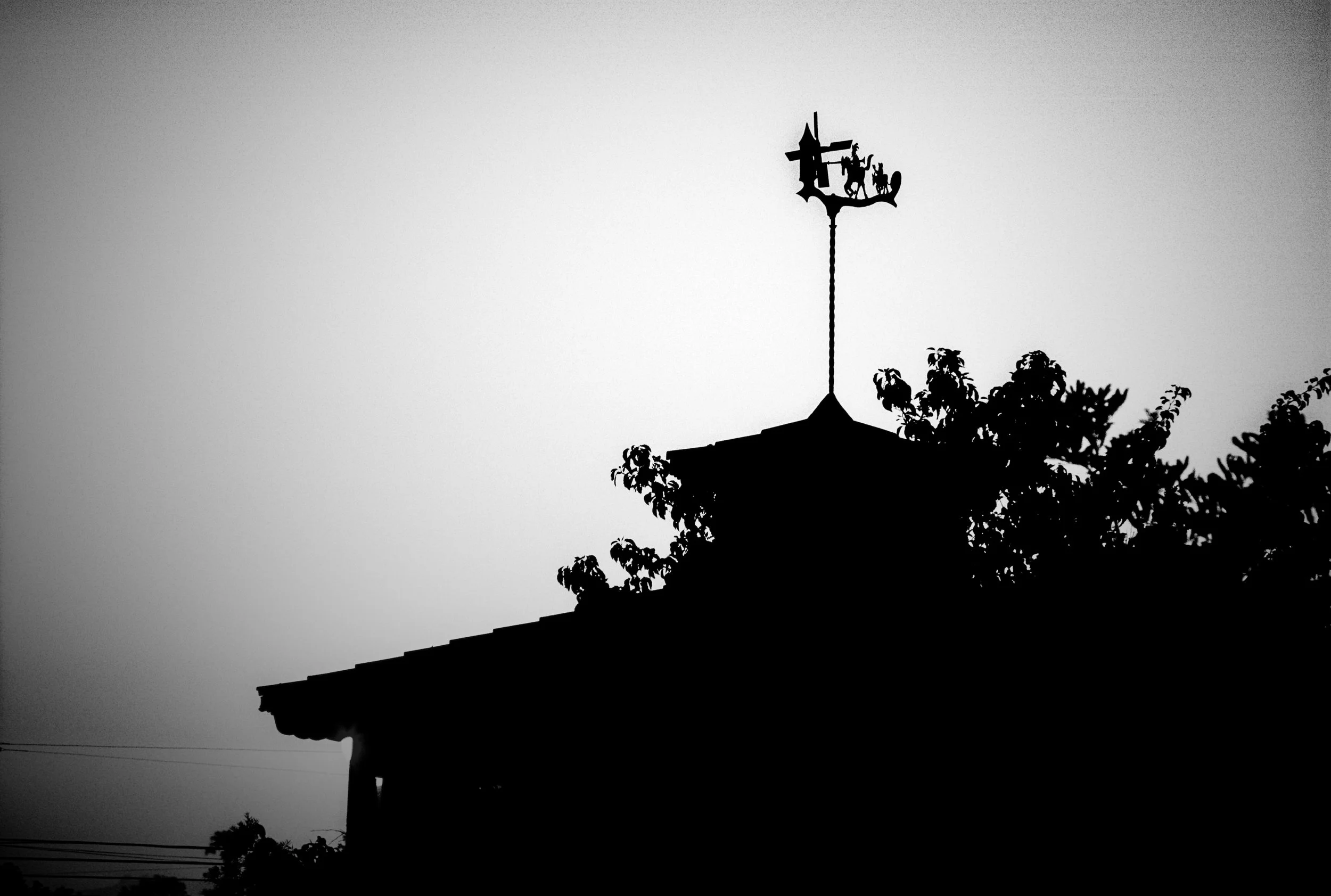
Don Quixote Weathervane in Silhouette. Tilting at windmills: a Don Quixote weathervane on a rooftop, framed against the evening sky.
“Only a compassionate gaze can hold these two levels together; a divided gaze either condemns or idealizes.”
Guadalupe Arbona - Why does Cervantes’s mad knight still unsettle us? When the knight’s gaze restores two women’s names and dignity.
Don Quixote: A Look at Humanity is the first installment in a series of articles on the celebrated Spanish novel The Ingenious Gentleman Don Quixote of La Mancha. In subsequent installments, Guadalupe Arbona will present a selection of episodes. These articles offer an interpretation of the tender yet powerful perspective through which Miguel de Cervantes creates his character, Don Quixote de la Mancha.
In my various readings of the most famous novel in Spanish literature, The Ingenious Gentleman Don Quixote of La Mancha, I have laughed and cried, I have learned and I have grown angry, but I have never been able to detach myself from the character who has kept me questioning for years. And he continues to do so. He is a sane madman, a nobleman who loses his mind reading chivalric novels and who, believing himself to be one of their protagonists, tries to mold himself after the stories he has read. What is it about the protagonist, Don Quixote de la Mancha? Why do I return to him, seeking to discover something more in each of his adventures, encounters, battles, and conversations? Going back to the source, to his creator, I ask myself: Why does Cervantes make us navigate the wisdom and folly of Don Quixote? Does he want to show us something hidden within them? If that weren’t the case, the work would be reduced to mere farce. But that is not so: the novel springs from a gentle yet powerful gaze upon the human condition.
My reading is one of the latest in a long line of readers, because ever since Don Quixote took on a life of his own, all of us who encounter him seek to understand who he is and why he challenges us. The first to do so were those who witnessed this explosion of life that the character embodies on the very fringes of fiction. From the novel’s very first pages, those around him reveal something about themselves every time they speak of him. His absurd yet tender presence lays bare their hearts. The characters reveal their true selves in the presence of Don Quixote. The reactions vary: the nobleman’s niece and housekeeper try to ensure he is content with an orderly life; his friends—the priest and the barber—want him to return home and stop acting foolishly; Sancho accompanies him on his adventures and goes from doing so for the sake of rewards to cherishing him more than the “fibers of his heart.”
These are the first, but throughout the work each encounter elicits different reactions: the innkeeper hopes to profit; the prostitutes at the inn feel honored; the goatherds are in awe; the dukes devise all sorts of pranks to mock him; the shepherdess Marcela feels understood; Lorenzo, the poet, is grateful; Antonio Moreno, in Barcelona, puts his intelligence to the test; lovers confide their affairs to him; the wretched hope he will set them free; those attacked by his madness beat him up, and so on. And while the characters who react to him are many—yet countable—the interpretations by readers and critics are innumerable: from F. Dostoevsky to Paul Auster, from L. Pirandello to Miguel de Unamuno, from J.L. Borges to M. Vargas Llosa, from J. Jiménez Lozano to H. Bloom, from L. Sciascia to Américo Castro, and a very long list of others.
I do not intend to comment on the many fascinating interpretations; what has led me to write these pages is my interest in the perspective from which Don Quixote emerges. I believe that exploring how the author of Don Quixote creates and presents his character offers an interesting perspective. Miguel de Cervantes traveled extensively, fought in the Battle of Lepanto, spent five years in an Algerian prison, and experienced financial hardship, accusations, and duels—all of which allowed him to gain insight into the human condition under the most diverse circumstances. His attention to what he lived through and witnessed led him to create a character so flesh-and-blood and authentic that he has become one of the most compelling figures in the history of literature. He is also the subject of the most varied interpretations, a fact that demonstrates his inexhaustible richness. Faced with Don Quixote, we readers ask ourselves:
A preposterous and beautiful character
And the challenge I face is to address Miguel de Cervantes’ creative audacity in bringing to life a character who is terribly preposterous and, at the same time, enormously beautiful. The question I pose to myself seeks to uncover what allows these open layers of the Quixotic figure to persist throughout the reading of the novel. How are these two layers reconciled? At times I’d like to be able to pigeonhole the character based on his madness and failure, but that would reduce him; I’d like to highlight his good intentions to love and do good, but that would reduce him as well. This shows that Cervantes does not allow us to reduce him either to his follies or to the idea he has of himself. We can get angry at such an unyielding character or try to see what he says about us. Cervantes does not give in; he embraces that incomplete nature and does so prodigiously, inserting masterstrokes into the cracks of Quixotic madness. These masterstrokes appear in his conscience and find expression in his dialogues.
And the challenge I face is that of paying attention to Miguel de Cervantes’ creative audacity in bringing to life a character who is both terribly absurd and, at the same time, immensely beautiful.
It is not my intention to explain Cervantes’ psychology—which, like that of any artist, is complex—but I will try to understand what he focuses on in order to grasp the result: that is, the adventures of Don Quixote. Cervantes presents us with a real man, a creature who sets out in search of a grand life and, confused by the fanciful tales in his head, commits many follies. At the same time, he is a simple and good man who seeks nothing more than “to defend maidens, protect widows, and aid orphans and the needy” (I, XI). What drives him from within is beautiful, but he fails to realize the difference between what he wants to achieve and the concrete situation in which he lives. To make what’s in his head a reality, he supplants what exists around him.
This imaginary replacement does not negate his humanity. On the contrary, in the novel his ridiculous follies open up spaces for his self-awareness—that uninterrupted stream of life that sustains him and emerges amid the nonsense. Cervantes’ genius lies in portraying this character with tenderness; that is, he does not condemn his excesses but rather reveals his humanity to us through them. He does not attempt to resolve this difficult combination; he leans neither toward the sarcasm that a madman might provoke nor toward pity for the naivety of a gullible person. Don Quixote is ridiculous, and the portrayal of his absurd deeds makes us laugh; yet he is wise because, after every failure, he offers a counterpoint that transports the reader to a realm that goes beyond mere nonsense. All of this is done in an immersive way because, through the harmony of these two elements, Cervantes manages to make us feel the Quixote within all of us—that is, what makes us human. And we laugh along with him because he manages to reconcile us with ourselves. Let me give a simple example: when he arrives at the roadside inn on his first outing, he treats the prostitutes like ladies. Is this nonsense? It is, but that perspective leaves the aftertaste of someone who sees beyond these women’s “profession.” They feel well treated, and the intelligent reader knows that Don Quixote sees more clearly than those who reduce these women to their occupation.
Only a compassionate gaze can bring people together; conversely, a divisive one either condemns or idealizes. The character himself, by revealing his self-awareness, embodies the tender gaze shared by his Creator. I’ll give two examples from the novel. They are two conversations with Sancho. After a series of adventures in which the characters have come out badly battered, Sancho tells Don Quixote that what they have endured are not chivalric adventures but rather misadventures; Don Quixote replies, with complete confidence, “But, despite all this, get on your donkey, good Sancho, and follow me, for God, who provides for all things, will not forsake us—especially since we are walking in His service as we do.
For He does not forsake the mosquitoes in the air, nor the little worms in the earth, nor the tadpoles in the water; and He is so merciful that He causes His sun to rise on the good and the bad alike, and sends rain upon the unjust and the just” I, XVIII. The message is clear: in any situation, a person is never without the providential guidance that allows them to start anew—just as the two friends will do. And on another occasion when Sancho doubts his ability to live up to what will be asked of him as the ruler of the island, Quixote replies: “Entrust it to God, Sancho,” replied Don Quixote, “for He will grant what is best for you; but do not let your spirit falter so much that you end up settling for less than being a governor” I, VII. Don Quixote is well aware that a person’s aspirations arise from the one who knows them well. In other words, the character himself knows that the unity between his ridiculousness and his aspirations is not something he can resolve on his own. There is a gaze that precedes him and makes him aware of his worth beyond his successes and failures; at the same time, it values the grandeur of his spirit’s aspirations. It is this gaze that reconciles the two levels that make up Don Quixote and serves as the mysterious “glue” that Cervantes uses to create his character—that is, by placing his structural disproportion under the gaze of an Other who moves him from within, despite his outlandish adventures.
Don Quixote’s ridiculous absurdities open up spaces for his self-awareness—that uninterrupted current of life that sustains him and emerges amid the nonsense.
Miguel de Cervantes was a voracious reader; he knew the literature of his time well and, within it, found the various ways of viewing oneself. He was familiar with the ways of narrating the human condition. He was a true Renaissance man. He draws on that humanist impetus that seeks to discover what is unique to man. As a true Renaissance man, he is steeped in the literature of classical heroes—battered by the gods yet submitting to fate with magnanimity; he is also familiar with the hagiographies dedicated to medieval saints, who fought for the divine without ever faltering. Cervantes is a Christian humanist—I do not say this merely as a label under which to pigeonhole the writer. He is a humanist because he views humanity exactly as it lives and expresses itself in all its facets, without fear of any of them; and he is a Christian insofar as his conscience is rooted in dependence on a “merciful” God, “who causes his sun to rise on the good and the evil, and sends rain on the unjust and the just” (I, XVIII). He is both at once: he dares to look human folly squarely in the face and, at the same time, sees it transfigured by the experience of knowing himself to be a child of a God who, when looking upon His creature, does not condemn him but holds him in infinite esteem. If this were not so, it would be impossible to bring into being, as Cervantes does, a character like Don Quixote.
A Tender Gaze
Cervantes creates something new by looking squarely at this humanity—wounded by madness yet pierced by sanity. That is why he does not conform to earlier models. He does not create a character who must suffer and accept whatever the gods have in store for him, nor a figure who must hide his fragility because it seems opposed to the divine. Quite the contrary: the disproportion lies at the very origin of the character; it is part of his structure and, for that very reason, cries out from his very core for mercy. If Don Quixote relentlessly strives to submit himself to a preposterous idea to which he devotes all his faith, energy, and entire life—without being aware of its mad intent—Cervantes strives with even greater energy to ensure that his character, from the very depths of his folly, reveals the evidence of his worth as a person. Don Quixote is valuable, in Cervantes’ eyes, in what he offers of himself through his fragility. Cervantes never ceases to view him with the grandeur of one who values everything that stirs within a person and discovers, in his structural disproportion, a possibility of reconciliation with that which makes him human. It is a tender gaze, akin to that of a father who sees his son’s follies and rejoices at every discovery of truth amid the fantasies to which his son subjects his life.
And I know I am repeating myself in my insistence: he is like the father who, knowing well the dynamics that drive human nature—the longing for adventure, for fame, for a lady’s love—lets him continue in his attempts to achieve them; he does not stop him in his follies, but rather celebrates the glimpses of grace he finds in his son. Thus, the figure of Don Quixote emerges not from a preconceived idea or from rigidity, but from a compassion akin to that of a father. How far we are from that view of the creator as a distant god who looks down on his characters from on high as if they were insects or grotesque creatures—as Valle Inclán would say centuries later! Cervantes’s perspective, aware of his character’s fragility, brings him to life just as he is—conscious of his limitations and powerlessness; and that is what makes the character a man. Not a grotesque figure, nor a puppet manipulated by who knows whom, nor a hero resigned to fate, nor is he a compendium of virtues.
If Don Quixote relentlessly insists on submitting himself to a preposterous idea, Cervantes strives with even greater energy to ensure that his character, from the very depths of his folly, reveals the evidence of his worth as a person.
From this highly realistic perspective, Cervantes demonstrates his keen cultural intelligence when engaging with other literary genres of his time. In other words, the novel systematically examines—with the fluidity of Cervantes’s pen—the various conceptions of humanity that shine through in the stories of that era. Cervantes puts to the test the dynamics that fuel the narratives of the era—that is, those stories later grouped into what critics call literary genres. These genres are grounded in a perspective on humanity that finds the most appropriate form of expression to transform it into literature. Cervantes, fundamentally and first and foremost, criticizes chivalric novels, which he has read to excess; he knows them to be full of historical absurdities, magical elements, and confusing and fabricated settings and time periods. He is also familiar with the idealization of the protagonists of bucolic life who pretend to be happy or unhappy in the pastoral novel. And, of course, he has become familiar with the degradation of the protagonists in picaresque novels—novels in which the heroes are at the mercy of the worst circumstances.
He is well acquainted with the sentimental novel, in which lovers inevitably die of love or suffer from unrequited love. Or they are familiar with the Morisco novel, which idealized relations between Moriscos and Christians on the Iberian Peninsula and in North Africa. Building on these forms, Cervantes creates something new. Fully aware of the dynamics of the genres in vogue at the time and the perspective on humanity they embody, he reworks them and incorporates them into his great novel, but he does not allow himself to be carried away by the idealization of unattainable ways of life (pastoral Arcadias), nor by the degradation of impossible models (chivalric novels), nor by stories of characters defined by poverty and injustice (picaresque novels); his work is full of stories of unrequited love or impossible romances (models of courtly love). He takes all these cultural references into account, weaves through them, and creates something new. Cervantes breaks the mold because his view of humanity goes beyond any model or simplification—above all, beyond those two reductive poles: idealization versus degradation.
No, Don Quixote is not predictable. He is a figure who cannot be reduced to formulas or theories. His appeal lies in that very indomitability. Cervantes is well aware of the follies a man can commit when he has an idea in his head to which he subordinates everything. From giving himself a name to create an identity—Don Quixote de la Mancha—to equipping himself with armor and a horse—the former rusty, the latter emaciated—to imagining a beloved—the Dulcinea of his imagination is not a beautiful lady, but a coarse farmwoman. Furthermore, he sets himself a mission—to aid orphans and the needy—even though he often makes the plight of those he seeks to help even worse; he seeks fame and glory through his adventures, even though in most of them he ends up battered and bruised. These outlandish ideas, to which he returns time and again, are part of his human journey. But that absurdity does not define Don Quixote unless he were also imbued with a persistent yearning for a beauty that drives him tenaciously from within: he wants his life, his beloved, and his adventures to be beautiful and to leave a mark. Herein lies Don Quixote’s indomitable spirit: no matter how much we might be tempted to focus on his absurdity, we cannot reduce him to that alone; and if, on the other hand, we wish to idealize his adventures, we cannot do that either.
Ridiculousness and Grace
Don Quixote is conceived as a dramatic character who, madly aspiring to the good, fails to realize his ideal. His secret lies in this combination of the two levels. Don Quixote offers us a stubborn testament to the nature of the human being—created from an infinite magnanimity and a freedom that allows for the greatest absurdities. Von Balthasar understands this dramatic tension, which, for my part, I experience as a form of reconciliation with my own nature. Often, when I feel my fragility, my failure, my inability to understand or see things for what they are—and not for what I have in my head—I return to the figure of Don Quixote and smile to myself. Where is the beauty of my nature? In glimpsing something else that comes to my aid. The theologian puts it this way: “There is a clear coordination between the lower and higher planes: the former is involuntarily ridiculous and farcical; in the latter, the light of grace shines.” None of his attempts—nor any of his successes or failures—annihilates grace. Moreover, grace shines through his attempts and in the way he faces both failures and successes. That is why, as the German scholar goes on to say, “Don Quixote is like a child playing at something very serious and who, precisely for that reason, cannot be deceived by the reality of the world” (Gloria: A Theological Aesthetics, 1996, 161 ff.). His personal seriousness in the pursuit of his chivalric glory will prevent him from succumbing to the deceptions and tricks of others, allowing him at times to glimpse his true merit: that of his relationship with the Creator.
Cervantes breaks the mold because his view of humanity goes beyond any model. Don Quixote is a figure who cannot be reduced to formulas and theories. His appeal lies in that very irreducibility.
On the other hand, Miguel de Cervantes not only creates Don Quixote but also seems to learn from him. First, because he is aware that his own character, too, shares in a wisdom that does not belong to him. Cervantes does not feel he owns his work. He states this in the prologue: “…but I, who, though I appear to be the father, am Don Quixote’s stepfather, do not wish to follow custom, nor to beg you—almost with tears in my eyes, as others do, dear reader—to forgive or overlook the flaws you will see in this son of mine…”. He acknowledges himself only as a stepfather or a half-father. In this way, he leaves room for a perspective that precedes him, recognizing that his voice is an echo. In fact, he devises various ways to indicate that his character and his work are not his own, but rather a discovery and a treasure found. And he makes this clear in Chapter IX of Part One, where the narrator says he found some notebooks in the Alcaná of Toledo written in Aljamiado and hired a Morisco to translate them for him, driven by curiosity and wonder at the story. By referring to the discovered manuscript, he further demonstrates that he is not the owner of his work. This distance—which could be interpreted in many different ways, such as false humility, a way to win over readers, or mere rhetoric—can also be interpreted as the certainty that the work is a gift and, as such, is offered to the reader. It is this experience that I believe every writer undergoes—that is, the surprise at the stories and characters that, created with human words, surpass all expectations. Thanks to this Cervantes-like awareness, we can witness firsthand how Don Quixote gradually gains depth and intelligence as the story unfolds. At the same time, it is part of his perspective on humanity to let the character speak for himself.
The Question of the Name
I’ll give an example that illustrates this Cervantes-like attempt to let the character speak for himself—to name himself, define himself, make mistakes, and search for himself. It concerns the question of the name. Who Don Quixote is remains an open question from the very first pages of the novel and stays open until the end. The nobleman Alonso Quijano, nicknamed “the Good,” wants to forge a new identity for himself, immersing himself in the novels of chivalry: “He spent his nights reading from dawn to dawn, and his days from dusk to dusk” (I,1)—that is, thinking of nothing else day and night. It takes him eight days to come up with the name he wants for himself. Finally, he finds it: he will be called Don Quixote de la Mancha, thus continuing and embodying the models from the novels he has read. After choosing his name, he is determined to reaffirm it; thus, every time he completes an adventure, he demands to be named the author of the feat and to be recognized with fame and glory; he repeats his request that his story and the name of its creator be taken to his beloved Dulcinea del Toboso so she may hear of it. So comical is his attempt to define himself that he repeats “I know who I am” with a confidence that makes people laugh because, far from knowing it, he subjects his self to various characters he has read about. He identifies with Amadis of Gaul, or with Ariosto’s Orlando, or with Lanzarote del Lago, with Palmerin of England, and a very long list of others. All of them are heroes he has read about in the popular novels of the time, which, far from revealing his identity, lead him to adopt a ridiculous way of life.
Later on, he will also call himself the Knight of the Sad Countenance or the Knight of the Lions. These last two epithets originate in the mind of a seeker and, at the same time, arise from the adventures he has experienced. The first occurred after he was pelted with stones for having gone against a funeral procession. Sancho witnesses his master’s defeat and tells him that his figure is sad, and Don Quixote decides to adopt it as his name. In contrast to this name, in Chapter XVII of Part Two, he confronts a caged lion, a gift for the king. Don Quixote faces the beast, and it is intimidated; for this reason, he decides to change his name to the Knight of the Lions, hoping that his feat and heroism will reach the king’s ears. There is also something very interesting about these two epithets: not only do they stem from two real-life adventures, but we also see his character emerge—whether through his success with the lions or through his failure, marked by the sad traces left on him by his successive misadventures.
And so we reach the end: back in his village and ill, it will be Sancho who tries to revive his master by giving him a new name—the shepherd Quijotiz—and encouraging him to embark on a pastoral adventure. The squire believes that this will restore his master’s spirits; however, the many adventures and the many names have shown him something that Sancho himself says about his master: “…welcome back your son Don Quixote, who, though defeated by the arms of others, has triumphed over himself; for, as he has told me, this is the greatest victory one could hope for” (Part II, Chapter LXXII). Cervantes, the “stepfather” of Don Quixote, lays bare the many forms of identity to which Don Quixote resorts, and upon reaching this final remark by Sancho, a new possibility opens up—one that remains unresolved for us—namely, the question of what it means to be a conqueror of oneself. Cervantes does not close it; rather, he confronts readers with the absurdity of knowing oneself when one adapts to so many others. And when Don Quixote proclaims himself to be greater than “the twelve Peers of France and the nine of Fame” (Book I, Chapter V), or says of himself, “I am worth a hundred” (Book I, Chapter XV), we wonder whether those twelve, that hundred, those nine, or those numerous knights to whom he turns in order to be himself have been enough for him to consider himself a conqueror of himself. Who is Don Quixote? Is he each and every one of his fabrications, or something more? Cervantes serves up on a silver platter to us, today’s readers, the task of examining the self.
Cervantes’s genius points to this very question—that is, to the inquiry into the human being.
The 160 chapters of the novel—divided into 52 in the first part and 74 in the second—are an invitation to savor this creative perspective of Cervantes. In this vein, I propose a reading of a selection of episodes in which this view of humanity is grounded in Quixotic absurdity and wit. Following on from this introduction, I will present my interpretation of various episodes, adventures, or characters from Don Quixote that allow us to appreciate this perspective.
In this second installment of Don Quixote: A Perspective on Humanity, we examine Don Quixote’s departure from home and his first adventure. It involves an encounter with two prostitutes, then referred to as “women of ill repute.” The character goes to rest at an inn that he believes to be a castle. From there, he emerges as a knighted knight: the nocturnal ceremony of his investiture is described in a parodic manner. The young women who knight him are two prostitutes—Tolosa and Molinera—on whom he sets his sights. Attentive and passionate, Don Quixote finds them beautiful and charming.
The novel’s second chapter recounts Don Quixote’s first departure from home to fulfill his dream. Armed and mounted on his horse Rocinante, he sets out before dawn on a hot July day. He seeks adventures that will make him famous for his deeds and exploits. As is repeated tirelessly throughout the novel, his mission is “to defend maidens, protect widows, and aid orphans and the needy” (I, XI). He does so by entrusting himself to his beloved, Dulcinea del Toboso. He sets out “with the greatest joy and elation at seeing how easily he had begun to fulfill his noble purpose” (I, II). With his head full of chivalric dreams and fantasies, he spends the day, and the narrator tells us that his madness has not abated, “and the sun was setting so quickly and with such intensity that it would have been enough to melt his brains, if he had any” (I, II).
But as evening falls, melancholy sets in: “He walked almost the entire day without anything worth mentioning happening to him” (I, II). We can imagine how the fervor of an impetuous Quixote has gradually faded over the course of the day, and it is easy to relate to the experience of a day when one has dreamed of remarkable events that never came to pass. There is nothing to say when nothing has happened. That is why, after wandering and daydreaming through La Mancha, “at dusk, he and his nag found themselves tired and starving, and, looking in all directions to see if he might spot a castle or a shepherd’s fold where he could take shelter and where he might alleviate his great hunger and need” (I, II). And indeed, as if by providence, his hunger and need find refuge.
Don Quixote finds a shabby inn, a roguish innkeeper, some local women of ill repute, and a meager supper. There he finds solace, and to what he sees, he adds his madness: he believes the inn to be a castle “with its four towers and spires of gleaming silver”; he sees the deceitful innkeeper as an honorable knight of the castle; the prostitutes seem to him like beautiful ladies, and the miserable supper, a banquet. All of this is accompanied by the blare of a swineherd blowing his horn to gather the herd, which Don Quixote mistakes for a trumpet celebrating his arrival at the castle. The contrast between what the narrator tells us and what Don Quixote imagines is utterly ridiculous. In just a few paragraphs, we’ve gone from fervor to exhaustion and from weakness to a distortion of what lies before him. Every time I read it, I find myself smiling. I feel Don Quixote’s absurdity, and at the same time, I’m struck by the melancholy that shines through in this character who can never be satisfied with his visions. Already in this second chapter, it becomes clear that the root of Cervantes’ humor lies in the melancholy of his character.
But by the end of the day, the melancholy emerges: “He walked almost the entire day without anything worth mentioning happening to him” (I, II).
Melancholy is the threshold to this adventure because it takes us into another realm. This Quixotic sentiment is far-reaching and does not seem to be appeased by his imaginings. Amid the blunders and absurdities, we will find the greatest of delights: Don Quixote’s gaze upon the two young women of ill repute. This will be the hallmark of his first adventure. Let’s see how it is told.
Don Quixote sees two prostitutes at the door of the inn: “There were perhaps two young women at the door—of the sort they call ‘women of the trade’—who were on their way to Seville with some muleteers who happened to be spending the night at the inn.” It is the narrator’s voice—always discreet—that tells us what the prostitutes were called: “women of the trade.” But to Don Quixote, they are “two beautiful maidens or two charming ladies who were enjoying themselves in front of the inn’s doorway.” Naturally, upon seeing the armed Don Quixote, the young women are frightened and try to take refuge inside the inn. The young women’s attempt to flee gives Don Quixote the opportunity to describe what he sees in them; his perception is not merely internal, but he expresses it aloud and in front of everyone—he does not intend to harm them: “Fear no misfortune.” On the contrary, he tells them “with a gentle demeanor and a calm voice” not to flee, for what he sees are “tall maidens,” just as “their very presence shows.”
There is no description of their figures, but we are already beginning to discover that Don Quixote, in his madness, sees what others do not. That said, he says it in such archaic language that they sense the strangeness of the words Don Quixote uses. At the same time, they initially do not recognize themselves in a designation “so far removed from their profession.” They do not see themselves as maidens traveling here and there with the muleteers who are calling out to them. That is why they burst out laughing. They cannot believe Don Quixote’s view of them. This angers Don Quixote, who, though he considers them beautiful and dignified, does not think such uncontrolled laughter befits ladies. That is why he dares to take it a step further: he places himself at their service. He says, once again in conversation with them, that his intention is to serve them.
Don Quixote is a madman, but his madness has a radiance of unconscious and involuntary sanctity. He is the defenseless man, open to the heavens, embodying realistic transcendence.
And the story doesn’t end here; it continues because it is the young women who help him take off his armor and then eat while still wearing his helmet. Once again we return to the absurdity of a character who cannot eat normally and, after being disarmed, presents a comical sight: “But it was a source of great laughter to see him eat, because, since he had his helmet on and the visor raised, he could not put anything in his mouth with his hands unless someone else gave it to him and placed it there; and so, one of those ladies attended to this task. But when it came to giving him a drink, it was impossible—and would have remained so had the innkeeper not pierced a reed; he placed one end in Don Quixote’s mouth and poured the wine through the other end.” Don Quixote, as we noted in the introduction, is like a child at play—but one who takes it very seriously: a knight, even when hungry, cannot remove any part of his armor. Furthermore, we see in this passage that the narrator has begun to adopt Don Quixote’s perspective, for he no longer refers to the prostitutes as “young women” but as “ladies.”
And this perspective will continue to develop throughout the episode. Grateful for having been disarmed by the young women, he decides to dedicate a poem to them, recited with great charm:
“Never was a knight of ladies so well served as Don Quixote was when he came from his village: maidens tended to him; princesses, to his nag.”
Grateful, though puzzled and bewildered by the words and rhetoric of chivalry, they offer him what they have—that is, something to eat. One can appreciate the shift in linguistic register used by the young women compared to Don Quixote’s pompous style, but there is something that has already brought them together despite their differences, as seen in the narrator’s commentary: “The young women, who were not accustomed to hearing such rhetoric, did not say a word; they only asked him if he wanted to eat something.” They have heard that there is someone who considers them worthy. Don Quixote introduces himself, says he wants to serve them, and that he is willing to take orders from them. How must these young women have felt upon hearing these things? They have stopped laughing; they are no longer afraid. There are things they do not understand, but they are willing to help Don Quixote.
The “young women of good family” gradually take center stage; as Don Quixote looks at them, addresses them, urges them not to laugh, not to flee, and to be of good cheer—but above all, he treats them as beautiful maidens.
In fact, in the following chapter—the third—they participate in his knighting ceremony. Following the ancient rites of the order of chivalry, one of them fastens his sword, and the other fits his spur. All this is done with a dignity that neither the innkeeper nor the muleteers display. The young women gradually take center stage as Don Quixote looks at them, addresses them, urges them not to laugh, not to run away, and to remain good-natured—but above all, he treats them as beautiful maidens.
We have felt their fear, their laughter, their gestures, their surprise, and their admiration for Don Quixote, but until the moment they receive the knighthood, we do not hear their words. It is one of them who, as she fastens his sword, says to him, “May God make you a most fortunate knight and grant you success in battle.” And upon hearing these words, Don Quixote asks her who she is. We can imagine the surprise of the young woman, who was most likely accustomed to favors that didn’t require knowing who he was or where he came from—it was enough simply to enjoy her company.
But this young woman responds, and she does so in detail and with pride. It is natural that she should feel heard by Don Quixote, who thanks her for her gesture (“a favor received”) and who is willing to share with her whatever he earns in his adventures: “She replied with great humility that her name was La Tolosa, and that she was the daughter of a cobbler from Toledo, who lived near Sancho Bienaya’s stalls, and that wherever she might be, she would serve him and regard him as her lord.” Don Quixote replied that, for her love’s sake, she should do him the favor of henceforth taking the title “Don” and calling herself “Doña Tolosa.” She promised to do so. In the seriousness with which La Tolosa—now Doña Tolosa—responds to Don Quixote, one can see that something has changed in her. Don Quixote, though ridiculous, sees the dignity in these women and takes them seriously.
He does the same with the second woman: “The other one put a spur on his foot, and he had almost the same conversation with her as he had with the one with the sword. He asked her name, and she said she was called La Molinera and that she was the daughter of an honorable miller from Antequera; to her as well, Don Quixote begged that she take the title “Doña” and call herself “Doña Molinera,” offering her further services and favors.”
Isabel Colón rightly points out that the two prostitutes become “two young women with names, not two anonymous figures,” and Carmen Castro discusses the process that marks the transformation of these two young women: “A lived experience brings out their distinction and humility from within,” and I would add that it brings their dignity to the forefront (El Quijote en clave de mujer/es, 2005). In any case, the two critics agree that Don Quixote’s gaze brings out the best in them.
It does not seem far-fetched to recall another encounter with a woman. It is the Gospel episode that recounts the arrival of Jesus of Nazareth at a well; thirsty like Don Quixote, he asks for water from a woman who is ostracized—both for being a Samaritan and for having had relationships with several men.
According to the Gospels, the Nazarene did not look at her because of her relationships—which made her an adulteress—but because of her thirst. He offers her water that will ensure she will never thirst again. Don Quixote cannot give the young women that, but he has indeed set in motion a process within Tolosa and La Molinera regarding their own selves. As for what became of the Samaritan woman, as recounted by the evangelist John, we know that she left happy. We also know that these two young women from Cervantes’s world felt so well regarded that they revealed their names and told their stories. All three felt they were being looked at differently. And it is that gaze that I bring to life and long for when I read these episodes.
That is why Don Quixote, when he looks at us, captivates us completely—just as he once captivated the women of high society who felt acknowledged, heard, and appreciated.
One might object to this first adventure of Don Quixote, arguing that it is merely another episode of his madness; yet the effects it has on the women speak to the radiance of an extraordinary quality that resonates more deeply with who they truly are. Don Quixote’s gaze is that of a madman who sees things that the rest of us do not. And here lies the novelty of the character that emerges from these very first pages. Don Quixote is not the classic hero who depended on his gods to be heroic, nor is he the perfect, virtuous saint in his actions. Don Quixote is a madman, but his madness “is surrounded by a radiance of unconscious and involuntary holiness. He is the defenseless man, open to the heights, of realistic transcendence […] the madman belongs to God, possesses a personal angel, and is worthy of religious respect” (Von Balthasar, “Madness and Glory,” Gloria).
That is why, when Don Quixote looks at us, he captivates us completely, just as he once captivated the women of high society who felt acknowledged, heard, and appreciated.
-
Guadalupe Arbona - Perché il cavaliere folle di Cervantes continua a turbarci? Quando lo sguardo del cavaliere restituisce il nome e la dignità a due donne.
Don Chisciotte: uno sguardo sull’umanità è la prima puntata di una serie di articoli dedicati al celebre romanzo spagnolo L’ingegnoso gentiluomo Don Chisciotte della Mancia. Nelle puntate successive, Guadalupe Arbona presenterà una selezione di episodi. Questi articoli offrono un’interpretazione della prospettiva tenera ma potente attraverso la quale Miguel de Cervantes crea il suo personaggio, Don Chisciotte della Mancia.
Nelle mie numerose letture del romanzo più famoso della letteratura spagnola, L’ingegnoso cavaliere Don Chisciotte della Mancia, ho riso e pianto, ho imparato e mi sono arrabbiata, ma non sono mai riuscita a distaccarmi dal personaggio che mi ha tenuta con il dubbio per anni. E continua a farlo. È un pazzo sano di mente, un nobile che perde la ragione leggendo romanzi cavallereschi e che, credendosi uno dei loro protagonisti, cerca di modellarsi sulle storie che ha letto. Cosa c’è nel protagonista, Don Chisciotte della Mancia? Perché torno a lui, cercando di scoprire qualcosa di più in ciascuna delle sue avventure, incontri, battaglie e conversazioni? Tornando alla fonte, al suo creatore, mi chiedo: perché Cervantes ci fa navigare tra la saggezza e la follia di Don Chisciotte? Vuole forse mostrarci qualcosa di nascosto in esse? Se così non fosse, l’opera si ridurrebbe a una mera farsa. Ma non è così: il romanzo nasce da uno sguardo delicato ma potente sulla condizione umana.
La mia lettura è una delle ultime di una lunga serie di lettori, perché da quando Don Chisciotte ha preso vita propria, tutti noi che lo incontriamo cerchiamo di capire chi sia e perché ci metta alla prova. I primi a farlo furono coloro che assistettero a questa esplosione di vita che il personaggio incarna ai margini stessi della finzione. Fin dalle primissime pagine del romanzo, chi gli sta intorno rivela qualcosa di sé ogni volta che parla di lui. La sua presenza assurda eppure tenera mette a nudo i loro cuori. I personaggi rivelano il loro vero io in presenza di Don Chisciotte. Le reazioni variano: la nipote del nobile e la governante cercano di assicurarsi che egli sia soddisfatto di una vita ordinata; i suoi amici — il prete e il barbiere — vogliono che torni a casa e smetta di comportarsi da sciocco; Sancho lo accompagna nelle sue avventure e passa dal farlo per il gusto della ricompensa ad amarlo più delle «fibre del suo cuore».Queste sono le prime, ma nel corso dell’opera ogni incontro suscita reazioni diverse: l’albergatore spera di trarne profitto; le prostitute della locanda si sentono onorate; i caprai sono pieni di ammirazione; i duchi escogitano ogni sorta di scherzo per deriderlo; la pastorella Marcela si sente compresa; Lorenzo, il poeta, è grato; Antonio Moreno, a Barcellona, mette alla prova la sua intelligenza; gli amanti gli confidano le loro relazioni; i disgraziati sperano che li liberi; coloro che sono colpiti dalla sua follia lo picchiano, e così via. E mentre i personaggi che reagiscono a lui sono molti — ma comunque contabili —, le interpretazioni dei lettori e dei critici sono innumerevoli: da F. Dostoevskij a Paul Auster, da L. Pirandello a Miguel de Unamuno, da J.L.
Borges a M. Vargas Llosa, da J. Jiménez Lozano a H. Bloom, da L. Sciascia ad Américo Castro, e una lunghissima lista di altri.
Non intendo commentare le numerose e affascinanti interpretazioni; ciò che mi ha spinto a scrivere queste pagine è il mio interesse per la prospettiva da cui emerge Don Chisciotte. Credo che esplorare il modo in cui l’autore del Don Chisciotte crea e presenta il suo personaggio offra una prospettiva interessante. Miguel de Cervantes viaggiò molto, combatté nella battaglia di Lepanto, trascorse cinque anni in una prigione algerina e affrontò difficoltà finanziarie, accuse e duelli — tutte esperienze che gli permisero di acquisire una profonda comprensione della condizione umana nelle circostanze più disparate. L’attenzione che prestava a ciò che viveva e a ciò di cui era testimone lo ha portato a creare un personaggio così in carne e ossa e autentico da diventare una delle figure più avvincenti della storia della letteratura. È anche oggetto delle interpretazioni più disparate, un fatto che dimostra la sua ricchezza inesauribile. Di fronte a Don Chisciotte, noi lettori ci chiediamo:
Un personaggio assurdo e bellissimo
E la sfida che mi trovo ad affrontare è quella di affrontare l’audacia creativa di Miguel de Cervantes nel dare vita a un personaggio terribilmente assurdo e, allo stesso tempo, enormemente bello. La domanda che mi pongo cerca di scoprire cosa permetta a questi strati aperti della figura di Don Chisciotte di persistere durante tutta la lettura del romanzo. Come si conciliano questi due strati? A volte vorrei poter etichettare il personaggio in base alla sua follia e al suo fallimento, ma ciò lo sminuirebbe; vorrei mettere in risalto le sue buone intenzioni di amare e fare del bene, ma anche questo lo sminuirebbe. Ciò dimostra che Cervantes non ci permette di ridurlo né alle sue follie né all’idea che ha di sé stesso. Possiamo arrabbiarci con un personaggio così irremovibile oppure cercare di capire cosa ci dice di noi stessi. Cervantes non cede; abbraccia quella natura incompleta e lo fa in modo prodigioso, inserendo colpi da maestro nelle fessure della follia quixotica. Questi colpi da maestro affiorano nella sua coscienza e trovano espressione nei suoi dialoghi.E la sfida che mi trovo ad affrontare è quella di prestare attenzione all’audacia creativa di Miguel de Cervantes nel dare vita a un personaggio che è al tempo stesso terribilmente assurdo e, allo stesso tempo, immensamente bello.
Non è mia intenzione spiegare la psicologia di Cervantes — che, come quella di qualsiasi artista, è complessa — ma cercherò di comprendere su cosa egli si concentri per cogliere il risultato: ovvero, le avventure di Don Chisciotte. Cervantes ci presenta un uomo vero, una creatura che parte alla ricerca di una vita grandiosa e, confuso dai racconti fantasiosi nella sua mente, commette molte follie. Allo stesso tempo, è un uomo semplice e buono che non cerca altro che «difendere le fanciulle, proteggere le vedove e aiutare gli orfani e i bisognosi» (I, XI). Ciò che lo spinge dall’interno è bello, ma egli non riesce a rendersi conto della differenza tra ciò che vuole realizzare e la situazione concreta in cui vive. Per trasformare in realtà ciò che ha in mente, soppianta ciò che esiste intorno a lui.Questa sostituzione immaginaria non nega la sua umanità. Al contrario, nel romanzo le sue ridicole follie aprono spazi alla sua autocoscienza — quel flusso ininterrotto di vita che lo sostiene ed emerge in mezzo all’assurdità. Il genio di Cervantes sta nel ritrarre questo personaggio con tenerezza; cioè, non condanna i suoi eccessi, ma piuttosto ci rivela la sua umanità attraverso di essi. Non cerca di risolvere questa difficile combinazione; non si inclina né verso il sarcasmo che un pazzo potrebbe suscitare né verso la pietà per l’ingenuità di una persona credulona. Don Chisciotte è ridicolo, e la descrizione delle sue azioni assurde ci fa ridere; eppure è saggio perché, dopo ogni fallimento, offre un contrappunto che trasporta il lettore in un regno che va oltre la mera assurdità. Tutto ciò avviene in modo coinvolgente perché, attraverso l’armonia di questi due elementi, Cervantes riesce a farci sentire il Don Chisciotte che è in ognuno di noi — cioè ciò che ci rende umani. E ridiamo insieme a lui perché riesce a riconciliarci con noi stessi. Permettetemi di fare un semplice esempio: quando arriva alla locanda lungo la strada durante la sua prima uscita, tratta le prostitute come signore. È un’assurdità? Lo è, ma quella prospettiva lascia il retrogusto di chi vede oltre la «professione» di queste donne. Esse si sentono ben trattate, e il lettore intelligente sa che Don Chisciotte vede più chiaramente di chi riduce queste donne alla loro occupazione.
Solo uno sguardo compassionevole può avvicinare le persone; al contrario, uno sguardo divisivo o condanna o idealizza. Il personaggio stesso, rivelando la sua autocoscienza, incarna lo sguardo tenero condiviso dal suo Creatore. Citerò due esempi tratti dal romanzo. Si tratta di due conversazioni con Sancho. Dopo una serie di avventure in cui i personaggi ne sono usciti malconci, Sancho dice a Don Chisciotte che ciò che hanno sopportato non sono avventure cavalleresche, ma piuttosto disavventure; Don Chisciotte risponde, con assoluta sicurezza: « Ma, nonostante tutto questo, sali sul tuo asino, buon Sancho, e seguimi, perché Dio, che provvede a ogni cosa, non ci abbandonerà — soprattutto poiché camminiamo al Suo servizio come facciamo.Poiché Egli non abbandona le zanzare nell’aria, né i piccoli vermi nella terra, né i girini nell’acqua; ed è così misericordioso che fa sorgere il Suo sole sui buoni e sui cattivi allo stesso modo, e manda la pioggia sugli ingiusti e sui giusti» I, XVIII. Il messaggio è chiaro: in qualsiasi situazione, una persona non è mai priva della guida provvidenziale che le permette di ricominciare da capo — proprio come faranno i due amici. E in un’altra occasione, quando Sancho dubita della propria capacità di essere all’altezza di ciò che gli verrà chiesto in qualità di governatore dell’isola, Don Chisciotte risponde: «Affidati a Dio, Sancho», rispose Don Chisciotte, «perché Egli ti concederà ciò che è meglio per te; ma non lasciare che il tuo spirito vacilli al punto da finire per accontentarti di meno che essere un governatore» I, VII. Don Chisciotte è ben consapevole che le aspirazioni di una persona scaturiscono da Colui che la conosce bene. In altre parole, il personaggio stesso sa che l’unità tra la sua ridicolaggine e le sue aspirazioni non è qualcosa che può risolvere da solo. C’è uno sguardo che lo precede e lo rende consapevole del suo valore al di là dei suoi successi e fallimenti; allo stesso tempo, valorizza la grandezza delle aspirazioni del suo spirito. È questo sguardo che riconcilia i due livelli che compongono Don Chisciotte e funge da misterioso «collante» che Cervantes utilizza per creare il suo personaggio — ovvero, ponendo la sua sproporzione strutturale sotto lo sguardo di un Altro che lo muove dall’interno, nonostante le sue stravaganti avventure.
Le ridicole assurdità di Don Chisciotte aprono spazi alla sua autocoscienza — quella corrente ininterrotta di vita che lo sostiene ed emerge in mezzo all’assurdità.
Miguel de Cervantes era un lettore vorace; conosceva bene la letteratura del suo tempo e, al suo interno, trovava i vari modi di guardare a se stessi. Aveva familiarità con i modi di narrare la condizione umana. Era un vero uomo del Rinascimento. Attinge a quell’impulso umanistico che cerca di scoprire ciò che è proprio dell’uomo. Da vero uomo del Rinascimento, è immerso nella letteratura degli eroi classici — malmenati dagli dei ma che si sottomettono al destino con magnanimità; conosce bene anche le agiografie dedicate ai santi medievali, che hanno combattuto per il divino senza mai vacillare. Cervantes è un umanista cristiano — non lo dico solo come etichetta con cui incasellare lo scrittore. È un umanista perché osserva l’umanità esattamente così come vive ed esprime se stessa in tutte le sue sfaccettature, senza temerne alcuna; ed è cristiano nella misura in cui la sua coscienza è radicata nella dipendenza da un Dio «misericordioso», «che fa sorgere il suo sole sui buoni e sui malvagi, e fa piovere sugli ingiusti e sui giusti» (I, XVIII). È entrambe le cose allo stesso tempo: osa guardare la follia umana dritto negli occhi e, al tempo stesso, la vede trasfigurata dall’esperienza di sapersi figlio di un Dio che, quando guarda la Sua creatura, non la condanna ma la tiene in infinita stima. Se così non fosse, sarebbe impossibile dare vita, come fa Cervantes, a un personaggio come Don Chisciotte.Uno sguardo tenero
Cervantes crea qualcosa di nuovo guardando dritto negli occhi questa umanità — ferita dalla follia ma trafitta dalla sanità mentale. Ecco perché non si conforma ai modelli precedenti. Non crea un personaggio che debba soffrire e accettare qualunque cosa gli riserveranno gli dei, né una figura che debba nascondere la propria fragilità perché sembra opposta al divino. Al contrario: la sproporzione sta proprio all’origine del personaggio; fa parte della sua struttura e, proprio per questo, grida dal profondo del suo essere asking for mercy. Se Don Chisciotte si sforza instancabilmente di sottomettersi a un’idea assurda alla quale dedica tutta la sua fede, la sua energia e la sua intera vita — senza rendersi conto della sua follia — Cervantes si sforza con energia ancora maggiore di garantire che il suo personaggio, dal profondo della sua follia, riveli la prova del suo valore come persona. Don Chisciotte è prezioso, agli occhi di Cervantes, proprio per ciò che offre di sé attraverso la sua fragilità. Cervantes non smette mai di guardarlo con la grandezza di chi apprezza tutto ciò che si muove dentro una persona e scopre, nella sua sproporzione strutturale, una possibilità di riconciliazione con ciò che lo rende umano. È uno sguardo tenero, simile a quello di un padre che vede le follie del figlio e gioisce per ogni scoperta di verità tra le fantasie a cui il figlio sottopone la propria vita.E so di ripetermi nella mia insistenza: egli è come il padre che, conoscendo bene le dinamiche che animano la natura umana — il desiderio di avventura, di fama, dell’amore di una donna — gli permette di proseguire nei suoi tentativi di raggiungerle; non lo ferma nelle sue follie, ma piuttosto celebra i barlumi di grazia che scorge in suo figlio. Così, la figura di Don Chisciotte emerge non da un’idea preconcetta o dalla rigidità, ma da una compassione simile a quella di un padre. Quanto siamo lontani da quella visione del creatore come un dio distante che guarda dall’alto i suoi personaggi come se fossero insetti o creature grottesche — come avrebbe detto Valle Inclán secoli dopo! La prospettiva di Cervantes, consapevole della fragilità del suo personaggio, lo fa vivere così com’è — consapevole dei propri limiti e della propria impotenza; ed è proprio questo che rende il personaggio un uomo. Non una figura grottesca, né un burattino manipolato da chissà chi, né un eroe rassegnato al destino, né tantomeno un compendio di virtù.
Se Don Chisciotte insiste senza tregua nel sottomettersi a un’idea assurda, Cervantes si impegna con energia ancora maggiore per garantire che il suo personaggio, proprio dal profondo della sua follia, riveli le prove del suo valore come persona.
Da questa prospettiva altamente realistica, Cervantes dimostra la sua acuta intelligenza culturale nel confrontarsi con altri generi letterari del suo tempo. In altre parole, il romanzo esamina sistematicamente — con la fluidità della penna di Cervantes — le varie concezioni dell’umanità che traspaiono dai racconti di quell’epoca. Cervantes mette alla prova le dinamiche che alimentano le narrazioni dell’epoca — ovvero quelle storie successivamente raggruppate in quelli che i critici definiscono generi letterari. Questi generi si fondano su una visione dell’umanità che trova la forma espressiva più appropriata per trasformarla in letteratura. Cervantes, fondamentalmente e prima di tutto, critica i romanzi cavallereschi, che ha letto in eccesso; sa che sono pieni di assurdità storiche, elementi magici e ambientazioni e periodi temporali confusi e inventati. Conosce bene anche l’idealizzazione dei protagonisti della vita bucolica che fingono di essere felici o infelici nel romanzo pastorale. E, naturalmente, ha familiarizzato con il degrado dei protagonisti nei romanzi picareschi — romanzi in cui gli eroi sono in balia delle circostanze più avverse.Conosce bene il romanzo sentimentale, in cui gli amanti muoiono inevitabilmente d’amore o soffrono per un amore non corrisposto. Oppure conosce il romanzo morisco, che idealizzava i rapporti tra moriscos e cristiani nella penisola iberica e nel Nord Africa. Partendo da queste forme, Cervantes crea qualcosa di nuovo. Pienamente consapevole delle dinamiche dei generi in voga all’epoca e della visione dell’umanità che essi incarnano, li rielabora e li incorpora nel suo grande romanzo, ma non si lascia trasportare né dall’idealizzazione di stili di vita irraggiungibili (le Arcadie pastorali), né dal degrado di modelli impossibili (i romanzi cavallereschi), né dalle storie di personaggi definiti dalla povertà e dall’ingiustizia (i romanzi picareschi); la sua opera è piena di storie di amori non corrisposti o di storie d’amore impossibili (modelli di amore cortese). Egli tiene conto di tutti questi riferimenti culturali, li intreccia tra loro e crea qualcosa di nuovo. Cervantes rompe gli schemi perché la sua visione dell’umanità va oltre qualsiasi modello o semplificazione — soprattutto, oltre quei due poli riduttivi: idealizzazione contro degradazione.
No, Don Chisciotte non è prevedibile. È una figura che non può essere ridotta a formule o teorie. Il suo fascino risiede proprio in quella indomabilità. Cervantes è ben consapevole delle follie che un uomo può commettere quando ha in testa un’idea alla quale subordina ogni cosa. Dal darsi un nome per crearsi un’identità — Don Chisciotte della Mancia — al dotarsi di un’armatura e di un cavallo — la prima arrugginita, il secondo emaciato — fino a immaginare un’amata: la Dulcinea della sua immaginazione non è una bella dama, ma una rozza contadina. Inoltre, si prefigge una missione — aiutare gli orfani e i bisognosi — anche se spesso peggiora ulteriormente la situazione di coloro che cerca di aiutare; cerca fama e gloria attraverso le sue avventure, anche se nella maggior parte di esse finisce malconcio e contuso. Queste idee stravaganti, alle quali ritorna più e più volte, fanno parte del suo percorso umano. Ma quell’assurdità non definisce Don Chisciotte a meno che egli non sia anche pervaso da un persistente desiderio di bellezza che lo spinge tenacemente dall’interno: vuole che la sua vita, la sua amata e le sue avventure siano belle e lascino un segno. È proprio qui che risiede lo spirito indomabile di Don Chisciotte: per quanto si possa essere tentati di concentrarsi sulla sua assurdità, non possiamo ridurlo solo a questo; e se, d’altra parte, volessimo idealizzare le sue avventure, non potremmo farlo nemmeno.
Ridicolaggine e grazia
Don Chisciotte è concepito come un personaggio drammatico che, aspirando follemente al bene, non riesce a realizzare il proprio ideale. Il suo segreto risiede in questa combinazione dei due livelli. Don Chisciotte ci offre una testimonianza ostinata della natura dell’essere umano — creato da un’infinita magnanimità e da una libertà che ammette le più grandi assurdità. Von Balthasar comprende questa tensione drammatica, che, da parte mia, vivo come una forma di riconciliazione con la mia stessa natura. Spesso, quando avverto la mia fragilità, il mio fallimento, la mia incapacità di comprendere o di vedere le cose per quello che sono – e non per come le immagino nella mia testa – ritorno alla figura di Don Chisciotte e sorrido tra me e me. Dove sta la bellezza della mia natura? Nell’intravedere qualcos’altro che viene in mio aiuto. Il teologo lo esprime così: «C’è un chiaro coordinamento tra il piano inferiore e quello superiore: il primo è involontariamente ridicolo e farsesco; nel secondo risplende la luce della grazia». Nessuno dei suoi tentativi – né alcuno dei suoi successi o fallimenti – annienta la grazia. Anzi, la grazia risplende attraverso i suoi tentativi e nel modo in cui affronta sia i fallimenti che i successi. Ecco perché, come prosegue lo studioso tedesco, «Don Chisciotte è come un bambino che gioca a qualcosa di molto serio e che, proprio per questo motivo, non può essere ingannato dalla realtà del mondo» (Gloria: A Theological Aesthetics, 1996, 161 ss.). La sua serietà personale nella ricerca della gloria cavalleresca gli impedirà di soccombere agli inganni e agli stratagemmi altrui, consentendogli a volte di intravedere il suo vero merito: quello del suo rapporto con il Creatore.
Cervantes rompe gli schemi perché la sua visione dell’umanità va oltre ogni modello. Don Chisciotte è una figura che non può essere ridotta a formule e teorie. Il suo fascino risiede proprio in questa irriducibilità.
D’altra parte, Miguel de Cervantes non solo crea Don Chisciotte, ma sembra anche imparare da lui. Innanzitutto, perché è consapevole che anche il suo stesso personaggio partecipa di una saggezza che non gli appartiene. Cervantes non si sente proprietario della propria opera. Lo afferma nel prologo: «…ma io, che, sebbene sembri esserne il padre, sono il patrigno di Don Chisciotte, non desidero seguire la consuetudine, né supplicarti — quasi con le lacrime agli occhi, come fanno altri, caro lettore — di perdonare o chiudere un occhio sui difetti che vedrai in questo mio figlio…». Si riconosce solo come patrigno o mezzo-padre. In questo modo, lascia spazio a una prospettiva che lo precede, riconoscendo che la sua voce è un’eco. Infatti, escogita vari modi per indicare che il suo personaggio e la sua opera non sono propri, ma piuttosto una scoperta e un tesoro ritrovato. E lo chiarisce nel capitolo IX della prima parte, dove il narratore racconta di aver trovato alcuni quaderni nell’Alcaná di Toledo scritti in aljamiado e di aver assunto un morisco per tradurli per lui, spinto dalla curiosità e dallo stupore per la storia. Facendo riferimento al manoscritto scoperto, dimostra ulteriormente di non essere il proprietario della sua opera. Questa distanza — che potrebbe essere interpretata in molti modi diversi, come falsa umiltà, un modo per conquistare i lettori o mera retorica — può anche essere interpretata come la certezza che l’opera sia un dono e, in quanto tale, venga offerta al lettore. È questa l’esperienza che, a mio avviso, ogni scrittore vive: ovvero la sorpresa di fronte alle storie e ai personaggi che, creati con parole umane, superano ogni aspettativa. Grazie a questa consapevolezza di stampo cervantesiano, possiamo osservare in prima persona come Don Chisciotte acquisisca gradualmente profondità e intelligenza man mano che la storia si svolge. Allo stesso tempo, fa parte della sua visione dell’umanità lasciare che il personaggio parli da sé.
La questione del nome
Farò un esempio che illustra questo tentativo di stampo cervantesiano di lasciare che il personaggio parli da sé — di darsi un nome, definirsi, commettere errori e cercare se stesso. Riguarda la questione del nome. Chi sia Don Chisciotte rimane una domanda aperta fin dalle primissime pagine del romanzo e rimane aperta fino alla fine. Il nobile Alonso Quijano, soprannominato «il Buono», vuole forgiarsi una nuova identità, immergendosi nei romanzi cavallereschi: «Trascorreva le notti leggendo dall’alba all’alba, e le giornate dal tramonto al tramonto» (I,1) — vale a dire, senza pensare ad altro né di giorno né di notte. Gli ci vogliono otto giorni per trovare il nome che desidera per sé. Alla fine lo trova: si chiamerà Don Chisciotte della Mancia, continuando così a incarnare i modelli dei romanzi che ha letto. Dopo aver scelto il proprio nome, è determinato a riaffermarlo; così, ogni volta che porta a termine un’avventura, esige di essere indicato come autore dell’impresa e di essere riconosciuto con fama e gloria; ripete la sua richiesta che la sua storia e il nome del suo creatore siano portati alla sua amata Dulcinea del Toboso affinché lei ne venga a conoscenza. Il suo tentativo di definirsi è talmente comico che ripete «So chi sono» con una sicurezza che fa ridere la gente perché, lungi dal saperlo, si identifica con vari personaggi di cui ha letto. Si identifica con Amadis di Gaul, o con l’Orlando dell’Ariosto, o con Lanzarote del Lago, con Palmerino d’Inghilterra e con una lunghissima lista di altri. Sono tutti eroi di cui ha letto nei romanzi popolari dell’epoca, i quali, lungi dal rivelare la sua identità, lo portano ad adottare uno stile di vita ridicolo.In seguito, si definirà anche il Cavaliere dal Volto Triste o il Cavaliere dei Leoni. Questi ultimi due epiteti nascono dalla mente di un cercatore e, al tempo stesso, derivano dalle avventure che ha vissuto. La prima occasione si presenta dopo che è stato bersagliato di pietre per essersi opposto a un corteo funebre. Sancho assiste alla sconfitta del suo padrone e gli dice che il suo aspetto è triste, e Don Chisciotte decide di adottarlo come nome. In contrasto con questo nome, nel capitolo XVII della seconda parte, si trova di fronte a un leone in gabbia, un dono per il re. Don Chisciotte affronta la bestia, che ne rimane intimidita; per questo motivo, decide di cambiare il proprio nome in Cavaliere dei Leoni, sperando che la sua impresa e il suo eroismo giungano alle orecchie del re. C’è anche qualcosa di molto interessante in questi due epiteti: non solo derivano da due avventure realmente vissute, ma vediamo anche emergere il suo carattere — sia attraverso il successo con i leoni sia attraverso il fallimento, segnato dalle tristi tracce lasciate su di lui dalle sue successive disavventure.
E così giungiamo alla fine: tornato al suo villaggio e malato, sarà Sancho a cercare di rinvigorire il suo padrone dandogli un nuovo nome — il pastore Quijotiz — e incoraggiandolo a intraprendere un’avventura pastorale. Lo scudiero crede che ciò restituirà il buonumore al suo padrone; tuttavia, le numerose avventure e i molti nomi gli hanno rivelato qualcosa che lo stesso Sancho afferma riguardo al suo padrone: «… accogli di nuovo tuo figlio Don Chisciotte, il quale, sebbene sconfitto dalle armi altrui, ha trionfato su se stesso; poiché, come mi ha detto, questa è la più grande vittoria che si possa sperare» (Parte II, Capitolo LXXII). Cervantes, il «patrigno» di Don Chisciotte, mette a nudo le molteplici forme di identità a cui Don Chisciotte ricorre, e una volta giunti a questa osservazione finale di Sancho, si apre una nuova possibilità — che per noi rimane irrisolta — ovvero la questione di cosa significhi essere un conquistatore di sé stessi. Cervantes non la chiude; piuttosto, pone i lettori di fronte all’assurdità di conoscere se stessi quando ci si adatta a così tanti altri. E quando Don Chisciotte si proclama più grande dei «dodici Pari di Francia e dei nove della Fama» (Libro I, Capitolo V), o dice di sé stesso: « io valgo cento» (Libro I, Capitolo XV), ci chiediamo se quei dodici, quel cento, quei nove o quei numerosi cavalieri a cui si rivolge per essere se stesso siano stati sufficienti affinché egli si considerasse un conquistatore di se stesso. Chi è Don Chisciotte? È ciascuna delle sue invenzioni, o qualcosa di più? Cervantes offre su un piatto d’argento a noi, lettori di oggi, il compito di esaminare il sé.
Il genio di Cervantes punta proprio a questa domanda, ovvero all’indagine sull’essere umano.I 160 capitoli del romanzo — suddivisi in 52 nella prima parte e 74 nella seconda — sono un invito ad assaporare questa prospettiva creativa di Cervantes. In questo spirito, propongo una lettura di una selezione di episodi in cui questa visione dell’umanità si fonda sull’assurdità e sull’arguzia quixotiche. A seguito di questa introduzione, presenterò la mia interpretazione di vari episodi, avventure o personaggi tratti da Don Chisciotte che ci consentono di apprezzare questa prospettiva.
In questa seconda puntata di Don Chisciotte: una prospettiva sull’umanità, esaminiamo la partenza di Don Chisciotte da casa e la sua prima avventura. Si tratta di un incontro con due prostitute, allora definite «donne di malafama». Il personaggio si reca a riposare in una locanda che crede essere un castello. Da lì, ne esce come cavaliere investito: la cerimonia notturna della sua investitura è descritta in chiave parodistica. Le giovani donne che lo nominano cavaliere sono due prostitute — Tolosa e Molinera — su cui egli posa lo sguardo. Attento e appassionato, Don Chisciotte le trova belle e affascinanti.
Il secondo capitolo del romanzo narra la prima partenza di Don Chisciotte da casa per realizzare il suo sogno. Armato e in sella al suo cavallo Rocinante, parte prima dell’alba in una calda giornata di luglio. Cerca avventure che lo rendano famoso per le sue gesta e le sue imprese. Come viene ripetuto instancabilmente nel corso del romanzo, la sua missione è «difendere le fanciulle, proteggere le vedove e soccorrere gli orfani e i bisognosi» (I, XI). Lo fa affidandosi alla sua amata, Dulcinea del Toboso. Parte «con la massima gioia ed esultanza nel vedere con quanta facilità avesse cominciato a realizzare il suo nobile proposito» (I, II). Con la testa piena di sogni e fantasie cavalleresche, trascorre la giornata, e il narratore ci dice che la sua follia non è diminuita, «e il sole tramontava così rapidamente e con tale intensità che sarebbe bastato a sciogliergli il cervello, se ne avesse avuto uno» (I, II).
Ma al calar della sera subentra la malinconia: «Camminò quasi tutto il giorno senza che gli accadesse nulla di degno di nota» (I, II). Possiamo immaginare come il fervore di un impetuoso Don Chisciotte si sia gradualmente affievolito nel corso della giornata, ed è facile immedesimarsi nell’esperienza di una giornata in cui si è sognato di eventi straordinari che non si sono mai verificati. Non c’è nulla da dire quando non è successo nulla. Ecco perché, dopo aver vagato e sognato ad occhi aperti per la Mancia, «al crepuscolo, lui e il suo ronzino si ritrovarono stanchi e affamati, e, guardandosi intorno in tutte le direzioni per vedere se riuscisse a scorgere un castello o un ovile dove potersi rifugiare e dove poter placare la sua grande fame e il suo bisogno» (I, II). E infatti, come per provvidenza, la sua fame e il suo bisogno trovano rifugio.Don Chisciotte trova una locanda malandata, un locandiere furbo, alcune donne del posto di dubbia reputazione e una cena frugale. Lì trova conforto e a ciò che vede aggiunge la sua follia: crede che la locanda sia un castello «con le sue quattro torri e guglie d’argento scintillante»; vede nell’albergatore disonesto un onorevole cavaliere del castello; le prostitute gli sembrano belle dame e la misera cena, un banchetto. Il tutto è accompagnato dal suono stridente di un porcaro che suona il corno per radunare il gregge, che Don Chisciotte scambia per una tromba che celebra il suo arrivo al castello. Il contrasto tra ciò che ci racconta il narratore e ciò che Don Chisciotte immagina è assolutamente ridicolo. In pochi paragrafi siamo passati dal fervore all’esaurimento e dalla debolezza a una distorsione di ciò che gli sta davanti. Ogni volta che lo leggo, mi ritrovo a sorridere. Percepisco l’assurdità di Don Chisciotte e, allo stesso tempo, sono colpito dalla malinconia che traspare da questo personaggio che non riesce mai a soddisfarsi delle proprie visioni. Già in questo secondo capitolo, diventa chiaro che la radice dell’umorismo di Cervantes risiede nella malinconia del suo personaggio.
Ma alla fine della giornata, la malinconia emerge: «Camminò quasi tutto il giorno senza che gli accadesse nulla di degno di nota» (I, II).
La malinconia è la soglia di questa avventura perché ci conduce in un altro regno. Questo sentimento donchisciottesco è di vasta portata e non sembra placarsi con le sue fantasie. Tra gli errori e le assurdità, troveremo la più grande delle delizie: lo sguardo di Don Chisciotte sulle due giovani donne di malafama. Questo sarà il segno distintivo della sua prima avventura. Vediamo come viene raccontata.
Don Chisciotte vede due prostitute sulla soglia della locanda: «C’erano forse due giovani donne sulla soglia — del genere che chiamano “donne del mestiere” — che stavano andando a Siviglia con alcuni mulattieri che per caso pernottavano alla locanda». È la voce del narratore — sempre discreta — a dirci come venivano chiamate le prostitute: «donne del mestiere». Ma per Don Chisciotte sono «due belle fanciulle o due affascinanti signore che si stavano divertendo davanti alla porta della locanda». Naturalmente, vedendo Don Chisciotte armato, le giovani donne si spaventano e cercano rifugio all’interno della locanda. Il tentativo di fuga delle giovani donne offre a Don Chisciotte l’occasione di descrivere ciò che vede in loro; la sua percezione non è meramente interiore, ma egli la esprime ad alta voce e davanti a tutti — non intende far loro del male: «Non temete alcuna sventura». Al contrario, dice loro «con contegno gentile e voce calma» di non fuggire, poiché ciò che vede sono «fanciulle alte», proprio come «la loro stessa presenza dimostra».
Non c’è alcuna descrizione delle loro figure, ma stiamo già cominciando a scoprire che Don Chisciotte, nella sua follia, vede ciò che gli altri non vedono. Detto questo, lo dice in un linguaggio talmente arcaico che loro avvertono la stranezza delle parole usate da Don Chisciotte. Allo stesso tempo, inizialmente non si riconoscono in una definizione «così lontana dalla loro professione». Non si vedono come fanciulle che viaggiano qua e là con i mulattieri che le chiamano. Ecco perché scoppiano a ridere. Non riescono a credere all’immagine che Don Chisciotte ha di loro. Questo fa arrabbiare Don Chisciotte, il quale, pur considerandoli belle e dignitose, non ritiene che una risata così sfrenata si addica a delle dame. Ecco perché osa spingersi oltre: si mette al loro servizio. Dice, ancora una volta parlando con loro, che la sua intenzione è quella di servirle.Don Chisciotte è un pazzo, ma la sua follia ha un’aureola di santità inconsapevole e involontaria. È l’uomo indifeso, aperto verso il cielo, che incarna una trascendenza realistica.
E la storia non finisce qui; continua perché sono proprio le giovani donne ad aiutarlo a togliersi l’armatura e poi a mangiare mentre indossa ancora l’elmo. Ancora una volta torniamo all’assurdità di un personaggio che non può mangiare normalmente e che, dopo essere stato disarmato, offre uno spettacolo comico: «Ma era motivo di grande ilarità vederlo mangiare, perché, avendo l’elmo in testa e la visiera alzata, non poteva portarsi nulla alla bocca con le mani a meno che qualcun altro non glielo porgesse e glielo mettesse lì; e così, una di quelle signore si occupò di questo compito. Ma quando si trattava di fargli bere, era impossibile — e lo sarebbe rimasto se l’albergatore non avesse forato una canna; ne mise un’estremità nella bocca di Don Chisciotte e versò il vino attraverso l’altra estremità». Don Chisciotte, come abbiamo osservato nell’introduzione, è come un bambino che gioca — ma che lo fa con grande serietà: un cavaliere, anche quando ha fame, non può togliersi nessuna parte della sua armatura. Inoltre, in questo brano vediamo che il narratore ha iniziato ad adottare la prospettiva di Don Chisciotte, poiché non si riferisce più alle prostitute come a «giovani donne» ma come a «signore».
E questa prospettiva continuerà a svilupparsi nel corso dell’episodio. Grato per essere stato disarmato dalle giovani donne, decide di dedicare loro una poesia, recitata con grande fascino:
«Mai un cavaliere di dame fu servito così bene come Don Chisciotte quando giunse dal suo villaggio: le fanciulle si presero cura di lui; le principesse, del suo ronzino».
Grate, sebbene perplesse e disorientate dalle parole e dalla retorica cavalleresca, gli offrono ciò che hanno, ovvero qualcosa da mangiare. Si può apprezzare il cambiamento di registro linguistico utilizzato dalle giovani donne rispetto allo stile pomposo di Don Chisciotte, ma c’è qualcosa che le ha già unite nonostante le loro differenze, come si evince dal commento del narratore: «Le giovani donne, che non erano abituate a sentire una tale retorica, non dissero una parola; gli chiesero solo se volesse mangiare qualcosa». Hanno sentito che c’è qualcuno che le considera degne. Don Chisciotte si presenta, dice di volerle servire e di essere disposto a prendere ordini da loro. Come devono essersi sentite queste giovani donne nel sentire queste cose? Hanno smesso di ridere; non hanno più paura. Ci sono cose che non capiscono, ma sono disposte ad aiutare Don Chisciotte.
Le «giovani donne di buona famiglia» assumono gradualmente un ruolo centrale; mentre Don Chisciotte le guarda, si rivolge a loro, le esorta a non ridere, a non fuggire e a mantenere il buon umore — ma soprattutto, le tratta come bellissime fanciulle.
Infatti, nel capitolo seguente — il terzo — partecipano alla sua cerimonia di investitura. Seguendo gli antichi riti dell’ordine cavalleresco, una di loro gli allaccia la spada e l’altra gli infila lo sperone. Tutto ciò avviene con una dignità che né l’albergatore né i mulattieri dimostrano. Le giovani donne assumono gradualmente un ruolo centrale mentre Don Chisciotte le guarda, si rivolge a loro, le esorta a non ridere, a non scappare, e di rimanere di buon umore — ma soprattutto, le tratta come bellissime fanciulle.
Abbiamo percepito la loro paura, le loro risate, i loro gesti, la loro sorpresa e la loro ammirazione per Don Chisciotte, ma fino al momento in cui ricevono l’investitura cavalleresca, non sentiamo le loro parole. È una di loro che, mentre gli allaccia la spada, gli dice: «Che Dio ti renda un cavaliere fortissimo e ti conceda il successo in battaglia». E sentendo queste parole, Don Chisciotte le chiede chi sia. Possiamo immaginare la sorpresa della giovane donna, che molto probabilmente era abituata a favori che non richiedevano di sapere chi fosse lui o da dove venisse: bastava semplicemente godersi la sua compagnia.
Ma questa giovane donna risponde, e lo fa in modo dettagliato e con orgoglio. È naturale che si senta ascoltata da Don Chisciotte, il quale la ringrazia per il suo gesto («un favore ricevuto») e si dichiara disposto a condividere con lei tutto ciò che guadagnerà nelle sue avventure: «Lei rispose con grande umiltà che il suo nome era La Tolosa, e che era figlia di un calzolaio di Toledo, che viveva vicino alle bancarelle di Sancho Bienaya, e che, ovunque si trovasse, lo avrebbe servito e considerato come suo signore». Don Chisciotte replicò che, in nome del suo amore, lei avrebbe dovuto fargli il favore di assumere d’ora in poi il titolo di «Don» e di chiamarsi «Doña Tolosa». Lei promise di farlo. Nella serietà con cui La Tolosa — ora Doña Tolosa — risponde a Don Chisciotte, si può vedere che qualcosa in lei è cambiato. Don Chisciotte, per quanto ridicolo, vede la dignità in queste donne e le prende sul serio.
Fa lo stesso con la seconda donna: « L’altra gli mise uno sperone sul piede, e con lei ebbe quasi la stessa conversazione che aveva avuto con quella con la spada. Le chiese il nome, e lei disse di chiamarsi La Molinera e di essere la figlia di un onorevole mugnaio di Antequera; anche a lei Don Chisciotte pregò di assumere il titolo di “Doña” e di farsi chiamare “Doña Molinera”, offrendole ulteriori servizi e favori.”
Isabel Colón sottolinea giustamente che le due prostitute diventano «due giovani donne con un nome, non due figure anonime», e Carmen Castro analizza il processo che segna la trasformazione di queste due giovani donne: «Un’esperienza vissuta fa emergere dal loro intimo la loro distinzione e umiltà», e io aggiungerei che mette in primo piano la loro dignità (El Quijote en clave de mujer/es, 2005). In ogni caso, le due critiche concordano sul fatto che lo sguardo di Don Chisciotte faccia emergere il meglio di loro.Non sembra azzardato ricordare un altro incontro con una donna. Si tratta dell’episodio evangelico che narra l’arrivo di Gesù di Nazaret presso un pozzo; assetato come Don Chisciotte, chiede acqua a una donna emarginata — sia perché samaritana, sia perché aveva avuto relazioni con diversi uomini.
Secondo i Vangeli, il Nazareno non la guardò a causa delle sue relazioni – che la rendevano un’adultera – ma a causa della sua sete. Le offre l’acqua che le garantirà di non avere mai più sete. Don Chisciotte non può dare questo alle giovani donne, ma ha certamente avviato un processo a Tolosa e a La Molinera riguardo alla loro stessa identità. Quanto a ciò che ne fu della donna samaritana, come racconta l’evangelista Giovanni, sappiamo che se ne andò felice. Sappiamo anche che queste due giovani donne del mondo di Cervantes si sono sentite così ben considerate da rivelare i propri nomi e raccontare le loro storie. Tutte e tre hanno percepito di essere guardate in modo diverso. Ed è proprio quello sguardo che faccio rivivere e che desidero ardentemente quando leggo questi episodi.
Ecco perché Don Chisciotte, quando ci guarda, ci affascina completamente — proprio come un tempo affascinò le donne dell’alta società che si sentivano riconosciute, ascoltate e apprezzate.
Si potrebbe obiettare a questa prima avventura di Don Chisciotte, sostenendo che sia semplicemente un altro episodio della sua follia; eppure gli effetti che essa ha sulle donne testimoniano lo splendore di una qualità straordinaria che risuona più profondamente con ciò che esse sono veramente. Lo sguardo di Don Chisciotte è quello di un pazzo che vede cose che il resto di noi non vede. Ed è proprio qui che risiede la novità del personaggio che emerge da queste primissime pagine. Don Chisciotte non è l’eroe classico che dipendeva dai propri dei per essere eroico, né è il santo perfetto e virtuoso nelle sue azioni. Don Chisciotte è un pazzo, ma la sua follia «è avvolta da un’aureola di santità inconsapevole e involontaria. È l’uomo indifeso, aperto alle vette, della trascendenza realistica […] il pazzo appartiene a Dio, possiede un angelo personale ed è degno di rispetto religioso» (Von Balthasar, «Follia e gloria», Gloria).
Ecco perché, quando Don Chisciotte ci guarda, ci affascina completamente, proprio come un tempo affascinò le donne dell’alta società che si sentivano riconosciute, ascoltate e apprezzate. -
Guadalupe Arbona - ¿Por qué el caballero loco de Cervantes sigue inquietándonos? Cuando la mirada del caballero devuelve a dos mujeres sus nombres y su dignidad.
«Don Quijote: una mirada a la humanidad» es la primera entrega de una serie de artículos sobre la célebre novela española El ingenioso hidalgo Don Quijote de la Mancha. En las próximas entregas, Guadalupe Arbona presentará una selección de episodios. Estos artículos ofrecen una interpretación de la perspectiva tierna a la par que poderosa a través de la cual Miguel de Cervantes crea a su personaje, Don Quijote de la Mancha.
En mis diversas lecturas de la novela más famosa de la literatura española, El ingenioso hidalgo Don Quijote de la Mancha, me he reído y he llorado, he aprendido y me he enfadado, pero nunca he sido capaz de distanciarme del personaje que me ha mantenido en un estado de cuestionamiento durante años. Y sigue haciéndolo. Es un loco en su sano juicio, un noble que pierde la cabeza leyendo novelas de caballerías y que, creyéndose uno de sus protagonistas, intenta moldearse a imagen y semejanza de las historias que ha leído. ¿Qué tiene de especial el protagonista, Don Quijote de la Mancha? ¿Por qué vuelvo a él, buscando descubrir algo más en cada una de sus aventuras, encuentros, batallas y conversaciones? Volviendo a la fuente, a su creador, me pregunto: ¿por qué Cervantes nos hace navegar por la sabiduría y la locura de Don Quijote? ¿Quiere mostrarnos algo oculto en ellas? Si no fuera así, la obra se reduciría a una mera farsa. Pero no es así: la novela surge de una mirada apacible, pero poderosa, sobre la condición humana.
Mi lectura es una de las últimas de una larga lista de lectores, porque desde que Don Quijote cobró vida propia, todos los que nos topamos con él buscamos comprender quién es y por qué nos desafía. Los primeros en hacerlo fueron aquellos que presenciaron esa explosión de vida que el personaje encarna en los límites mismos de la ficción. Desde las primeras páginas de la novela, quienes le rodean revelan algo de sí mismos cada vez que hablan de él. Su presencia, absurda a la vez que tierna, pone al descubierto sus corazones. Los personajes revelan su verdadero yo en presencia de Don Quijote. Las reacciones varían: la sobrina y la ama de llaves del noble intentan asegurarse de que se conforme con una vida ordenada; sus amigos —el cura y el barbero— quieren que vuelva a casa y deje de comportarse como un loco; Sancho le acompaña en sus aventuras y pasa de hacerlo por las recompensas a quererle más que a las «fibras de su corazón».Estas son las primeras, pero a lo largo de la obra cada encuentro suscita reacciones diferentes: el posadero espera sacar provecho; las prostitutas de la posada se sienten honradas; los cabreros están asombrados; los duques idean todo tipo de bromas para burlarse de él; la pastora Marcela se siente comprendida; Lorenzo, el poeta, está agradecido; Antonio Moreno, en Barcelona, pone a prueba su inteligencia; los amantes le confían sus aventuras; los desdichados esperan que los libere; los que se ven atacados por su locura le dan una paliza, y así sucesivamente. Y aunque los personajes que reaccionan ante él son muchos —aunque contables—, las interpretaciones de lectores y críticos son innumerables: desde F. Dostoievski hasta Paul Auster, desde L. Pirandello hasta Miguel de Unamuno, desde J. L.
Borges a M. Vargas Llosa, de J. Jiménez Lozano a H. Bloom, de L. Sciascia a Américo Castro, y una larguísima lista de otros.
No pretendo comentar las numerosas y fascinantes interpretaciones; lo que me ha llevado a escribir estas páginas es mi interés por la perspectiva desde la que surge Don Quijote. Creo que explorar cómo el autor de Don Quijote crea y presenta a su personaje ofrece una perspectiva interesante. Miguel de Cervantes viajó mucho, luchó en la batalla de Lepanto, pasó cinco años en una prisión argelina y sufrió dificultades económicas, acusaciones y duelos; todo ello le permitió comprender la condición humana en las circunstancias más diversas. Su atención a lo que vivió y presenció le llevó a crear un personaje tan real y auténtico que se ha convertido en una de las figuras más cautivadoras de la historia de la literatura. También es objeto de las más variadas interpretaciones, un hecho que demuestra su inagotable riqueza. Ante Don Quijote, los lectores nos preguntamos:
Un personaje absurdo y hermoso
Y el reto al que me enfrento es abordar la audacia creativa de Miguel de Cervantes al dar vida a un personaje que es terriblemente absurdo y, al mismo tiempo, enormemente hermoso. La pregunta que me planteo busca descubrir qué es lo que permite que estas capas abiertas de la figura quijotesca persistan a lo largo de la lectura de la novela. ¿Cómo se concilian estas dos capas? A veces me gustaría poder encasillar al personaje basándome en su locura y su fracaso, pero eso lo reduciría; me gustaría destacar sus buenas intenciones de amar y hacer el bien, pero eso también lo reduciría. Esto demuestra que Cervantes no nos permite reducirlo ni a sus locuras ni a la idea que tiene de sí mismo. Podemos enfadarnos ante un personaje tan inflexible o intentar ver qué dice de nosotros. Cervantes no cede; abraza esa naturaleza incompleta y lo hace de forma prodigiosa, insertando trazos magistrales en las grietas de la locura quijotesca. Estos trazos magistrales aparecen en su conciencia y encuentran expresión en sus diálogos.Y el reto al que me enfrento es el de prestar atención a la audacia creativa de Miguel de Cervantes a la hora de dar vida a un personaje que es a la vez terriblemente absurdo y, al mismo tiempo, inmensamente bello.
No es mi intención explicar la psicología de Cervantes —que, como la de cualquier artista, es compleja—, pero intentaré comprender en qué se centra para asimilar el resultado: es decir, las aventuras de Don Quijote. Cervantes nos presenta a un hombre real, un ser que se lanza en busca de una vida grandiosa y, confundido por los cuentos fantásticos que tiene en la cabeza, comete muchas locuras. Al mismo tiempo, es un hombre sencillo y bueno que no busca más que «defender a las doncellas, proteger a las viudas y socorrer a los huérfanos y a los necesitados» (I, XI). Lo que le impulsa desde dentro es hermoso, pero no se da cuenta de la diferencia entre lo que quiere lograr y la situación concreta en la que vive. Para hacer realidad lo que tiene en la cabeza, suplantando lo que existe a su alrededor.Esta sustitución imaginaria no niega su humanidad. Al contrario, en la novela sus ridículas locuras abren espacios para su autoconciencia —esa corriente ininterrumpida de vida que le sostiene y emerge en medio del sinsentido—. La genialidad de Cervantes reside en retratar a este personaje con ternura; es decir, no condena sus excesos, sino que nos revela su humanidad a través de ellos. No intenta resolver esta difícil combinación; no se inclina ni hacia el sarcasmo que podría provocar un loco ni hacia la lástima por la ingenuidad de una persona crédula. Don Quijote es ridículo, y la descripción de sus actos absurdos nos hace reír; sin embargo, es sabio porque, tras cada fracaso, ofrece un contrapunto que transporta al lector a un reino que va más allá del mero sinsentido. Todo ello se hace de forma envolvente porque, a través de la armonía de estos dos elementos, Cervantes consigue que sintamos al Quijote que hay en todos nosotros, es decir, lo que nos hace humanos. Y nos reímos con él porque consigue reconciliarnos con nosotros mismos. Permítanme poner un ejemplo sencillo: cuando llega a la posada de camino en su primera salida, trata a las prostitutas como damas. ¿Es esto un disparate? Lo es, pero esa perspectiva deja el regusto de alguien que ve más allá de la «profesión» de estas mujeres. Ellas se sienten bien tratadas, y el lector inteligente sabe que Don Quijote ve con más claridad que aquellos que reducen a estas mujeres a su oficio.
Solo una mirada compasiva puede unir a las personas; por el contrario, una mirada divisiva o bien condena o bien idealiza. El propio personaje, al revelar su autoconciencia, encarna la mirada tierna que comparte su Creador. Daré dos ejemplos de la novela. Se trata de dos conversaciones con Sancho. Tras una serie de aventuras en las que los personajes han salido muy maltrechos, Sancho le dice a Don Quijote que lo que han vivido no son aventuras caballerescas, sino más bien desventuras; Don Quijote responde, con total confianza: « Pero, a pesar de todo esto, súbete a tu burro, buen Sancho, y sígueme, pues Dios, que provee de todo, no nos abandonará —sobre todo porque caminamos a su servicio como lo hacemos—.Pues Él no abandona a los mosquitos en el aire, ni a los gusanitos en la tierra, ni a los renacuajos en el agua; y es tan misericordioso que hace salir su sol sobre buenos y malos por igual, y envía lluvia sobre injustos y justos» (I, XVIII). El mensaje es claro: en cualquier situación, una persona nunca carece de la guía providencial que le permite empezar de nuevo —tal y como harán los dos amigos—. Y en otra ocasión, cuando Sancho duda de su capacidad para estar a la altura de lo que se le pedirá como gobernante de la isla, Quijote le responde: «Confía en Dios, Sancho —respondió Don Quijote—, pues Él te concederá lo mejor para ti; pero no dejes que tu ánimo decaiga tanto que acabes conformándote con menos que ser gobernador» (I, VII). Don Quijote es muy consciente de que las aspiraciones de una persona surgen de quien bien la conoce. En otras palabras, el propio personaje sabe que la unidad entre su ridículo y sus aspiraciones no es algo que pueda resolver por sí mismo. Hay una mirada que le precede y le hace consciente de su valor más allá de sus éxitos y fracasos; al mismo tiempo, valora la grandeza de las aspiraciones de su espíritu. Es esta mirada la que reconcilia los dos niveles que conforman a Don Quijote y sirve como el misterioso «pegamento» que Cervantes utiliza para crear a su personaje —es decir, situando su desproporción estructural bajo la mirada de un Otro que le mueve desde dentro, a pesar de sus extravagantes aventuras—.
Las ridículas incongruencias de Don Quijote abren espacios para su autoconciencia —esa corriente ininterrumpida de vida que lo sostiene y emerge en medio del sinsentido—.
Miguel de Cervantes era un lector voraz; conocía bien la literatura de su tiempo y, en ella, encontró las diversas formas de mirarse a uno mismo. Estaba familiarizado con las formas de narrar la condición humana. Era un auténtico hombre del Renacimiento. Se inspira en ese ímpetu humanista que busca descubrir lo que es propio del hombre. Como auténtico hombre del Renacimiento, está impregnado de la literatura de los héroes clásicos —maltratados por los dioses, pero que se someten al destino con magnanimidad—; también está familiarizado con las hagiografías dedicadas a los santos medievales, que lucharon por lo divino sin vacilar jamás. Cervantes es un humanista cristiano —no lo digo simplemente como una etiqueta con la que encasillar al escritor—. Es humanista porque contempla a la humanidad tal y como vive y se expresa en todas sus facetas, sin temer a ninguna de ellas; y es cristiano en la medida en que su conciencia se arraiga en la dependencia de un Dios «misericordioso», «que hace salir su sol sobre buenos y malos, y hace llover sobre justos e injustos» (I, XVIII). Es ambas cosas a la vez: se atreve a mirar de frente la locura humana y, al mismo tiempo, la ve transfigurada por la experiencia de saberse hijo de un Dios que, al contemplar a su criatura, no la condena, sino que la tiene en infinita estima. Si no fuera así, sería imposible dar vida, como hace Cervantes, a un personaje como Don Quijote.Una mirada tierna
Cervantes crea algo nuevo al mirar de frente a esta humanidad —herida por la locura, pero traspasada por la cordura—. Por eso no se ajusta a los modelos anteriores. No crea un personaje que deba sufrir y aceptar lo que los dioses le tengan reservado, ni una figura que deba ocultar su fragilidad porque parezca contraria a lo divino. Más bien al contrario: la desproporción se encuentra en el origen mismo del personaje; forma parte de su estructura y, precisamente por eso, clama desde lo más profundo de su ser pidiendo misericordia. Si Don Quijote se esfuerza sin descanso por someterse a una idea absurda a la que dedica toda su fe, su energía y toda su vida —sin ser consciente de su intención descabellada—, Cervantes se esfuerza con aún mayor energía por garantizar que su personaje, desde lo más profundo de su locura, revele la prueba de su valía como persona. Don Quijote es valioso, a ojos de Cervantes, por lo que ofrece de sí mismo a través de su fragilidad. Cervantes nunca deja de mirarlo con la grandeza de quien valora todo lo que se agita en el interior de una persona y descubre, en su desproporción estructural, una posibilidad de reconciliación con aquello que lo hace humano. Es una mirada tierna, similar a la de un padre que ve las locuras de su hijo y se regocija ante cada descubrimiento de la verdad en medio de las fantasías a las que su hijo somete su vida.Y sé que me repito en mi insistencia: es como el padre que, conociendo bien las dinámicas que mueven la naturaleza humana —el anhelo de aventura, de fama, del amor de una dama—, le deja continuar en sus intentos por alcanzarlas; no le detiene en sus locuras, sino que celebra los destellos de gracia que encuentra en su hijo. Así, la figura de Don Quijote surge no de una idea preconcebida ni de la rigidez, sino de una compasión similar a la de un padre. ¡Qué lejos estamos de esa visión del creador como un dios distante que mira a sus personajes desde las alturas como si fueran insectos o criaturas grotescas —como diría Valle Inclán siglos más tarde! La perspectiva de Cervantes, consciente de la fragilidad de su personaje, le da vida tal y como es —consciente de sus limitaciones y de su impotencia—; y eso es lo que convierte al personaje en un hombre. No es una figura grotesca, ni un títere manipulado por quién sabe quién, ni un héroe resignado al destino, ni tampoco un compendio de virtudes.
Si Don Quijote insiste implacablemente en someterse a una idea absurda, Cervantes se esfuerza con aún mayor energía por garantizar que su personaje, desde lo más profundo de su locura, revele la evidencia de su valía como persona.
Desde esta perspectiva tan realista, Cervantes demuestra su aguda inteligencia cultural al relacionarse con otros géneros literarios de su época. En otras palabras, la novela examina sistemáticamente —con la fluidez de la pluma de Cervantes— las diversas concepciones de la humanidad que se reflejan en las historias de aquella época. Cervantes pone a prueba las dinámicas que alimentan las narrativas de la época —es decir, aquellas historias que más tarde se agruparon en lo que los críticos denominan géneros literarios—. Estos géneros se asientan en una perspectiva de la humanidad que encuentra la forma de expresión más adecuada para transformarla en literatura. Cervantes, fundamentalmente y ante todo, critica las novelas de caballerías, que ha leído en exceso; sabe que están llenas de absurdos históricos, elementos mágicos y escenarios y épocas confusos e inventados. También está familiarizado con la idealización de los protagonistas de la vida bucólica que fingen ser felices o infelices en la novela pastoral. Y, por supuesto, se ha familiarizado con la degradación de los protagonistas en las novelas picarescas —novelas en las que los héroes están a merced de las peores circunstancias—.Conoce bien la novela sentimental, en la que los amantes mueren inevitablemente de amor o sufren por un amor no correspondido. O está familiarizado con la novela morisca, que idealizaba las relaciones entre moriscos y cristianos en la Península Ibérica y en el norte de África. Partiendo de estas formas, Cervantes crea algo nuevo. Plenamente consciente de la dinámica de los géneros en boga en aquella época y de la visión de la humanidad que encarnan, los reelabora y los incorpora a su gran novela, pero no se deja llevar ni por la idealización de modos de vida inalcanzables (las Arcadias pastorales), ni por la degradación de modelos imposibles (las novelas de caballerías), ni por historias de personajes definidos por la pobreza y la injusticia (las novelas picarescas); su obra está llena de historias de amor no correspondido o romances imposibles (modelos del amor cortés). Tiene en cuenta todas estas referencias culturales, las entrelaza y crea algo nuevo. Cervantes rompe el molde porque su visión de la humanidad va más allá de cualquier modelo o simplificación; sobre todo, más allá de esos dos polos reductores: la idealización frente a la degradación.
No, Don Quijote no es predecible. Es una figura que no puede reducirse a fórmulas o teorías. Su atractivo reside precisamente en esa indomabilidad. Cervantes es muy consciente de las locuras que un hombre puede cometer cuando tiene en la cabeza una idea a la que subordina todo lo demás. Desde darse un nombre para crearse una identidad —Don Quijote de la Mancha— hasta equiparse con una armadura y un caballo —la primera oxidada, el segundo demacrado— o imaginarse una amada —la Dulcinea de su imaginación no es una bella dama, sino una ruda campesina—. Además, se fija una misión —ayudar a los huérfanos y a los necesitados—, aunque a menudo empeora aún más la situación de aquellos a quienes pretende ayudar; busca la fama y la gloria a través de sus aventuras, aunque en la mayoría de ellas acaba maltrecho y magullado. Estas ideas extravagantes, a las que vuelve una y otra vez, forman parte de su recorrido humano. Pero ese absurdo no define a Don Quijote a menos que también esté imbuido de un anhelo persistente por una belleza que le impulsa tenazmente desde dentro: quiere que su vida, su amada y sus aventuras sean bellas y dejen huella. Ahí reside el espíritu indomable de Don Quijote: por mucho que nos sintamos tentados a centrarnos en su absurdo, no podemos reducirlo solo a eso; y si, por el contrario, deseamos idealizar sus aventuras, tampoco podemos hacerlo.
Lo ridículo y la gracia
Don Quijote se concibe como un personaje dramático que, aspirando locamente al bien, no logra hacer realidad su ideal. Su secreto reside en esta combinación de ambos niveles. Don Quijote nos ofrece un testamento obstinado de la naturaleza del ser humano —creado a partir de una magnanimidad infinita y de una libertad que da cabida a los mayores absurdos—. Von Balthasar comprende esta tensión dramática, que, por mi parte, experimento como una forma de reconciliación con mi propia naturaleza. A menudo, cuando siento mi fragilidad, mi fracaso, mi incapacidad para comprender o ver las cosas tal y como son —y no como las tengo en la cabeza—, vuelvo a la figura de Don Quijote y sonrío para mis adentros. ¿Dónde está la belleza de mi naturaleza? En vislumbrar algo más que acude en mi ayuda. El teólogo lo expresa así: «Existe una clara coordinación entre los planos inferior y superior: el primero es involuntariamente ridículo y burlesco; en el segundo, brilla la luz de la gracia». Ninguno de sus intentos —ni ninguno de sus éxitos o fracasos— aniquila la gracia. Es más, la gracia brilla a través de sus intentos y en la forma en que afronta tanto los fracasos como los éxitos. Por eso, como continúa diciendo el estudioso alemán, «Don Quijote es como un niño que juega a algo muy serio y que, precisamente por eso, no puede dejarse engañar por la realidad del mundo» (Gloria: A Theological Aesthetics, 1996, 161 y ss.). Su seriedad personal en la búsqueda de su gloria caballeresca le impedirá sucumbir a los engaños y artimañas de los demás, lo que le permitirá, en ocasiones, vislumbrar su verdadero mérito: el de su relación con el Creador.
Cervantes rompe el molde porque su visión de la humanidad va más allá de cualquier modelo. Don Quijote es una figura que no puede reducirse a fórmulas y teorías. Su atractivo reside precisamente en esa irreducibilidad.
Por otra parte, Miguel de Cervantes no solo crea a Don Quijote, sino que también parece aprender de él. En primer lugar, porque es consciente de que su propio personaje también participa de una sabiduría que no le pertenece. Cervantes no se siente dueño de su obra. Así lo afirma en el prólogo: «…pero yo, que, aunque parezca el padre, soy el padrastro de Don Quijote, no quiero seguir la costumbre, ni suplicarte —casi con lágrimas en los ojos, como hacen otros, querido lector— que perdones o pases por alto los defectos que verás en este hijo mío…». Se reconoce a sí mismo únicamente como padrastro o medio padre. De este modo, deja espacio para una perspectiva que le precede, reconociendo que su voz es un eco. De hecho, ideó diversas formas de indicar que su personaje y su obra no le pertenecen, sino que son más bien un descubrimiento y un tesoro hallado. Y lo deja claro en el capítulo IX de la primera parte, donde el narrador cuenta que encontró unos cuadernos en la Alcaná de Toledo escritos en aljamiado y que contrató a un morisco para que se los tradujera, impulsado por la curiosidad y el asombro ante la historia. Al referirse al manuscrito descubierto, demuestra aún más que no es el dueño de su obra. Esta distancia —que podría interpretarse de muchas formas diferentes, como falsa humildad, una forma de ganarse a los lectores o mera retórica— también puede interpretarse como la certeza de que la obra es un regalo y, como tal, se ofrece al lector. Es esta experiencia la que, en mi opinión, vive todo escritor: es decir, la sorpresa ante las historias y los personajes que, creados con palabras humanas, superan todas las expectativas. Gracias a esta conciencia al estilo de Cervantes, podemos ser testigos de primera mano de cómo Don Quijote va adquiriendo poco a poco profundidad e inteligencia a medida que se desarrolla la historia. Al mismo tiempo, forma parte de su visión de la humanidad dejar que el personaje hable por sí mismo.
La cuestión del nombre
Pondré un ejemplo que ilustra este intento al estilo de Cervantes de dejar que el personaje hable por sí mismo: que se ponga nombre, se defina, cometa errores y se busque a sí mismo. Se trata de la cuestión del nombre. Quién es Don Quijote sigue siendo una pregunta abierta desde las primeras páginas de la novela y permanece así hasta el final. El noble Alonso Quijano, apodado «el Bueno», quiere forjarse una nueva identidad, sumergiéndose en las novelas de caballerías: «Pasaba las noches leyendo de amanecer a amanecer, y los días de atardecer a atardecer» (I, 1); es decir, sin pensar en nada más ni de día ni de noche. Tarda ocho días en dar con el nombre que desea para sí mismo. Por fin, lo encuentra: se llamará Don Quijote de la Mancha, continuando así y encarnando los modelos de las novelas que ha leído. Tras elegir su nombre, está decidido a reafirmarlo; así, cada vez que completa una aventura, exige que se le nombre autor de la hazaña y que se le reconozca con fama y gloria; repite su petición de que su historia y el nombre de su creador lleguen hasta su amada Dulcinea del Toboso para que ella pueda enterarse. Tan cómico resulta su intento de definirse a sí mismo que repite «Yo sé quién soy» con una seguridad que hace reír a la gente porque, lejos de saberlo, se somete a diversos personajes sobre los que ha leído. Se identifica con Amadis de Galia, o con el Orlando de Ariosto, o con Lanzarote del Lago, con Palmerín de Inglaterra y con una larguísima lista de otros. Todos ellos son héroes de los que ha leído en las novelas populares de la época, lo cual, lejos de revelar su identidad, le lleva a adoptar una forma de vida ridícula.Más adelante, también se autodenominará el Caballero del Triste Rostro o el Caballero de los Leones. Estos dos últimos epítetos tienen su origen en la mente de un buscador y, al mismo tiempo, surgen de las aventuras que ha vivido. La primera tuvo lugar después de que le lanzaran piedras por haberse interpuesto en una procesión fúnebre. Sancho es testigo de la derrota de su amo y le dice que su aspecto es triste, y Don Quijote decide adoptarlo como nombre. En contraste con este nombre, en el capítulo XVII de la segunda parte, se enfrenta a un león enjaulado, un regalo para el rey. Don Quijote se enfrenta a la bestia, y esta se intimida; por esta razón, decide cambiar su nombre por el de Caballero de los Leones, con la esperanza de que su hazaña y su heroísmo lleguen a oídos del rey. Hay también algo muy interesante en estos dos epítetos: no solo se derivan de dos aventuras de la vida real, sino que también vemos surgir su carácter —ya sea a través de su éxito con los leones o de su fracaso, marcado por las tristes huellas que le han dejado sus sucesivas desventuras—.
Y así llegamos al final: de vuelta en su pueblo y enfermo, será Sancho quien intente animar a su amo dándole un nuevo nombre —el pastor Quijotiz— y animándole a embarcarse en una aventura pastoral. El escudero cree que esto devolverá el ánimo a su amo; sin embargo, las numerosas aventuras y los muchos nombres le han revelado algo que el propio Sancho dice sobre su amo: «…da la bienvenida a tu hijo Don Quijote, quien, aunque derrotado por las armas ajenas, ha triunfado sobre sí mismo; pues, como él mismo me ha dicho, esta es la mayor victoria que uno podría esperar» (Parte II, capítulo LXXII). Cervantes, el «padrastro» de Don Quijote, pone al descubierto las múltiples formas de identidad a las que recurre Don Quijote, y al llegar a esta última observación de Sancho, se abre una nueva posibilidad —que para nosotros queda sin resolver—, a saber, la cuestión de qué significa ser un conquistador de uno mismo. Cervantes no la zanja; más bien, enfrenta a los lectores con lo absurdo que resulta conocerse a uno mismo cuando uno se adapta a tantos otros. Y cuando Don Quijote se proclama mayor que «los doce pares de Francia y los nueve de la Fama» (Libro I, capítulo V), o dice de sí mismo: « yo valgo por cien» (Libro I, capítulo XV), nos preguntamos si esos doce, esos cien, esos nueve o esos numerosos caballeros a los que recurre para ser él mismo han sido suficientes para que se considere un conquistador de sí mismo. ¿Quién es Don Quijote? ¿Es cada una de sus invenciones, o algo más? Cervantes nos sirve en bandeja de plata, a nosotros, los lectores de hoy, la tarea de examinar el yo.
El genio de Cervantes apunta precisamente a esta cuestión: es decir, a la indagación sobre el ser humano.Los 160 capítulos de la novela —divididos en 52 en la primera parte y 74 en la segunda— son una invitación a saborear esta perspectiva creativa de Cervantes. En este sentido, propongo una lectura de una selección de episodios en los que esta visión de la humanidad se fundamenta en el absurdo y el ingenio quijotescos. A raíz de esta introducción, presentaré mi interpretación de diversos episodios, aventuras o personajes de Don Quijote que nos permiten apreciar esta perspectiva.
En esta segunda entrega de Don Quijote: una perspectiva sobre la humanidad, examinamos la partida de Don Quijote de su hogar y su primera aventura. Se trata de un encuentro con dos prostitutas, a las que entonces se denominaba «mujeres de mala vida». El personaje se aloja en una posada que él cree que es un castillo. De allí sale convertido en caballero: la ceremonia nocturna de su investidura se describe de manera paródica. Las jóvenes que lo nombran caballero son dos prostitutas —Tolosa y Molinera— en las que fija su mirada. Atento y apasionado, Don Quijote las encuentra hermosas y encantadoras.
El segundo capítulo de la novela narra la primera partida de Don Quijote de su hogar para cumplir su sueño. Armado y montado en su caballo Rocinante, parte antes del amanecer en un caluroso día de julio. Busca aventuras que le hagan famoso por sus hazañas y proezas. Como se repite incansablemente a lo largo de la novela, su misión es «defender a las doncellas, proteger a las viudas y socorrer a los huérfanos y a los necesitados» (I, XI). Lo hace poniéndose en manos de su amada, Dulcinea del Toboso. Parte «con la mayor alegría y júbilo al ver con qué facilidad había comenzado a cumplir su noble propósito» (I, II). Con la cabeza llena de sueños y fantasías caballerescas, pasa el día, y el narrador nos cuenta que su locura no ha remitido, «y el sol se ponía tan rápido y con tal intensidad que habría bastado para derretirle el cerebro, si es que tuviera alguno» (I, II).
Pero al caer la tarde, la melancolía se apodera de él: «Caminó casi todo el día sin que le sucediera nada digno de mención» (I, II). Podemos imaginar cómo el fervor de un Quijote impetuoso se ha ido desvaneciendo poco a poco a lo largo del día, y es fácil identificarse con la experiencia de un día en el que uno ha soñado con acontecimientos extraordinarios que nunca llegaron a suceder. No hay nada que decir cuando no ha pasado nada. Por eso, tras deambular y ensoñarse por La Mancha, «al anochecer, él y su joroba se encontraron cansados y hambrientos, y, mirando en todas direcciones para ver si divisaba algún castillo o algún redil de pastores donde pudiera refugiarse y donde pudiera aliviar su gran hambre y necesidad» (I, II). Y, en efecto, como por providencia, su hambre y su necesidad encuentran refugio.Don Quijote encuentra una posada destartalada, un posadero pícaro, algunas mujeres locales de mala reputación y una escasa cena. Allí encuentra consuelo, y a lo que ve añade su locura: cree que la posada es un castillo «con sus cuatro torres y agujas de reluciente plata»; ve al posadero embaucador como un honorable caballero del castillo; las prostitutas le parecen bellas damas, y la miserable cena, un banquete. Todo ello va acompañado del estruendo de un porquero que toca su cuerno para reunir a la piara, lo que Don Quijote confunde con una trompeta que celebra su llegada al castillo. El contraste entre lo que nos cuenta el narrador y lo que imagina Don Quijote es absolutamente ridículo. En tan solo unos párrafos, hemos pasado del fervor al agotamiento y de la debilidad a una distorsión de lo que tiene ante sí. Cada vez que lo leo, no puedo evitar sonreír. Siento lo absurdo de Don Quijote y, al mismo tiempo, me llama la atención la melancolía que se trasluce en este personaje que nunca puede sentirse satisfecho con sus visiones. Ya en este segundo capítulo queda claro que la raíz del humor de Cervantes reside en la melancolía de su personaje.
Pero al final del día, la melancolía sale a la luz: «Caminó casi todo el día sin que le sucediera nada digno de mención» (I, II).
La melancolía es el umbral de esta aventura, pues nos transporta a otro reino. Este sentimiento quijotesco es de gran alcance y no parece apaciguarse con sus fantasías. Entre los errores y los absurdos, encontraremos el mayor de los placeres: la mirada de Don Quijote hacia las dos jóvenes de mala reputación. Este será el sello distintivo de su primera aventura. Veamos cómo se narra.
Don Quijote ve a dos prostitutas en la puerta de la posada: «Había quizá dos jóvenes en la puerta —de esas que llaman “mujeres de la vida”— que se dirigían a Sevilla con unos arrieros que, por casualidad, pasaban la noche en la posada». Es la voz del narrador —siempre discreta— la que nos dice cómo se llamaban las prostitutas: «mujeres de la vida». Pero para Don Quijote, son «dos hermosas doncellas o dos encantadoras damas que se divertían frente a la puerta de la posada». Naturalmente, al ver a Don Quijote armado, las jóvenes se asustan e intentan refugiarse en el interior de la posada. El intento de huida de las jóvenes le da a Don Quijote la oportunidad de describir lo que ve en ellas; su percepción no es meramente interna, sino que la expresa en voz alta y delante de todos —no pretende hacerles daño—: «No temáis ninguna desgracia». Al contrario, les dice «con actitud amable y voz tranquila» que no huyan, pues lo que ve son «doncellas de alta estatura», tal y como «su propia presencia lo demuestra».
No hay ninguna descripción de sus figuras, pero ya empezamos a descubrir que Don Quijote, en su locura, ve lo que otros no ven. Dicho esto, lo dice en un lenguaje tan arcaico que ellas perciben lo extraño de las palabras que utiliza Don Quijote. Al mismo tiempo, al principio no se reconocen a sí mismas en una designación «tan alejada de su profesión». No se ven a sí mismas como doncellas que viajan de aquí para allá con los arrieros que las llaman. Por eso se echan a reír. No pueden creer la visión que Don Quijote tiene de ellas. Esto enfurece a Don Quijote, quien, aunque las considera bellas y dignas, no cree que una risa tan descontrolada sea propia de damas. Por eso se atreve a ir un paso más allá: se pone a su servicio. Les dice, una vez más en conversación con ellas, que su intención es servirles.Don Quijote es un loco, pero su locura tiene un resplandor de santidad inconsciente e involuntaria. Es el hombre indefenso, abierto a los cielos, que encarna la trascendencia realista.
Y la historia no termina aquí; continúa porque son las jóvenes quienes le ayudan a quitarse la armadura y luego comen mientras él sigue con el yelmo puesto. Una vez más volvemos al absurdo de un personaje que no puede comer con normalidad y que, tras ser desarmado, ofrece un espectáculo cómico: «Pero era motivo de gran risa verle comer, porque, al llevar puesto el yelmo y la visera levantada, no podía llevarse nada a la boca con las manos a menos que alguien se lo diera y se lo colocara allí; y así, una de aquellas damas se encargó de esta tarea. Pero a la hora de darle de beber, resultaba imposible —y así habría seguido siendo de no ser porque el posadero perforó una caña; le introdujo un extremo en la boca a Don Quijote y vertió el vino por el otro extremo». Don Quijote, como señalamos en la introducción, es como un niño que juega —pero uno que se lo toma muy en serio—: un caballero, incluso cuando tiene hambre, no puede quitarse ninguna parte de su armadura. Además, vemos en este pasaje que el narrador ha comenzado a adoptar la perspectiva de Don Quijote, pues ya no se refiere a las prostitutas como «jóvenes» sino como «damas».
Y esta perspectiva seguirá desarrollándose a lo largo del episodio. Agradecido por haber sido desarmado por las jóvenes, decide dedicarles un poema, recitado con gran encanto:
«Nunca un caballero de damas fue tan bien atendido como Don Quijote cuando llegó de su pueblo: las doncellas lo atendían a él; las princesas, a su joroba».
Agradecidas, aunque desconcertadas y perplejas ante las palabras y la retórica de la caballería, le ofrecen lo que tienen, es decir, algo de comer. Se aprecia el cambio en el registro lingüístico utilizado por las jóvenes en comparación con el estilo pomposo de Don Quijote, pero hay algo que ya las ha unido a pesar de sus diferencias, como se ve en el comentario del narrador: «Las jóvenes, que no estaban acostumbradas a oír tal retórica, no dijeron ni una palabra; solo le preguntaron si quería comer algo». Han oído que hay alguien que las considera dignas. Don Quijote se presenta, dice que quiere servirles y que está dispuesto a recibir órdenes de ellas. ¿Cómo se habrán sentido estas jóvenes al oír estas cosas? Han dejado de reír; ya no tienen miedo. Hay cosas que no entienden, pero están dispuestas a ayudar a Don Quijote.
Las «jóvenes de buena familia» van ocupando poco a poco un lugar central; mientras Don Quijote las mira, se dirige a ellas, las insta a que no se rían, a que no huyan y a que se animen —pero, sobre todo, las trata como a hermosas doncellas—.
De hecho, en el capítulo siguiente —el tercero— participan en su ceremonia de investidura. Siguiendo los antiguos ritos de la orden de caballería, una de ellas le ata la espada y la otra le coloca la espuela. Todo ello se hace con una dignidad de la que ni el posadero ni los arrieros dan muestra. Las jóvenes van ocupando poco a poco un lugar central mientras Don Quijote las mira, se dirige a ellas, les insta a que no se rían, a que no huyan, y que se mantengan afables; pero, sobre todo, las trata como a hermosas doncellas.
Hemos percibido su miedo, sus risas, sus gestos, su sorpresa y su admiración por Don Quijote, pero hasta el momento en que reciben el título de caballero no oímos sus palabras. Es una de ellas quien, mientras le ata la espada, le dice: «Que Dios te haga un caballero muy afortunado y te conceda éxito en la batalla». Y al oír estas palabras, Don Quijote le pregunta quién es. Podemos imaginar la sorpresa de la joven, que seguramente estaba acostumbrada a favores que no requerían saber quién era él ni de dónde venía; bastaba simplemente con disfrutar de su compañía.
Pero esta joven responde, y lo hace con detalle y con orgullo. Es natural que se sienta escuchada por Don Quijote, quien le agradece su gesto («un favor recibido») y se muestra dispuesto a compartir con ella todo lo que gane en sus aventuras: «Ella respondió con gran humildad que se llamaba La Tolosa, y que era hija de un zapatero de Toledo, que vivía cerca de los puestos de Sancho Bienaya, y que, dondequiera que se encontrara, le serviría y le consideraría su señor». Don Quijote respondió que, por amor a ella, le hiciera el favor de adoptar en adelante el título de «Don» y llamarse «Doña Tolosa». Ella prometió hacerlo. En la seriedad con la que La Tolosa —ahora Doña Tolosa— responde a Don Quijote, se aprecia que algo ha cambiado en ella. Don Quijote, aunque resulte ridículo, ve la dignidad en estas mujeres y las toma en serio.
Hace lo mismo con la segunda mujer: « La otra le puso una espuela en el pie, y mantuvo con ella casi la misma conversación que había tenido con la de la espada. Le preguntó su nombre, y ella dijo que se llamaba La Molinera y que era hija de un honorable molinero de Antequera; también a ella, Don Quijote le rogó que adoptara el título de «Doña» y se hiciera llamar «Doña Molinera», ofreciéndole además servicios y favores».
Isabel Colón señala acertadamente que las dos prostitutas se convierten en «dos jóvenes con nombre, no en dos figuras anónimas», y Carmen Castro analiza el proceso que marca la transformación de estas dos jóvenes: «Una experiencia vivida hace aflorar desde dentro su distinción y humildad», y yo añadiría que pone de relieve su dignidad (El Quijote en clave de mujer/es, 2005). En cualquier caso, las dos críticas coinciden en que la mirada de Don Quijote saca lo mejor de ellas.No parece descabellado recordar otro encuentro con una mujer. Se trata del episodio evangélico que narra la llegada de Jesús de Nazaret a un pozo; sediento como Don Quijote, pide agua a una mujer marginada, tanto por ser samaritana como por haber mantenido relaciones con varios hombres.
Según los Evangelios, el Nazareno no la miró por sus relaciones —que la convertían en adúltera—, sino por su sed. Le ofrece agua que le garantizará que nunca más volverá a tener sed. Don Quijote no puede ofrecerles eso a las jóvenes, pero sí ha puesto en marcha un proceso en Tolosa y La Molinera en relación con ellas mismas. En cuanto a lo que fue de la mujer samaritana, tal y como lo relata el evangelista Juan, sabemos que se marchó feliz. También sabemos que estas dos jóvenes del mundo de Cervantes se sintieron tan bien consideradas que revelaron sus nombres y contaron sus historias. Las tres sintieron que se las miraba de otra manera. Y es esa mirada la que revivo y anhelo cuando leo estos episodios.
Por eso Don Quijote, cuando nos mira, nos cautiva por completo —al igual que en su día cautivó a las mujeres de la alta sociedad que se sintieron reconocidas, escuchadas y apreciadas—.
Se podría objetar esta primera aventura de Don Quijote, argumentando que no es más que otro episodio de su locura; sin embargo, los efectos que tiene en las mujeres dan testimonio del resplandor de una cualidad extraordinaria que resuena más profundamente con lo que ellas son en realidad. La mirada de Don Quijote es la de un loco que ve cosas que el resto de nosotros no vemos. Y ahí radica la novedad del personaje que surge de estas primeras páginas. Don Quijote no es el héroe clásico que dependía de sus dioses para ser heroico, ni es el santo perfecto y virtuoso en sus acciones. Don Quijote es un loco, pero su locura «está rodeada de un resplandor de santidad inconsciente e involuntaria. Es el hombre indefenso, abierto a las alturas, de trascendencia realista […] el loco pertenece a Dios, posee un ángel de la guarda y es digno de respeto religioso» (Von Balthasar, «Locura y gloria», Gloria).
Por eso, cuando Don Quijote nos mira, nos cautiva por completo, igual que en su día cautivó a las mujeres de la alta sociedad, que se sentían reconocidas, escuchadas y apreciadas. -
Guadalupe Arbona - Pourquoi le chevalier fou de Cervantes continue-t-il de nous troubler ? Quand le regard du chevalier redonne leur nom et leur dignité à deux femmes.
«Don Quichotte : un regard sur l’humanité» est le premier volet d’une série d’articles consacrés au célèbre roman espagnol L’Ingénieux Chevalier Don Quichotte de la Manche. Dans les prochains volets, Guadalupe Arbona présentera une sélection d’épisodes. Ces articles proposent une interprétation de la perspective à la fois tendre et puissante à travers laquelle Miguel de Cervantes crée son personnage, Don Quichotte de la Manche.
Au fil de mes différentes lectures du roman le plus célèbre de la littérature espagnole, L’Ingénieux Chevalier Don Quichotte de la Manche, j’ai ri et pleuré, j’ai appris et je me suis mise en colère, mais je n’ai jamais pu me détacher de ce personnage qui m’a poussée à m’interroger pendant des années. Et il continue de le faire. C’est un fou sensé, un noble qui perd la raison à force de lire des romans chevaleresques et qui, se croyant l’un de leurs protagonistes, tente de se modeler à l’image des histoires qu’il a lues. Qu’y a-t-il donc chez ce protagoniste, Don Quichotte de la Manche ? Pourquoi y reviens-je sans cesse, cherchant à découvrir quelque chose de plus dans chacune de ses aventures, de ses rencontres, de ses combats et de ses conversations ? En revenant à la source, à son créateur, je me demande : pourquoi Cervantes nous fait-il naviguer entre la sagesse et la folie de Don Quichotte ? Veut-il nous montrer quelque chose de caché en elles ? Si ce n’était pas le cas, l’œuvre serait réduite à une simple farce. Mais il n’en est rien : le roman jaillit d’un regard à la fois doux et puissant sur la condition humaine.
Ma lecture s’inscrit parmi les dernières d’une longue lignée de lecteurs, car depuis que Don Quichotte a pris vie, tous ceux qui le rencontrent cherchent à comprendre qui il est et pourquoi il nous interpelle. Les premiers à le faire furent ceux qui ont été témoins de cette explosion de vie que le personnage incarne aux confins mêmes de la fiction. Dès les toutes premières pages du roman, ceux qui l’entourent révèlent quelque chose d’eux-mêmes chaque fois qu’ils parlent de lui. Sa présence absurde mais tendre met à nu leur cœur. Les personnages se dévoilent tels qu’ils sont en présence de Don Quichotte. Les réactions varient : la nièce et la gouvernante du noble s’efforcent de lui assurer une vie ordonnée et sereine ; ses amis – le curé et le barbier – veulent qu’il rentre chez lui et cesse de se comporter comme un fou ; Sancho l’accompagne dans ses aventures et passe d’une motivation purement matérielle à un attachement plus profond que « les fibres de son cœur ».Ce ne sont là que les premiers exemples, mais tout au long de l’œuvre, chaque rencontre suscite des réactions différentes : l’aubergiste espère en tirer profit ; les prostituées de l’auberge se sentent honorées ; les chevriers sont émerveillés ; les ducs concoctent toutes sortes de farces pour se moquer de lui ; la bergère Marcela se sent comprise ; Lorenzo, le poète, est reconnaissant ; Antonio Moreno, à Barcelone, met son intelligence à l’épreuve ; les amants lui confient leurs aventures ; les misérables espèrent qu’il les libérera ; ceux qui sont pris de sa folie le rouent de coups, et ainsi de suite. Et si les personnages qui réagissent à sa présence sont nombreux — mais dénombrables —, les interprétations des lecteurs et des critiques sont innombrables : de F. Dostoïevski à Paul Auster, de L. Pirandello à Miguel de Unamuno, de J.L.
Borges à M. Vargas Llosa, de J. Jiménez Lozano à H. Bloom, de L. Sciascia à Américo Castro, et une très longue liste d’autres encore.
Je n’ai pas l’intention de commenter ces nombreuses interprétations fascinantes ; ce qui m’a poussé à écrire ces pages, c’est mon intérêt pour la perspective à partir de laquelle Don Quichotte émerge. Je pense qu’explorer la manière dont l’auteur de Don Quichotte crée et présente son personnage offre une perspective intéressante. Miguel de Cervantes a beaucoup voyagé, a combattu lors de la bataille de Lépante, a passé cinq ans dans une prison algérienne et a connu des difficultés financières, des accusations et des duels — autant d’expériences qui lui ont permis d’acquérir une vision approfondie de la condition humaine dans les circonstances les plus diverses. L’attention qu’il portait à ce qu’il avait vécu et observé l’a conduit à créer un personnage si vivant et si authentique qu’il est devenu l’une des figures les plus captivantes de l’histoire de la littérature. Il fait également l’objet des interprétations les plus variées, ce qui témoigne de sa richesse inépuisable. Face à Don Quichotte, nous, lecteurs, nous posons la question suivante :
Un personnage à la fois absurde et magnifique
Et le défi auquel je suis confronté consiste à aborder l’audace créative de Miguel de Cervantes, qui a su donner vie à un personnage à la fois terriblement absurde et, en même temps, d’une immense beauté. La question que je me pose vise à mettre au jour ce qui permet à ces facettes contrastées de la figure de Don Quichotte de persister tout au long de la lecture du roman. Comment ces deux facettes se concilient-elles ? Parfois, j’aimerais pouvoir cataloguer le personnage en fonction de sa folie et de ses échecs, mais cela reviendrait à le réduire ; j’aimerais mettre en avant ses bonnes intentions d’aimer et de faire le bien, mais cela reviendrait également à le réduire. Cela montre que Cervantes ne nous permet pas de le réduire ni à ses folies, ni à l’idée qu’il se fait de lui-même. Nous pouvons nous indigner face à un personnage aussi inflexible ou essayer de voir ce qu’il dit de nous. Cervantes ne cède pas ; il embrasse cette nature incomplète et le fait de manière prodigieuse, en insérant des coups de maître dans les fissures de la folie quichottesque. Ces coups de maître apparaissent dans sa conscience et trouvent leur expression dans ses dialogues.Et le défi auquel je suis confronté est celui de prêter attention à l’audace créative de Miguel de Cervantes, qui a su donner vie à un personnage à la fois terriblement absurde et, en même temps, immensément beau.
Je n’ai pas l’intention d’expliquer la psychologie de Cervantes — qui, comme celle de tout artiste, est complexe —, mais je vais tenter de comprendre ce sur quoi il se concentre afin d’appréhender le résultat : à savoir, les aventures de Don Quichotte. Cervantes nous présente un homme bien réel, une créature qui part à la recherche d’une vie grandiose et qui, désorienté par les récits fantaisistes qui peuplent son esprit, commet de nombreuses folies. En même temps, c’est un homme simple et bon qui ne cherche rien d’autre qu’à « défendre les jeunes filles, protéger les veuves et venir en aide aux orphelins et aux nécessiteux » (I, XI). Ce qui l’anime de l’intérieur est beau, mais il ne parvient pas à faire la distinction entre ce qu’il souhaite accomplir et la situation concrète dans laquelle il vit. Pour faire de ce qu’il a en tête une réalité, il supplante ce qui existe autour de lui.Ce remplacement imaginaire ne nie pas son humanité. Au contraire, dans le roman, ses folies ridicules ouvrent des espaces à sa conscience de soi — ce flux ininterrompu de vie qui le soutient et émerge au milieu de l’absurdité. Le génie de Cervantès réside dans le fait de dépeindre ce personnage avec tendresse ; c’est-à-dire qu’il ne condamne pas ses excès, mais nous révèle plutôt son humanité à travers eux. Il ne tente pas de résoudre cette combinaison difficile ; il ne penche ni vers le sarcasme qu’un fou pourrait susciter, ni vers la pitié pour la naïveté d’une personne crédule. Don Quichotte est ridicule, et la description de ses actes absurdes nous fait rire ; pourtant, il est sage car, après chaque échec, il offre un contrepoint qui transporte le lecteur dans un royaume qui dépasse le simple non-sens. Tout cela se fait de manière immersive car, grâce à l’harmonie de ces deux éléments, Cervantes parvient à nous faire ressentir le Quichotte qui sommeille en chacun de nous — c’est-à-dire ce qui nous rend humains. Et nous rions avec lui parce qu’il parvient à nous réconcilier avec nous-mêmes. Permettez-moi de donner un exemple simple : lorsqu’il arrive à l’auberge au bord de la route lors de sa première sortie, il traite les prostituées comme des dames. Est-ce un non-sens ? Oui, mais cette perspective laisse l’impression de quelqu’un qui voit au-delà de la « profession » de ces femmes. Elles se sentent bien traitées, et le lecteur avisé sait que Don Quichotte voit plus clair que ceux qui réduisent ces femmes à leur métier.
Seul un regard compatissant peut rapprocher les gens ; à l’inverse, un regard qui divise condamne ou idéalise. Le personnage lui-même, en révélant sa conscience de soi, incarne le regard tendre partagé par son Créateur. Je vais donner deux exemples tirés du roman. Il s’agit de deux conversations avec Sancho. Après une série d’aventures au cours desquelles les personnages sont sortis très mal en point, Sancho dit à Don Quichotte que ce qu’ils ont enduré n’est pas une aventure chevaleresque, mais plutôt une mésaventure ; Don Quichotte répond, avec une totale assurance : « Mais, malgré tout cela, monte sur ton âne, bon Sancho, et suis-moi, car Dieu, qui pourvoit à tout, ne nous abandonnera pas — d’autant plus que nous marchons à son service comme nous le faisons.Car Il n’abandonne pas les moustiques dans les airs, ni les petits vers dans la terre, ni les têtards dans l’eau ; et Il est si miséricordieux qu’Il fait lever Son soleil sur les bons comme sur les mauvais, et qu’Il envoie la pluie sur les injustes comme sur les justes » I, XVIII. Le message est clair : quelle que soit la situation, une personne ne se trouve jamais dépourvue de cette guidance providentielle qui lui permet de prendre un nouveau départ — tout comme le feront les deux amis. Et à une autre occasion, lorsque Sancho doute de sa capacité à se montrer à la hauteur de ce qu’on lui demandera en tant que gouverneur de l’île, Don Quichotte répond : « Confie-toi à Dieu, Sancho », répondit Don Quichotte, « car Il t’accordera ce qu’il y a de mieux pour toi ; mais ne laisse pas ton esprit faiblir au point de finir par te contenter de moins que d’être gouverneur » I, VII. Don Quichotte est bien conscient que les aspirations d’une personne proviennent de Celui qui la connaît bien. En d’autres termes, le personnage lui-même sait que l’unité entre son côté ridicule et ses aspirations n’est pas quelque chose qu’il peut résoudre seul. Il existe un regard qui le précède et lui fait prendre conscience de sa valeur au-delà de ses succès et de ses échecs ; en même temps, ce regard valorise la grandeur des aspirations de son esprit. C’est ce regard qui réconcilie les deux niveaux qui composent Don Quichotte et sert de mystérieux « ciment » que Cervantes utilise pour créer son personnage — c’est-à-dire en plaçant sa disproportion structurelle sous le regard d’un Autre qui le fait évoluer de l’intérieur, malgré ses aventures farfelues.
Les absurdités risibles de Don Quichotte ouvrent des espaces à sa conscience de soi — ce courant ininterrompu de vie qui le soutient et émerge au milieu du non-sens.
Miguel de Cervantes était un lecteur vorace ; il connaissait bien la littérature de son temps et, en son sein, y trouvait les différentes manières de se percevoir soi-même. Il maîtrisait les modes de narration de la condition humaine. C’était un véritable homme de la Renaissance. Il puise dans cet élan humaniste qui cherche à découvrir ce qui est propre à l’homme. En véritable homme de la Renaissance, il est imprégné de la littérature des héros classiques — malmenés par les dieux mais se soumettant au destin avec magnanimité ; il connaît également les hagiographies consacrées aux saints médiévaux, qui se sont battus pour le divin sans jamais faiblir. Cervantes est un humaniste chrétien — je ne dis pas cela simplement pour lui coller une étiquette permettant de le cataloguer. Il est humaniste parce qu’il considère l’humanité telle qu’elle vit et s’exprime sous toutes ses facettes, sans craindre aucune d’entre elles ; et il est chrétien dans la mesure où sa conscience est enracinée dans la dépendance envers un Dieu « miséricordieux », « qui fait lever son soleil sur les bons et les méchants, et fait pleuvoir sur les injustes et les justes » (I, XVIII). Il est les deux à la fois : il ose regarder la folie humaine droit dans les yeux et, en même temps, la voit transfigurée par l’expérience de se savoir enfant d’un Dieu qui, en regardant sa créature, ne la condamne pas mais la tient en estime infinie. S’il n’en était pas ainsi, il serait impossible de donner vie, comme le fait Cervantès, à un personnage tel que Don Quichotte.Un regard tendre
Cervantes crée quelque chose de nouveau en regardant en face cette humanité — blessée par la folie mais transpercée par la raison. C’est pourquoi il ne se conforme pas aux modèles antérieurs. Il ne crée pas un personnage qui doit souffrir et accepter tout ce que les dieux lui réservent, ni une figure qui doit cacher sa fragilité parce qu’elle semble s’opposer au divin. Bien au contraire : la disproportion réside à l’origine même du personnage ; elle fait partie de sa structure et, pour cette raison même, il implore la miséricorde du plus profond de son être. Si Don Quichotte s’efforce sans relâche de se soumettre à une idée absurde à laquelle il consacre toute sa foi, son énergie et toute sa vie — sans se rendre compte de son caractère insensé —, Cervantes s’efforce avec encore plus d’énergie de faire en sorte que son personnage, du plus profond de sa folie, révèle la preuve de sa valeur en tant qu’être humain. Don Quichotte a de la valeur, aux yeux de Cervantes, dans ce qu’il offre de lui-même à travers sa fragilité. Cervantes ne cesse jamais de le considérer avec la grandeur de celui qui valorise tout ce qui s’anime en l’être humain et découvre, dans sa disproportion structurelle, une possibilité de réconciliation avec ce qui le rend humain. C’est un regard tendre, semblable à celui d’un père qui voit les folies de son fils et se réjouit de chaque découverte de vérité au milieu des fantasmes auxquels son fils soumet sa vie.Et je sais que je me répète en insistant : il est comme ce père qui, connaissant bien les dynamiques qui animent la nature humaine — la soif d’aventure, de gloire, de l’amour d’une dame —, le laisse poursuivre ses tentatives pour les atteindre ; il ne l’arrête pas dans ses folies, mais célèbre plutôt les lueurs de grâce qu’il trouve chez son fils. Ainsi, la figure de Don Quichotte n’émerge pas d’une idée préconçue ni d’une rigidité, mais d’une compassion semblable à celle d’un père. Comme nous sommes loin de cette vision du créateur en tant que dieu distant qui contemple ses personnages d’en haut comme s’il s’agissait d’insectes ou de créatures grotesques — comme le dira Valle Inclán des siècles plus tard ! La perspective de Cervantes, consciente de la fragilité de son personnage, lui donne vie tel qu’il est — conscient de ses limites et de son impuissance ; et c’est ce qui fait de ce personnage un homme. Ni une figure grotesque, ni une marionnette manipulée par on ne sait qui, ni un héros résigné face au destin, ni un recueil de vertus.
Si Don Quichotte s’obstine sans relâche à se soumettre à une idée absurde, Cervantes s’efforce avec encore plus d’énergie de faire en sorte que son personnage, du plus profond de sa folie, révèle les preuves de sa valeur en tant qu’être humain.
Dans cette perspective hautement réaliste, Cervantes fait preuve d’une vive intelligence culturelle lorsqu’il aborde d’autres genres littéraires de son époque. En d’autres termes, le roman examine systématiquement — avec la fluidité de la plume de Cervantes — les diverses conceptions de l’humanité qui transparaissent dans les récits de cette époque. Cervantes met à l’épreuve les dynamiques qui alimentent les récits de l’époque — c’est-à-dire ces récits regroupés par la suite dans ce que les critiques appellent des genres littéraires. Ces genres s’ancrent dans une vision de l’humanité qui trouve la forme d’expression la plus appropriée pour la transformer en littérature. Cervantes critique avant tout et fondamentalement les romans chevaleresques, qu’il a lus à outrance ; il sait qu’ils regorgent d’absurdités historiques, d’éléments magiques, ainsi que de cadres et d’époques confus et inventés de toutes pièces. Il connaît également bien l’idéalisation des protagonistes de la vie bucolique qui feignent d’être heureux ou malheureux dans le roman pastoral. Et, bien sûr, il s’est familiarisé avec la dégradation des protagonistes dans les romans picaresques — romans dans lesquels les héros sont à la merci des pires circonstances.Il connaît bien le roman sentimental, dans lequel les amants meurent inévitablement d’amour ou souffrent d’un amour non partagé. Ou encore, il connaît le roman morisco, qui idéalisait les relations entre morisques et chrétiens dans la péninsule ibérique et en Afrique du Nord. S’appuyant sur ces formes, Cervantes crée quelque chose de nouveau. Parfaitement conscient de la dynamique des genres en vogue à l’époque et de la vision de l’humanité qu’ils incarnent, il les retravaille et les intègre dans son grand roman, mais il ne se laisse pas emporter ni par l’idéalisation de modes de vie inaccessibles (les Arcadies pastorales), ni par la dégradation de modèles impossibles (les romans chevaleresques), ni par les histoires de personnages définis par la pauvreté et l’injustice (les romans picaresques) ; son œuvre regorge d’histoires d’amour non partagé ou de romances impossibles (modèles de l’amour courtois). Il prend en compte toutes ces références culturelles, s’en inspire et crée quelque chose de nouveau. Cervantes sort des sentiers battus car sa vision de l’humanité dépasse tout modèle ou toute simplification — et surtout, ces deux pôles réducteurs : l’idéalisation contre la dégradation.
Non, Don Quichotte n’est pas prévisible. C’est un personnage qui ne peut être réduit à des formules ou à des théories. Son attrait réside précisément dans cette indomptabilité. Cervantes est bien conscient des folies dont un homme peut se rendre coupable lorsqu’il a en tête une idée à laquelle il subordonne tout le reste. Qu’il s’agisse de se donner un nom pour se forger une identité — Don Quichotte de la Manche —, de s’équiper d’une armure et d’un cheval — la première rouillée, le second émacié —, ou encore d’imaginer une bien-aimée — la Dulcinée de son imagination n’est pas une belle dame, mais une paysanne rustre. De plus, il se fixe une mission — venir en aide aux orphelins et aux nécessiteux — même s’il ne fait souvent qu’aggraver le sort de ceux qu’il cherche à aider ; il recherche la renommée et la gloire à travers ses aventures, même si, dans la plupart d’entre elles, il finit meurtri et contusionné. Ces idées farfelues, auxquelles il revient sans cesse, font partie de son parcours humain. Mais cette absurdité ne définit pas Don Quichotte, à moins qu’il ne soit également animé d’un désir persistant de beauté qui le pousse avec ténacité de l’intérieur : il veut que sa vie, sa bien-aimée et ses aventures soient belles et laissent une empreinte. C’est là que réside l’esprit indomptable de Don Quichotte : même si nous sommes tentés de nous focaliser sur son absurdité, nous ne pouvons pas le réduire à cela seul ; et si, à l’inverse, nous souhaitons idéaliser ses aventures, nous ne le pouvons pas non plus.
Ridicule et grâce
Don Quichotte est conçu comme un personnage dramatique qui, aspirant follement au bien, ne parvient pas à réaliser son idéal. Son secret réside dans cette combinaison des deux niveaux. Don Quichotte nous offre un témoignage obstiné de la nature de l’être humain — créé à partir d’une magnanimité infinie et d’une liberté qui laisse place aux plus grandes absurdités. Von Balthasar comprend cette tension dramatique, que je vis, pour ma part, comme une forme de réconciliation avec ma propre nature. Souvent, lorsque je ressens ma fragilité, mon échec, mon incapacité à comprendre ou à voir les choses telles qu’elles sont — et non telles que je les imagine —, je reviens à la figure de Don Quichotte et je souris en mon for intérieur. Où réside la beauté de ma nature ? Dans l’aperçu de quelque chose d’autre qui vient à mon secours. Le théologien l’exprime ainsi : « Il existe une coordination évidente entre les plans inférieur et supérieur : le premier est involontairement ridicule et burlesque ; dans le second, la lumière de la grâce resplendit. » Aucune de ses tentatives — ni aucun de ses succès ou échecs — n’anéantit la grâce. Au contraire, la grâce transparaît à travers ses tentatives et dans la manière dont il affronte tant ses échecs que ses succès. C’est pourquoi, comme le poursuit ce spécialiste allemand, « Don Quichotte est comme un enfant qui joue à quelque chose de très sérieux et qui, précisément pour cette raison, ne peut être trompé par la réalité du monde » (Gloria : A Theological Aesthetics, 1996, p. 161 et suivantes). Le sérieux avec lequel il poursuit sa gloire chevaleresque l’empêchera de succomber aux tromperies et aux ruses des autres, lui permettant parfois d’entrevoir son véritable mérite : celui de sa relation avec le Créateur.
Cervantes sort des sentiers battus car sa vision de l’humanité dépasse tout modèle. Don Quichotte est un personnage qui ne peut être réduit à des formules et à des théories. Son attrait réside précisément dans cette irréductibilité.
D’autre part, Miguel de Cervantes ne se contente pas de créer Don Quichotte, il semble aussi apprendre de lui. Tout d’abord, parce qu’il est conscient que son propre personnage, lui aussi, participe d’une sagesse qui ne lui appartient pas. Cervantes n’a pas le sentiment d’être le propriétaire de son œuvre. Il l’affirme dans le prologue : « … mais moi, qui, bien que je paraisse en être le père, ne suis que le beau-père de Don Quichotte, je ne souhaite ni suivre la coutume, ni vous supplier — presque les larmes aux yeux, comme le font d’autres, cher lecteur — de pardonner ou de fermer les yeux sur les défauts que vous verrez chez ce fils à moi… ». Il ne se reconnaît lui-même que comme un beau-père ou un demi-père. Ce faisant, il laisse place à une perspective qui le précède, reconnaissant que sa voix n’est qu’un écho. En effet, il imagine divers moyens pour indiquer que son personnage et son œuvre ne lui appartiennent pas, mais constituent plutôt une découverte et un trésor retrouvé. Et il le précise clairement au chapitre IX de la première partie, où le narrateur raconte avoir trouvé, dans l’Alcaná de Tolède, des cahiers rédigés en aljamiado et avoir engagé un morisco pour les traduire, poussé par la curiosité et l’émerveillement face à cette histoire. En faisant référence au manuscrit découvert, il démontre encore davantage qu’il n’est pas le propriétaire de son œuvre. Cette distance — qui pourrait être interprétée de bien des façons différentes, comme une fausse humilité, un moyen de séduire les lecteurs ou une simple rhétorique — peut également être perçue comme la certitude que l’œuvre est un don et qu’à ce titre, elle est offerte au lecteur. C’est cette expérience que, selon moi, tout écrivain vit : la surprise face aux histoires et aux personnages qui, créés avec des mots humains, dépassent toutes les attentes. Grâce à cette conscience à la Cervantes, nous pouvons constater de nos propres yeux comment Don Quichotte gagne progressivement en profondeur et en intelligence au fur et à mesure que l’histoire se déroule. En même temps, laisser le personnage s’exprimer par lui-même fait partie de sa vision de l’humanité.
La question du nom
Je vais donner un exemple qui illustre cette tentative, à la manière de Cervantes, de laisser le personnage s’exprimer par lui-même — de se nommer, de se définir, de commettre des erreurs et de se chercher lui-même. Il s’agit de la question du nom. L’identité de Don Quichotte reste une question ouverte dès les toutes premières pages du roman et le reste jusqu’à la fin. Le noble Alonso Quijano, surnommé « le Bon », souhaite se forger une nouvelle identité en se plongeant dans les romans de chevalerie : « Il passait ses nuits à lire de l’aube à l’aube, et ses journées du crépuscule au crépuscule » (I, 1) — c’est-à-dire sans penser à rien d’autre, jour et nuit. Il lui faut huit jours pour trouver le nom qu’il souhaite se donner. Finalement, il le trouve : il s’appellera Don Quichotte de la Manche, perpétuant et incarnant ainsi les modèles tirés des romans qu’il a lus. Après avoir choisi son nom, il est déterminé à l’affirmer ; ainsi, chaque fois qu’il accomplit une aventure, il exige d’être désigné comme l’auteur de l’exploit et d’être reconnu par la renommée et la gloire ; il répète sa demande que son histoire et le nom de son créateur soient transmis à sa bien-aimée Dulcinée du Toboso afin qu’elle en prenne connaissance. Sa tentative de se définir est si comique qu’il répète « Je sais qui je suis » avec une assurance qui fait rire les gens car, loin de le savoir, il se projette dans divers personnages dont il a lu les aventures. Il s’identifie à Amadis de Gaule, ou à l’Orlando d’Ariosto, ou encore à Lanzarote del Lago, à Palmerin d’Angleterre, et à une très longue liste d’autres personnages. Tous sont des héros dont il a pris connaissance dans les romans populaires de l’époque, ce qui, loin de révéler son identité, le conduit à adopter un mode de vie ridicule.Plus tard, il se fera également appeler le Chevalier au Visage Triste ou le Chevalier des Lions. Ces deux dernières épithètes trouvent leur origine dans l’esprit d’un chercheur et, en même temps, découlent des aventures qu’il a vécues. La première survenue a eu lieu après qu’il eut été lapidé pour s’être opposé à un cortège funèbre. Sancho est témoin de la défaite de son maître et lui fait remarquer que son air est triste ; Don Quichotte décide alors d’en faire son nom. En contraste avec ce nom, au chapitre XVII de la deuxième partie, il se retrouve face à un lion en cage, un cadeau destiné au roi. Don Quichotte affronte la bête, qui se montre intimidée ; c’est pourquoi il décide de changer de nom pour devenir le Chevalier des Lions, dans l’espoir que son exploit et son héroïsme parviennent aux oreilles du roi. Ces deux épithètes présentent également un aspect très intéressant : non seulement elles découlent de deux aventures réelles, mais elles laissent également transparaître son caractère — que ce soit à travers son succès face aux lions ou à travers son échec, marqué par les traces tristes que ses mésaventures successives ont laissées sur lui.
Et ainsi, nous arrivons à la fin : de retour dans son village et malade, c’est Sancho qui tentera de redonner vie à son maître en lui donnant un nouveau nom — le berger Quijotiz — et en l’encourageant à se lancer dans une aventure pastorale. L’écuyer croit que cela redonnera du courage à son maître ; cependant, les nombreuses aventures et les nombreux noms lui ont révélé quelque chose que Sancho lui-même dit à propos de son maître : « …accueille à nouveau ton fils Don Quichotte, qui, bien que vaincu par les armes d’autrui, a triomphé de lui-même ; car, comme il me l’a dit, c’est là la plus grande victoire que l’on puisse espérer » (Partie II, chapitre LXXII). Cervantes, le « beau-père » de Don Quichotte, met à nu les multiples formes d’identité auxquelles Don Quichotte a recours, et lorsqu’on parvient à cette dernière remarque de Sancho, une nouvelle possibilité s’ouvre — qui reste sans réponse pour nous —, à savoir la question de savoir ce que signifie être un conquérant de soi-même. Cervantes ne la clôt pas ; au contraire, il confronte les lecteurs à l’absurdité de se connaître soi-même lorsqu’on s’adapte à tant d’autres. Et lorsque Don Quichotte se proclame plus grand que « les douze pairs de France et les neuf de la Renommée » (Livre I, chapitre V), ou dit de lui-même : « je vaux cent » (Livre I, chapitre XV), nous nous demandons si ces douze, cette centaine, ces neuf, ou ces nombreux chevaliers vers lesquels il se tourne pour être lui-même, ont suffi pour qu’il se considère comme un vainqueur de lui-même. Qui est Don Quichotte ? Est-il chacune de ses inventions, ou bien quelque chose de plus ? Cervantes nous sert sur un plateau d’argent, à nous, lecteurs d’aujourd’hui, la tâche d’examiner le soi.
Le génie de Cervantes pointe précisément vers cette question, c’est-à-dire vers la recherche de l’être humain.Les 160 chapitres du roman — répartis en 52 dans la première partie et 74 dans la seconde — constituent une invitation à savourer cette perspective créative de Cervantes. Dans cet esprit, je propose une lecture d’une sélection d’épisodes dans lesquels cette vision de l’humanité s’ancre dans l’absurdité et l’esprit quichotiques. À la suite de cette introduction, je présenterai mon interprétation de divers épisodes, aventures ou personnages de Don Quichotte qui nous permettent d’apprécier cette perspective.
Dans ce deuxième volet de Don Quichotte : une perspective sur l’humanité, nous examinons le départ de Don Quichotte de chez lui et sa première aventure. Celle-ci implique une rencontre avec deux prostituées, alors qualifiées de « femmes de mauvaise réputation ». Le personnage va se reposer dans une auberge qu’il prend pour un château. De là, il en ressort en tant que chevalier adoubé : la cérémonie nocturne de son investiture est décrite de manière parodique. Les jeunes femmes qui l’adonnent à la chevalerie sont deux prostituées — Tolosa et Molinera — sur lesquelles il jette son dévolu. Attentif et passionné, Don Quichotte les trouve belles et charmantes.
Le deuxième chapitre du roman raconte le premier départ de Don Quichotte de chez lui pour réaliser son rêve. Armé et monté sur son cheval Rocinante, il part avant l’aube par une chaude journée de juillet. Il part à la recherche d’aventures qui le rendront célèbre par ses actes et ses exploits. Comme on le répète inlassablement tout au long du roman, sa mission consiste à « défendre les jeunes filles, protéger les veuves et venir en aide aux orphelins et aux nécessiteux » (I, XI). Il s’y emploie en se confiant à sa bien-aimée, Dulcinée du Toboso. Il part « avec la plus grande joie et la plus grande exaltation en voyant avec quelle facilité il avait commencé à réaliser son noble dessein » (I, II). La tête pleine de rêves et de fantasmes chevaleresques, il passe la journée, et le narrateur nous dit que sa folie n’a pas faibli, « et le soleil se couchait si vite et avec une telle intensité qu’il aurait suffi à lui faire fondre la cervelle, s’il en avait eu une » (I, II).
Mais à la tombée de la nuit, la mélancolie s’installe : « Il avait marché presque toute la journée sans qu’il ne lui soit arrivé quoi que ce soit qui vaille la peine d’être mentionné » (I, II). On peut imaginer comment la ferveur d’un Don Quichotte impétueux s’est peu à peu estompée au fil de la journée, et il est facile de s’identifier à l’expérience d’une journée où l’on a rêvé d’événements remarquables qui ne se sont jamais produits. Il n’y a rien à dire quand rien ne s’est passé. C’est pourquoi, après avoir erré et rêvassé à travers la Manche, « à la tombée de la nuit, lui et sa jument se retrouvèrent fatigués et affamés, et, regardant dans toutes les directions pour voir s’il apercevrait un château ou une bergerie où il pourrait trouver refuge et où il pourrait apaiser sa grande faim et son grand besoin » (I, II). Et en effet, comme par la providence, sa faim et son besoin trouvent refuge.Don Quichotte trouve une auberge miteuse, un aubergiste malicieux, quelques femmes du coin de mauvaise réputation et un maigre souper. C’est là qu’il trouve du réconfort, et à ce qu’il voit, il ajoute sa folie : il croit que l’auberge est un château « avec ses quatre tours et ses flèches d’argent étincelant » ; il voit dans l’aubergiste fourbe un chevalier honorable du château ; les prostituées lui apparaissent comme de belles dames, et le maigre souper, comme un banquet. Tout cela s’accompagne du son strident d’un porcher soufflant dans son cor pour rassembler le troupeau, que Don Quichotte prend pour une trompette célébrant son arrivée au château. Le contraste entre ce que le narrateur nous raconte et ce que Don Quichotte imagine est tout à fait ridicule. En quelques paragraphes à peine, nous sommes passés de la ferveur à l’épuisement, et de la faiblesse à une déformation de ce qui se trouve devant lui. À chaque fois que je lis ce passage, je ne peux m’empêcher de sourire. Je ressens l’absurdité de Don Quichotte, et en même temps, je suis frappé par la mélancolie qui transparaît chez ce personnage qui ne peut jamais se satisfaire de ses visions. Dès ce deuxième chapitre, il apparaît clairement que la source de l’humour de Cervantès réside dans la mélancolie de son personnage.
Mais à la fin de la journée, la mélancolie refait surface : « Il marcha presque toute la journée sans qu’il ne lui arrive rien qui vaille la peine d’être mentionné » (I, II).
La mélancolie est le seuil de cette aventure, car elle nous transporte dans un autre monde. Ce sentiment quichottesque est profond et ne semble pas apaisé par ses fantasmes. Au milieu des bévues et des absurdités, nous trouverons le plus grand des délices : le regard de Don Quichotte posé sur les deux jeunes femmes de mauvaise réputation. Ce sera la marque distinctive de sa première aventure. Voyons comment elle est racontée.
Don Quichotte aperçoit deux prostituées à l’entrée de l’auberge : « Il y avait peut-être deux jeunes femmes à l’entrée — de celles qu’on appelle les “femmes de grand monde” — qui se rendaient à Séville avec des muletiers qui passaient justement la nuit à l’auberge. » C’est la voix du narrateur — toujours discrète — qui nous dit comment on appelait ces prostituées : « femmes de grand monde ». Mais pour Don Quichotte, ce sont « deux belles jeunes filles ou deux charmantes dames qui s’amusaient devant la porte de l’auberge ». Naturellement, en voyant Don Quichotte armé, les jeunes femmes prennent peur et tentent de se réfugier à l’intérieur de l’auberge. La tentative de fuite des jeunes femmes donne à Don Quichotte l’occasion de décrire ce qu’il voit en elles ; sa perception n’est pas seulement intérieure, mais il l’exprime à haute voix et devant tout le monde — il n’a pas l’intention de leur faire du mal : « Ne craignez aucun malheur. » Au contraire, il leur dit « d’un air doux et d’une voix calme » de ne pas s’enfuir, car ce qu’il voit, ce sont « de grandes jeunes filles », comme « leur présence même le montre ».
Il n’y a pas de description de leurs silhouettes, mais nous commençons déjà à découvrir que Don Quichotte, dans sa folie, voit ce que les autres ne voient pas. Cela dit, il s’exprime dans un langage si archaïque qu’elles perçoivent l’étrangeté des mots qu’utilise Don Quichotte. En même temps, elles ne se reconnaissent pas, dans un premier temps, dans une désignation « si éloignée de leur métier ». Elles ne se voient pas comme des jeunes filles voyageant çà et là avec les muletiers qui les interpellent. C’est pourquoi elles éclatent de rire. Elles ne peuvent croire à l’image que Don Quichotte se fait d’elles. Cela met Don Quichotte en colère, lui qui, bien qu’il les trouve belles et dignes, estime qu’un tel rire incontrôlé ne sied pas à des dames. C’est pourquoi il ose aller encore plus loin : il se met à leur service. Il déclare, une fois de plus en s’adressant à elles, que son intention est de les servir.Don Quichotte est un fou, mais sa folie rayonne d’une sainteté inconsciente et involontaire. C’est l’homme sans défense, ouvert vers les cieux, incarnant une transcendance réaliste.
Et l’histoire ne s’arrête pas là ; elle se poursuit car ce sont les jeunes femmes qui l’aident à retirer son armure, puis à manger tout en gardant son casque. Une fois encore, nous revenons à l’absurdité d’un personnage incapable de manger normalement et qui, après avoir été désarmé, offre un spectacle comique : « Mais le voir manger provoquait de grands éclats de rire, car, comme il portait son casque et que la visière était relevée, il ne pouvait rien mettre dans sa bouche avec ses mains à moins que quelqu’un d’autre ne le lui donne et ne le place là ; c’est ainsi qu’une de ces dames s’acquitta de cette tâche. Mais quand il s’agissait de lui faire boire, c’était impossible — et cela serait resté ainsi si l’aubergiste n’avait pas percé un roseau ; il en plaça une extrémité dans la bouche de Don Quichotte et versa le vin par l’autre extrémité. » Don Quichotte, comme nous l’avons noté dans l’introduction, est comme un enfant qui joue — mais qui prend son jeu très au sérieux : un chevalier, même lorsqu’il a faim, ne peut retirer aucune partie de son armure. De plus, nous voyons dans ce passage que le narrateur a commencé à adopter le point de vue de Don Quichotte, car il ne désigne plus les prostituées comme des « jeunes femmes », mais comme des « dames ».
Et ce point de vue va continuer à se développer tout au long de l’épisode. Reconnaissant d’avoir été désarmé par les jeunes femmes, il décide de leur dédier un poème, qu’il récite avec beaucoup de charme :
« Jamais chevalier ne fut si bien servi par les dames que Don Quichotte lorsqu’il quitta son village : des jeunes filles s’occupaient de lui ; des princesses, de sa vieille jument. »
Reconnaissantes, bien que perplexes et déconcertées par les mots et la rhétorique de la chevalerie, elles lui offrent ce qu’elles ont, c’est-à-dire de quoi manger. On peut apprécier le changement de registre linguistique utilisé par les jeunes femmes par rapport au style pompeux de Don Quichotte, mais il y a quelque chose qui les a déjà rapprochées malgré leurs différences, comme le montre le commentaire du narrateur : « Les jeunes femmes, qui n’étaient pas habituées à entendre une telle rhétorique, ne dirent pas un mot ; elles se contentèrent de lui demander s’il voulait manger quelque chose. » Elles ont entendu dire qu’il y avait quelqu’un qui les considérait comme dignes d’intérêt. Don Quichotte se présente, dit qu’il veut les servir et qu’il est prêt à recevoir leurs ordres. Que doivent avoir ressenti ces jeunes femmes en entendant ces paroles ? Elles ont cessé de rire ; elles n’ont plus peur. Il y a des choses qu’elles ne comprennent pas, mais elles sont disposées à aider Don Quichotte.
Les « jeunes femmes de bonne famille » occupent peu à peu le devant de la scène ; tandis que Don Quichotte les regarde, s’adresse à elles, les exhorte à ne pas rire, à ne pas s’enfuir et à garder le moral — mais surtout, il les traite comme de belles jeunes filles.
En effet, dans le chapitre suivant — le troisième —, elles participent à sa cérémonie d’investiture. Conformément aux rites anciens de l’ordre de chevalerie, l’une d’elles lui attache son épée, et l’autre lui met son éperon. Tout cela est accompli avec une dignité dont ni l’aubergiste ni les muletiers ne font preuve. Les jeunes femmes occupent peu à peu le devant de la scène tandis que Don Quichotte les regarde, s’adresse à elles, les exhorte à ne pas rire, à ne pas s’enfuir, et à rester de bonne humeur — mais surtout, il les traite comme de belles jeunes filles.
Nous avons ressenti leur peur, leurs rires, leurs gestes, leur surprise et leur admiration pour Don Quichotte, mais jusqu’au moment où elles reçoivent le titre de chevalier, nous n’entendons pas leurs paroles. C’est l’une d’entre elles qui, alors qu’elle attache son épée, lui dit : « Que Dieu fasse de vous un chevalier des plus chanceux et vous accorde le succès au combat. » Et en entendant ces mots, Don Quichotte lui demande qui elle est. On imagine la surprise de la jeune femme, qui était sans doute habituée à des faveurs ne nécessitant pas de savoir qui il était ni d’où il venait — il suffisait simplement de profiter de sa compagnie.
Mais cette jeune femme répond, et elle le fait en détail et avec fierté. Il est naturel qu’elle se sente écoutée par Don Quichotte, qui la remercie pour son geste (« une faveur reçue ») et qui est prêt à partager avec elle tout ce qu’il gagnera au cours de ses aventures : « Elle répondit avec une grande humilité que son nom était La Tolosa, et qu’elle était la fille d’un cordonnier de Tolède, qui vivait près des étals de Sancho Bienaya, et que, où qu’elle se trouve, elle le servirait et le considérerait comme son seigneur. » Don Quichotte répondit que, par amour pour elle, elle devrait lui faire la faveur de prendre désormais le titre de « Don » et de s’appeler « Doña Tolosa ». Elle promit de le faire. Dans le sérieux avec lequel La Tolosa — désormais Doña Tolosa — répond à Don Quichotte, on voit bien que quelque chose a changé en elle. Don Quichotte, bien que ridicule, perçoit la dignité de ces femmes et les prend au sérieux.
Il fait de même avec la deuxième femme : « L’autre lui mit un éperon au pied, et il eut avec elle presque la même conversation qu’avec celle qui portait l’épée. Il lui demanda son nom, et elle répondit qu’elle s’appelait La Molinera et qu’elle était la fille d’un honorable meunier d’Antequera ; à elle aussi, Don Quichotte supplia qu’elle prenne le titre de « Doña » et se fasse appeler « Doña Molinera », lui offrant d’autres services et faveurs. »
Isabel Colón souligne à juste titre que les deux prostituées deviennent « deux jeunes femmes dotées d’un nom, et non deux figures anonymes », et Carmen Castro évoque le processus qui marque la transformation de ces deux jeunes femmes : « Une expérience vécue fait ressortir de l’intérieur leur distinction et leur humilité », et j’ajouterais qu’elle met en avant leur dignité (El Quijote en clave de mujer/es, 2005). Quoi qu’il en soit, les deux critiques s’accordent à dire que le regard de Don Quichotte fait ressortir le meilleur d’elles-mêmes.Il ne semble pas exagéré de rappeler une autre rencontre avec une femme. Il s’agit de l’épisode évangélique qui raconte l’arrivée de Jésus de Nazareth près d’un puits ; assoiffé comme Don Quichotte, il demande de l’eau à une femme mise au ban de la société — à la fois parce qu’elle est Samaritaine et parce qu’elle a eu des relations avec plusieurs hommes.
Selon les Évangiles, le Nazaréen ne l’a pas regardée à cause de ses relations — qui faisaient d’elle une adultère —, mais à cause de sa soif. Il lui offre une eau qui lui garantira de ne plus jamais avoir soif. Don Quichotte ne peut pas offrir cela aux jeunes femmes, mais il a bel et bien déclenché un processus au sein de Tolosa et de La Molinera concernant leur propre identité. Quant à ce qu’est devenue la Samaritaine, telle que la raconte l’évangéliste Jean, nous savons qu’elle est repartie heureuse. Nous savons également que ces deux jeunes femmes issues de l’univers de Cervantes se sont senties si bien considérées qu’elles ont révélé leurs noms et raconté leurs histoires. Toutes les trois ont eu le sentiment d’être regardées différemment. Et c’est ce regard que je fais revivre et auquel j’aspire lorsque je lis ces épisodes.
C’est pourquoi Don Quichotte, lorsqu’il nous regarde, nous captive complètement — tout comme il a autrefois captivé les femmes de la haute société qui se sentaient reconnues, écoutées et appréciées.
On pourrait contester cette première aventure de Don Quichotte, en arguant qu’il ne s’agit là que d’un épisode de plus de sa folie ; pourtant, les effets qu’elle produit sur les femmes témoignent de l’éclat d’une qualité extraordinaire qui résonne plus profondément avec ce qu’elles sont véritablement. Le regard de Don Quichotte est celui d’un fou qui voit des choses que le reste d’entre nous ne voit pas. Et c’est là que réside la nouveauté du personnage qui émerge de ces toutes premières pages. Don Quichotte n’est pas le héros classique qui comptait sur ses dieux pour être héroïque, ni le saint parfait et vertueux dans ses actes. Don Quichotte est un fou, mais sa folie « est entourée d’un rayonnement de sainteté inconsciente et involontaire. C’est l’homme sans défense, ouvert aux sommets, d’une transcendance réaliste […] le fou appartient à Dieu, possède un ange gardien et est digne de respect religieux » (Von Balthasar, « Folie et gloire », Gloria).
C’est pourquoi, lorsque Don Quichotte nous regarde, il nous captive complètement, tout comme il a autrefois captivé les femmes de la haute société qui se sentaient reconnues, écoutées et appréciées.