
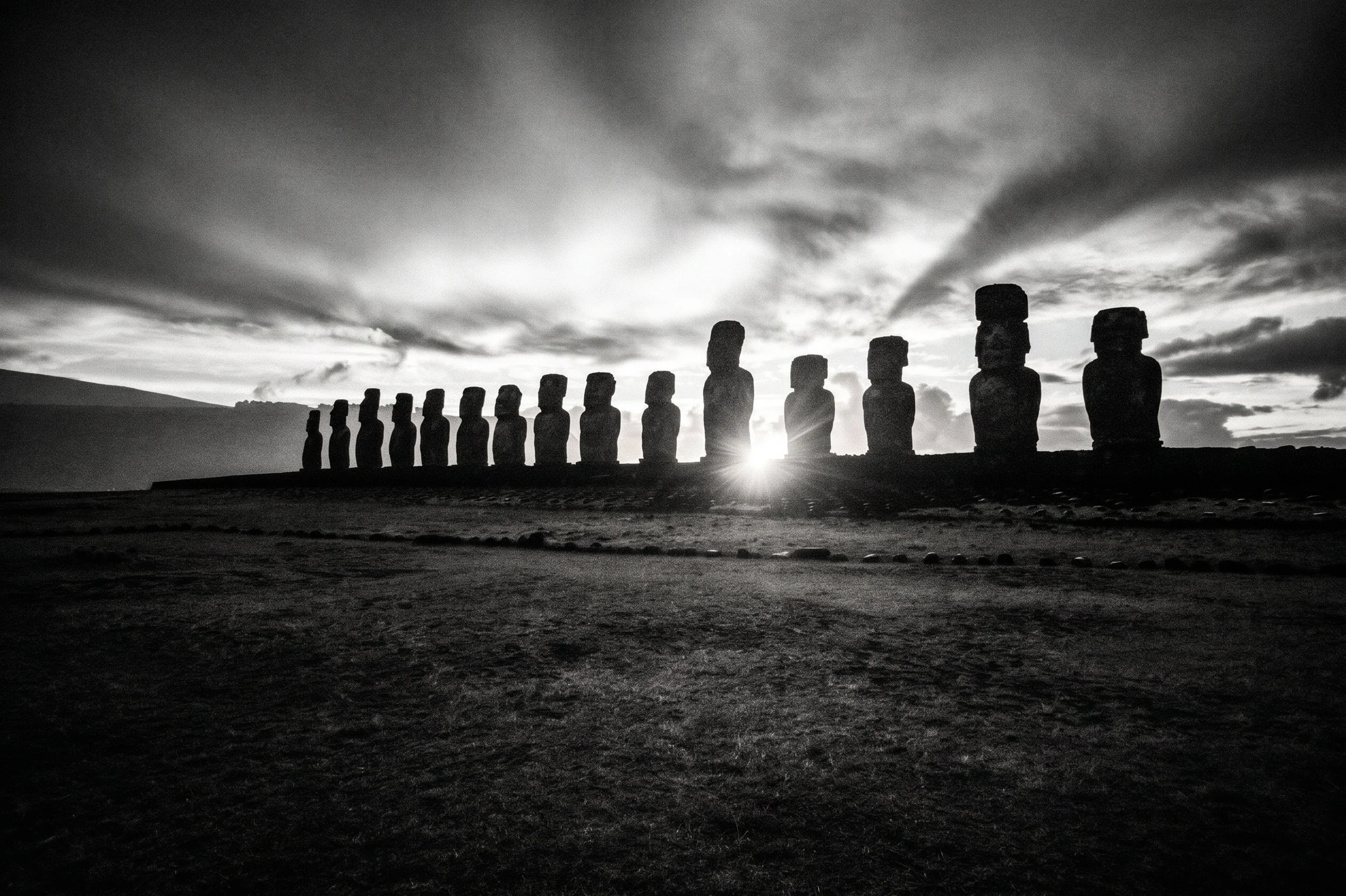
The monolithic stone heads (moai) that await Chris Carlisle at the end of his journey—a dramatic, shadowy horizon where human insignificance meets the enduring and transcendent.
“In Martin McDonagh’s Wild Horse Nine, a dying CIA hitman discovers that a human being is much more than his transgressions, and a friend can keep the gates of heaven ajar.””
A dying hitman seeks redemption beneath the stars in Martin McDonagh’s Wild Horse Nine.
Sooner or later, life settles the score. This film is really about a man’s need for redemption as he realizes he is in his final days and looks back at his past. He wonders whether someone like him, who has done so much evil, can go to heaven—and whether there will even be dinosaurs there.Now Number 68.
Mercy eliminates neither guilt nor crime. What mercy achieves is to prevent a man from being overwhelmed by them, even in his most desperate moment. This is the hope in a funny and cynical movie.
Chris Carlisle keeps count. Sixty-eight killings, he says, though nobody who knows him believes the number is complete. It is 1973. In Santiago, the coup against Salvador Allende that he and his partner Lee Chesterfield helped prepare is only weeks away. Chris, played by John Malkovich, is in his seventies and dying of cancer. Lee, played by Sam Rockwell, has promised to take him to Rapa Nui to see the great stone heads before the end.
A man reduced to a number, daunted by his evil past. That is where Wild Horse Nine begins. The question McDonagh is asking repeatedly, beneath all the jokes, is whether ultimately the number has the final say.
The Cynic and the Moths
The film is steeped in cynicism, most of it very funny. Chris says he sometimes feels more affection for the moths of Chile than he does for its inhabitants. That's old Chris talking, the one who overthrew governments in countries his listeners can't even spell.
But look at what he does. He no longer kills the moths in his house. He traps them, carries them outside, and feels bad when he has to put one out in the rain. The joke is from before. The gesture is from someone else. Something in him has begun to change and aspire to a good larger than the one he served.
Under the Stars
The brightest scene in the movie takes place at night. Chris is lying on the ground, looking up at the stars, a pistol near his hand, considering suicide. A wild horse emerges from the darkness and approaches him. It does not flee.
But nothing happens. Or perhaps, everything happens. For a moment there is only presence between two creatures, and that itself is a miracle. The man who has spent his life making other lives smaller is met, without conditions, by a creature that asks nothing of him. Chris is speechless about what is coming upon him beneath those stars. Still, this scene provides a peek into that look: a man who knows he is dying, coming to the awareness that he is connected to something greater than his life.
A Friend Who Stays
Between the two men, the same thing happens, but more slowly. Lee is the exasperated straight guy, and his exasperation is his form of love. They argue about whether Nazis go to heaven. They devise a code word, Arkansas, to use when Chris is ready to die and be killed by his best friend.
Lee can't heal him. He can't unsee the Congo, or Guatemala, or Dallas. All he can do is remain. Friendship is offered as it is; we are not the fulfillment of the other. This is what makes the friendship between Chris and Lee notable. It looks beyond itself.
It is tempting to think that perhaps their love for each other is what God needs to see—that maybe their love is all God needs to open heaven's gates. I wish that were true. I would be happy to leave my analysis there. But the film will not let me. Mercy does not preclude the crime. And mercy does not need the crime to be concealed. Friendship does not exculpate Chris. It gives him the one space in which he can afford to look at what he has done.
A Door Left Open
This ending is the one we expected from the first scene. And yet freedom stays open to the very end. "The possibility of changing course always remains open." That is the strange tension of Wild Horse Nine: an outcome written from the beginning, and a heart that can still say yes or no until the last minute.
In the end, it’s asking the fundamental human questions about life, death, friendship, and trust. Beneath all its profanity, it’s a prayer, a begging for forgiveness. You can hear in it the echo of the old Prayer for Grace: “Grant that before I die I may regain all the graces which I have lost through my carelessness and folly.”
What Was Lost in Dallas
There is a political film within this film, and McDonagh leaves it incomplete - purposely so you can start questioning yourself. Chris was in Dallas in November 1963. He glosses over the specifics, but he's sure about one thing: since Kennedy died, "the world turned to shit."
Coups, assassinations, a democracy that for decades has been involved in forming other countries' governments behind the scenes: the subject is the core of the narrative, and yet it is never elaborated.
Drew Gorman at Foreign Policy laments that in the movie "the question of who killed Kennedy ultimately becomes a bigger narrative question in the film than anything to do with Allende or Chile." He is right. The film intimates that America lost something of its own democracy in Dallas and exported the loss, among other places, to Santiago. The film knows this, and it looks away as it is interested to look at one man's story.
Maybe that’s the honesty of McDonagh: he knows how to judge an empire, and he prefers to look at a single man under the stars—left alone as his horse runs away.
-
In Wild Horse Nine di Martin McDonagh, un killer della CIA in fin di vita scopre che un essere umano è molto più delle sue trasgressioni e che un amico può tenere socchiuse le porte del paradiso.
Prima o poi, la vita regola i conti. Questo film parla in realtà del bisogno di redenzione di un uomo che, rendendosi conto di essere agli sgoccioli, ripensa al proprio passato. Si chiede se una persona come lui, che ha commesso così tanto male, possa andare in paradiso — e se lì ci saranno persino i dinosauri.
Ora il numero 68.
«La misericordia non elimina né la colpa né il crimine. Ciò che la misericordia riesce a fare è impedire che un uomo ne sia sopraffatto, anche nel momento più disperato». Questa è la speranza in un film divertente e cinico.
Chris Carlisle tiene il conto. Sessantotto omicidi, dice, anche se nessuno di chi lo conosce crede che il numero sia completo. È il 1973. A Santiago, mancano solo poche settimane al colpo di Stato contro Salvador Allende che lui e il suo socio Lee Chesterfield hanno contribuito a preparare. Chris, interpretato da John Malkovich, ha settant’anni e sta morendo di cancro. Lee, interpretato da Sam Rockwell, ha promesso di portarlo a Rapa Nui per vedere le grandi teste di pietra prima della fine.
Un uomo ridotto a un numero, oppresso dal suo passato malvagio. È da qui che inizia Wild Horse Nine. La domanda che McDonagh pone ripetutamente, al di là di tutte le battute, è se alla fine sia il numero ad avere l’ultima parola.
Il cinico e le falene
Il film è intriso di cinismo, per lo più molto divertente. Chris dice che a volte prova più affetto per le falene del Cile che per i suoi abitanti. È il vecchio Chris che parla, quello che ha rovesciato governi in paesi di cui i suoi ascoltatori non sanno nemmeno scrivere il nome.
Ma guardate cosa fa. Non uccide più le falene in casa sua. Le cattura, le porta fuori e si sente in colpa quando deve lasciarne una sotto la pioggia. La battuta è di prima. Il gesto è di qualcun altro. Qualcosa in lui ha cominciato a cambiare e ad aspirare a un bene più grande di quello che ha servito.
Sotto le stelle
La scena più luminosa del film si svolge di notte. Chris è disteso a terra, guarda le stelle, con una pistola vicino alla mano, e sta pensando al suicidio. Un cavallo selvaggio emerge dall’oscurità e gli si avvicina. Non fugge.
Ma non succede nulla. O forse, succede tutto. Per un attimo c’è solo la presenza tra due creature, e questo di per sé è un miracolo. L’uomo che ha trascorso la vita a sminuire quella degli altri viene accolto, senza condizioni, da una creatura che non gli chiede nulla. Chris rimane senza parole di fronte a ciò che sta per accadergli sotto quelle stelle. Eppure, questa scena offre uno scorcio di quello sguardo: un uomo che sa di stare per morire, che prende coscienza di essere collegato a qualcosa di più grande della sua vita.
Un amico che resta
Tra i due uomini accade la stessa cosa, ma più lentamente. Lee è l’eterosessuale esasperato, e la sua esasperazione è la sua forma d’amore. Discutono se i nazisti vadano in paradiso. Concepiscono una parola in codice, «Arkansas», da usare quando Chris sarà pronto a morire e a farsi uccidere dal suo migliore amico.
Lee non può guarirlo. Non può cancellare dalla sua mente il Congo, o il Guatemala, o Dallas. Tutto ciò che può fare è restare. L’amicizia viene offerta così com’è; non siamo la realizzazione dell’altro. È questo che rende notevole l’amicizia tra Chris e Lee. Guarda oltre se stessa.
Si è tentati di pensare che forse il loro amore reciproco sia ciò che Dio ha bisogno di vedere — che forse il loro amore sia tutto ciò di cui Dio ha bisogno per aprire le porte del paradiso. Vorrei che fosse vero. Sarei felice di fermarmi qui con la mia analisi. Ma il film non me lo permette. La misericordia non esclude il crimine. E la misericordia non ha bisogno che il crimine venga nascosto. L’amicizia non scagiona Chris. Gli offre l’unico spazio in cui può permettersi di guardare a ciò che ha fatto.
Una porta lasciata aperta
Questo finale è quello che ci aspettavamo fin dalla prima scena. Eppure la libertà rimane aperta fino alla fine. «La possibilità di cambiare rotta rimane sempre aperta». È questa la strana tensione di Wild Horse Nine: un esito scritto fin dall’inizio e un cuore che può ancora dire sì o no fino all’ultimo minuto.
Alla fine, il film pone le domande fondamentali dell’umanità sulla vita, la morte, l’amicizia e il desiderio. Al di là di tutte le sue parolacce, è una preghiera, una supplica di perdono. Vi si può udire l’eco dell’antica Preghiera per la Grazia: «Concedimi che, prima di morire, io possa riottenere tutte le grazie che ho perso per la mia incuria e la mia follia».
Ciò che è andato perduto a Dallas
C’è un film politico all’interno di questo film, e McDonagh lo lascia incompleto – di proposito, affinché lo spettatore possa iniziare a porsi delle domande. Chris era a Dallas nel novembre del 1963. Tralascia i dettagli, ma su una cosa è sicuro: da quando Kennedy è morto, «il mondo è andato a rotoli».
Colpi di Stato, omicidi, una democrazia che per decenni è stata coinvolta nel plasmare dietro le quinte i governi di altri paesi: l’argomento è il fulcro della narrazione, eppure non viene mai approfondito.
Drew Gorman su Foreign Policy lamenta che nel film «la questione di chi abbia ucciso Kennedy finisce per diventare un tema narrativo più importante di qualsiasi cosa abbia a che fare con Allende o il Cile». Ha ragione. Il film suggerisce che l’America abbia perso parte della propria democrazia a Dallas e abbia esportato quella perdita, tra gli altri luoghi, a Santiago. Il film ne è consapevole, ma distoglie lo sguardo perché è interessato a raccontare la storia di un solo uomo.Forse è questa l’onestà di McDonagh: sa come giudicare un impero, ma preferisce guardare un singolo uomo sotto le stelle — lasciato solo mentre il suo cavallo scappa via.
-
En Wild Horse Nine, de Martin McDonagh, un asesino a sueldo de la CIA moribundo descubre que un ser humano es mucho más que sus transgresiones, y que un amigo puede mantener entreabiertas las puertas del cielo.
Tarde o temprano, la vida ajusta cuentas. Esta película trata, en realidad, de la necesidad de redención de un hombre que, al darse cuenta de que sus días están contados, echa la vista atrás a su pasado. Se pregunta si alguien como él, que ha cometido tanto mal, puede ir al cielo… y si allí habrá siquiera dinosaurios.
Ahora, el número 68.
«La misericordia no elimina ni la culpa ni el crimen. Lo que consigue la misericordia es evitar que un hombre se vea abrumado por ellos, incluso en su momento más desesperado». Esta es la esperanza que transmite una película divertida y cínica.
Chris Carlisle lleva la cuenta. Sesenta y ocho asesinatos, dice, aunque nadie que lo conozca cree que la cifra sea definitiva. Es 1973. En Santiago, faltan solo unas semanas para el golpe de Estado contra Salvador Allende que él y su compañero Lee Chesterfield ayudaron a preparar. Chris, interpretado por John Malkovich, tiene más de setenta años y se está muriendo de cáncer. Lee, interpretado por Sam Rockwell, le ha prometido llevarlo a Rapa Nui para ver las grandes cabezas de piedra antes del final.
Un hombre reducido a un número, abrumado por su pasado malvado. Ahí es donde comienza Wild Horse Nine. La pregunta que McDonagh plantea una y otra vez, bajo todas las bromas, es si, en última instancia, el número tiene la última palabra.
El cínico y las polillas
La película está impregnada de cinismo, en su mayor parte muy divertido. Chris dice que a veces siente más afecto por las polillas de Chile que por sus habitantes. Así habla el viejo Chris, aquel que derrocó gobiernos en países cuyos nombres sus oyentes ni siquiera saben deletrear.
Pero fíjate en lo que hace. Ya no mata a las polillas de su casa. Las atrapa, las lleva fuera y se siente mal cuando tiene que soltar a una bajo la lluvia. La broma es de antes. El gesto es de otra persona. Algo en él ha empezado a cambiar y a aspirar a un bien mayor que aquel al que servía.
Bajo las estrellas
La escena más brillante de la película tiene lugar por la noche. Chris está tumbado en el suelo, mirando las estrellas, con una pistola cerca de la mano, planteándose el suicidio. Un caballo salvaje emerge de la oscuridad y se le acerca. No huye.
Pero no pasa nada. O quizá, pasa todo. Por un instante solo existe la presencia entre dos criaturas, y eso en sí mismo es un milagro. El hombre que se ha pasado la vida menospreciando a los demás se encuentra, sin condiciones, con una criatura que no le pide nada. Chris se queda sin palabras ante lo que le está sucediendo bajo aquellas estrellas. Aun así, esta escena permite vislumbrar esa mirada: la de un hombre que sabe que está muriendo y que toma conciencia de que está conectado con algo más grande que su propia vida.
Un amigo que se queda
Entre los dos hombres ocurre lo mismo, pero más lentamente. Lee es el heterosexual exasperado, y su exasperación es su forma de amar. Discuten sobre si los nazis van al cielo. Acuerdan una palabra clave, «Arkansas», para usar cuando Chris esté listo para morir y ser asesinado por su mejor amigo.
Lee no puede curarlo. No puede dejar de ver el Congo, ni Guatemala, ni Dallas. Lo único que puede hacer es quedarse. La amistad se ofrece tal y como es; no somos la realización del otro. Esto es lo que hace que la amistad entre Chris y Lee sea notable. Mira más allá de sí misma.
Es tentador pensar que quizá su amor mutuo es lo que Dios necesita ver, que tal vez su amor es todo lo que Dios necesita para abrir las puertas del cielo. Ojalá fuera cierto. Me encantaría dejar mi análisis ahí. Pero la película no me lo permite. La misericordia no excluye el crimen. Y la misericordia no necesita que el crimen se oculte. La amistad no exculpa a Chris. Le brinda el único espacio en el que puede permitirse mirar lo que ha hecho.
Una puerta abierta
Este final es el que esperábamos desde la primera escena. Y, sin embargo, la libertad permanece abierta hasta el último momento. «La posibilidad de cambiar de rumbo siempre permanece abierta». Esa es la extraña tensión de Wild Horse Nine: un desenlace escrito desde el principio y un corazón que aún puede decir sí o no hasta el último minuto.
Al final, plantea las preguntas humanas fundamentales sobre la vida, la muerte, la amistad y el deseo. Bajo toda su blasfemia, es una oración, una súplica de perdón. En ella se puede oír el eco de la antigua Oración por la Gracia: «Concédeme que, antes de morir, pueda recuperar todas las gracias que he perdido por mi descuido y mi necedad».
Lo que se perdió en Dallas
Hay una película política dentro de esta película, y McDonagh la deja incompleta —a propósito, para que el espectador empiece a cuestionarse las cosas—. Chris estaba en Dallas en noviembre de 1963. Pasa por alto los detalles, pero de una cosa está seguro: desde que murió Kennedy, «el mundo se ha ido a la mierda».
Golpes de Estado, asesinatos, una democracia que durante décadas se ha dedicado a formar los gobiernos de otros países entre bastidores: el tema es el núcleo de la narración y, sin embargo, nunca se profundiza en él.
Drew Gorman, de Foreign Policy, lamenta que en la película «la cuestión de quién mató a Kennedy acabe convirtiéndose en un tema narrativo más importante que cualquier cosa relacionada con Allende o Chile». Tiene razón. La película insinúa que Estados Unidos perdió algo de su propia democracia en Dallas y exportó esa pérdida, entre otros lugares, a Santiago. La película lo sabe, pero mira hacia otro lado, ya que le interesa centrarse en la historia de un solo hombre.Quizá esa sea la honestidad de McDonagh: sabe cómo juzgar a un imperio, pero prefiere fijarse en un solo hombre bajo las estrellas, abandonado a su suerte mientras su caballo se aleja galopando.
-
Dans Wild Horse Nine de Martin McDonagh, un tueur à gages de la CIA à l’article de la mort découvre qu’un être humain est bien plus que ses transgressions, et qu’un ami peut laisser les portes du paradis entrouvertes.
Tôt ou tard, la vie règle ses comptes. Ce film traite en réalité du besoin de rédemption d’un homme qui, prenant conscience que ses derniers jours approchent, revient sur son passé. Il se demande si quelqu’un comme lui, qui a commis tant de méfaits, peut aller au paradis — et s’il y aura même des dinosaures là-bas.
Passons maintenant au numéro 68.
« La miséricorde n’élimine ni la culpabilité ni le crime. Ce qu’elle accomplit, c’est d’empêcher un homme d’être submergé par celles-ci, même dans ses moments les plus désespérés. » Tel est l’espoir qui se dégage de ce film à la fois drôle et cynique.
Chris Carlisle tient le compte. Soixante-huit meurtres, dit-il, bien que personne parmi ceux qui le connaissent ne croie que ce chiffre soit exact. Nous sommes en 1973. À Santiago, le coup d’État contre Salvador Allende, que lui et son partenaire Lee Chesterfield ont aidé à préparer, n’est plus qu’à quelques semaines. Chris, interprété par John Malkovich, a la septantaine et se meurt d’un cancer. Lee, interprété par Sam Rockwell, lui a promis de l’emmener à Rapa Nui pour voir les grandes têtes de pierre avant la fin.
Un homme réduit à un simple chiffre, accablé par son passé sinistre. C’est ainsi que commence Wild Horse Nine. La question que McDonagh pose sans cesse, sous toutes ces blagues, est de savoir si, en fin de compte, c’est ce chiffre qui a le dernier mot.
Le cynique et les papillons de nuit
Le film est imprégné de cynisme, souvent très drôle. Chris dit qu’il éprouve parfois plus d’affection pour les papillons de nuit du Chili que pour ses habitants. C’est le vieux Chris qui parle, celui qui a renversé des gouvernements dans des pays dont ses auditeurs ne savent même pas épeler le nom.
Mais regardez ce qu’il fait. Il ne tue plus les papillons de nuit chez lui. Il les attrape, les emmène dehors, et se sent mal quand il doit en mettre un sous la pluie. La blague date d’avant. Le geste vient de quelqu’un d’autre. Quelque chose en lui a commencé à changer et aspire à un bien plus grand que celui qu’il servait.
Sous les étoiles
La scène la plus lumineuse du film se déroule de nuit. Chris est allongé par terre, les yeux levés vers les étoiles, un pistolet près de la main, songeant au suicide. Un cheval sauvage émerge de l’obscurité et s’approche de lui. Il ne s’enfuit pas.
Mais il ne se passe rien. Ou peut-être que tout se passe. L’espace d’un instant, il n’y a que la présence entre deux créatures, et cela en soi est un miracle. L’homme qui a passé sa vie à rabaisser les autres se retrouve face à une créature qui ne lui demande rien, sans aucune condition. Chris reste sans voix face à ce qui lui arrive sous ces étoiles. Pourtant, cette scène laisse entrevoir ce regard : celui d’un homme qui sait qu’il va mourir et qui prend conscience d’être lié à quelque chose de plus grand que sa propre vie.
Un ami qui reste
Entre les deux hommes, la même chose se produit, mais plus lentement. Lee est l’hétéro exaspéré, et son exaspération est sa forme d’amour. Ils se disputent pour savoir si les nazis vont au paradis. Ils inventent un mot de passe, « Arkansas », à utiliser lorsque Chris sera prêt à mourir et à se faire tuer par son meilleur ami.
Lee ne peut pas le guérir. Il ne peut pas oublier ce qu’il a vu au Congo, au Guatemala ou à Dallas. Tout ce qu’il peut faire, c’est rester. L’amitié s’offre telle qu’elle est ; nous ne sommes pas l’accomplissement de l’autre. C’est ce qui rend l’amitié entre Chris et Lee remarquable. Elle regarde au-delà d’elle-même.
Il est tentant de penser que c’est peut-être leur amour l’un pour l’autre que Dieu a besoin de voir — que leur amour est peut-être tout ce dont Dieu a besoin pour ouvrir les portes du paradis. J’aimerais que ce soit vrai. Je serais heureux d’en rester là dans mon analyse. Mais le film ne me le permet pas. La miséricorde n’exclut pas le crime. Et la miséricorde n’a pas besoin que le crime soit dissimulé. L’amitié n’innocente pas Chris. Elle lui offre le seul espace où il peut se permettre de regarder ce qu’il a fait.
Une porte laissée ouverte
Cette fin est celle à laquelle nous nous attendions dès la première scène. Et pourtant, la liberté reste ouverte jusqu’à la toute fin. « La possibilité de changer de cap reste toujours ouverte. » Telle est l’étrange tension de Wild Horse Nine : une issue écrite dès le début, et un cœur qui peut encore dire oui ou non jusqu’à la dernière minute.
Au final, le film pose les questions humaines fondamentales sur la vie, la mort, l’amitié et le désir. Sous tout ce langage grossier, c’est une prière, une supplication pour obtenir le pardon. On y entend l’écho de l’ancienne Prière pour la grâce : « Accorde-moi, avant ma mort, de retrouver toutes les grâces que j’ai perdues par ma négligence et ma folie. »
Ce qui a été perdu à Dallas
Il y a un film politique au sein de ce film, et McDonagh le laisse inachevé – délibérément, pour que vous puissiez commencer à vous poser des questions. Chris était à Dallas en novembre 1963. Il passe sous silence les détails, mais il est sûr d’une chose : depuis la mort de Kennedy, « le monde est parti en vrille ».
Coups d’État, assassinats, une démocratie qui, depuis des décennies, s’implique en coulisses dans la formation des gouvernements d’autres pays : le sujet est au cœur du récit, et pourtant il n’est jamais approfondi.
Drew Gorman, dans Foreign Policy, déplore que dans le film, « la question de savoir qui a tué Kennedy finisse par prendre plus d’importance dans le récit que tout ce qui concerne Allende ou le Chili ». Il a raison. Le film laisse entendre que l’Amérique a perdu une partie de sa propre démocratie à Dallas et qu’elle a exporté cette perte, entre autres, à Santiago. Le film en est conscient, mais il détourne le regard, car il s’intéresse davantage à l’histoire d’un seul homme.C’est peut-être là l’honnêteté de McDonagh : il sait juger un empire, mais il préfère se concentrer sur un seul homme sous les étoiles — laissé seul tandis que son cheval s’enfuit.