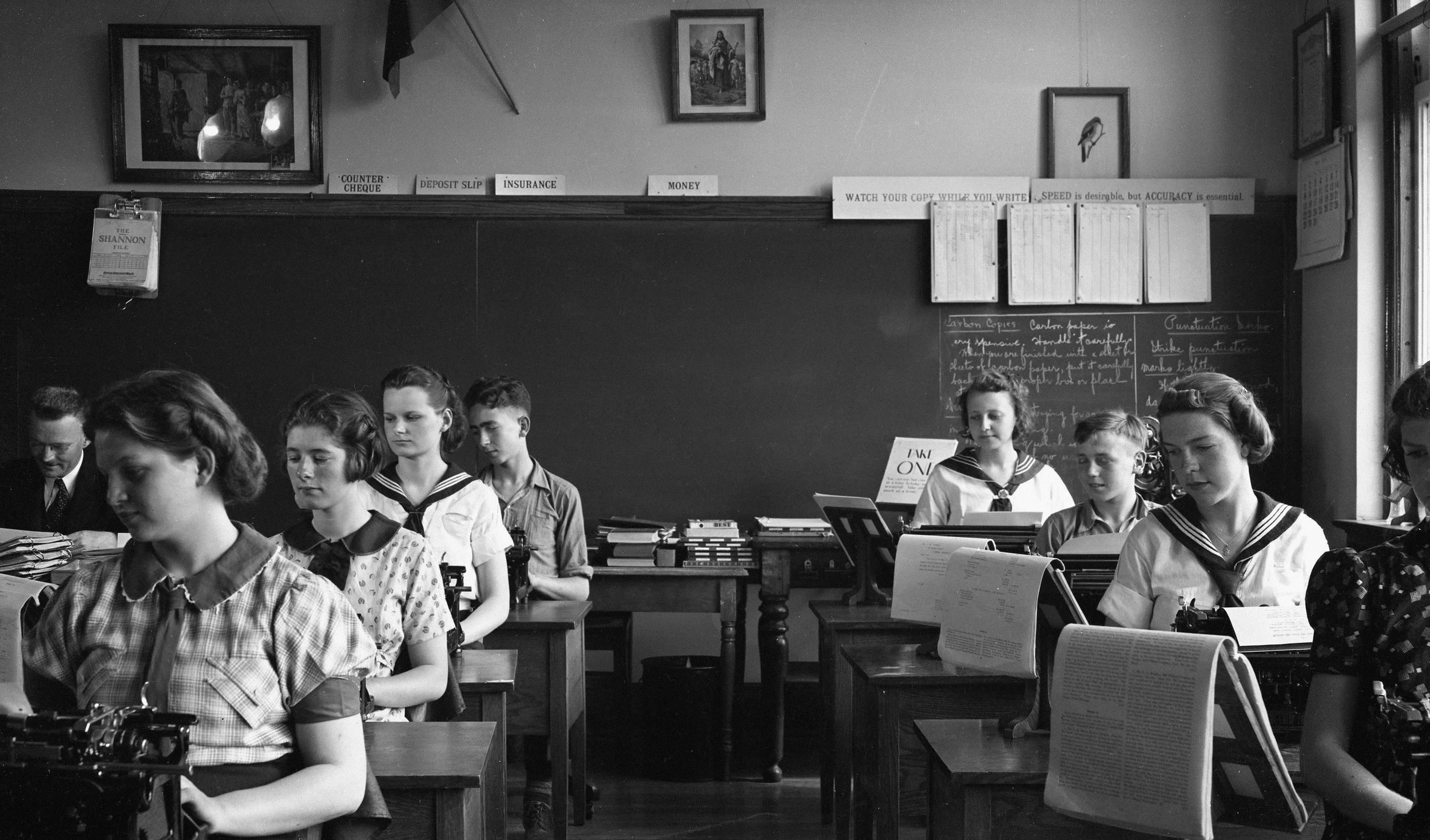
Who Is the Adult? A vintage typing class.
“I could have answered my students by laying out my views and arguing them carefully, telling them what is right and what is wrong. But what would they have discovered about the criteria they already use to face life?”
Simone Riva - People want change—some even through violence—but there’s no revolution without an “I.” Talking about Milan in the classroom.
The question came before I was even through the classroom door: “Prof., what do you think about what happened in Milan?” The room went quiet while they waited for my answer. But the man standing in front of them—and they know this well—can’t shake off the education he received, summed up in one of the most revolutionary expressions of Christian education: “We want—and this is our goal—to liberate young people: to liberate them from mental slavery, from the conformity that makes them mentally enslaved to others. From the very first class, I have always said, 'I am not here so that you may accept the ideas I give you as your own, but to teach you a true method for judging the things I will tell you. And the things I will tell you are an experience that is the result of a long history: two thousand years.’’’1
So I turned the question back on them: “Why didn’t you go to Milan?” What followed was one of those conversations where you lose track of the day and the hour, and it drew in even the students who usually keep to themselves. At one point, one of them explained why he had turned down his friends’ invitation. He spends Saturdays at work with his father, and he knows what it takes to keep a business afloat. Then he added: “The most useful thing I can do is study.”
I’ve known him for years, and I was struck by how seriously, and with what conviction, he said it. The same challenge came up in my other classes. At the end of the hour, two students walked out with me and said, “Okay, but you have to tell us what you think.” I smiled: “You can tell what I think from the questions I ask you.”
When reality throws down a challenge, you can tell right away who steps up and who cleverly passes the buck. We’ve seen it again these past few days, buried under an avalanche of commentary and appeals. We should say this, we should do that, we need to change… but who is going to do all this? What has become of the educating subject (which can never be the State)?
Where will we find this subject? Amid this whole tangle of good intentions? Among the interviews of people who no longer know where they come from and lean every time on the world’s criteria? In the refrain of those who have grown old, opposing everything and everyone? Or in the tired round of initiatives, events, meetings, speeches, entertainment, and slogans that have never touched anyone’s heart?
Then there’s that other refrain about adults: absent, weak, and unfamiliar with the young. But who is the adult? I could have answered my students by laying out my views and arguing them carefully, telling them what is right and what is wrong. But what would they have discovered about the criteria they already use to face life? How could they have verified their position?
The events in Milan certainly raise big questions—but those questions have been open for years, not for a week. Within the life of the Church, for example, Archbishop Mario Delpini of Milan told Avvenire on October 20: “The Christian community does not have a formula for education but rather should create the conditions so that the inner Teacher, through the gift of the Holy Spirit, may teach the ways of the good. Parish oratories can help those who attend them. But I believe that those who attend oratories should be encouraged to help those who do not. In the past, perhaps, people were advised to throw out the rotten apple so that the rot would not infect the healthy apples in the basket. I believe that instead of apples, we should speak of lamps: whoever welcomes Jesus becomes like a lamp that can give light to everyone and point to the goal that is worth desiring—namely, the fulfillment of each person’s vocation—and the path that can be followed.”
His words recall Fr. Giussani’s definition of an adult: “An adult is someone who strives to live relationships, as St. Paul said, in Christ, and thus embodies that great character of the Christian who has crossed the threshold of maturity in faith (and this is the moment when one feels smallest!): a character full of victory and boldness, because Christ is risen.”2
All this could leave us with nothing but a raised middle finger, the one we’ve seen in video after video these past few days. It doesn’t have to. We might ask whether we could be the ones to embody what we hope to receive from others. That means remembering how we were reached, what brought about the change in our lives, and through which faces and circumstances.
Otherwise, as always, we’ll wait for a chance to turn the page and brush it all aside with a yawn.
Notes
1. Luigi Giussani, Il rischio educativo (Turin: SEI, 1995), xv.
2. Luigi Giussani, Faith Is Recognizing a Presence: Notes from a Conversation with a Group of Adults (Milan, 1977).
Translated from the Italian by the editorial team at epochalchange.org
-
Dopo Milano, la lezione di Giussani
Simone Riva
Si cerca un cambiamento, anche in modo violento, ma non può esserci alcuna rivoluzione senza un io vero. Parlando a scuola dei fatti di Milano
Appena il tempo di entrare in classe e subito arriva la domanda: “Prof, cosa ne pensa di quello che è successo a Milano?”. Cala il silenzio in attesa di quello che avrei detto. Ma l’uomo che hanno davanti i miei studenti, e lo sanno bene, non può più togliersi dalla pelle il modo con cui è stato cresciuto, riassunto in una delle espressioni più rivoluzionarie dell’educazione cristiana: “Noi vogliamo – e questo è il nostro scopo – liberare i giovani: liberare i giovani dalla schiavitù mentale, dalla omologazione che rende schiavi mentalmente degli altri. Fin dalla prima ora di scuola ho sempre detto: ‘Non sono qui perché voi riteniate come vostre le idee che vi do io, ma per insegnarvi un metodo vero per giudicare le cose che io vi dirò. E le cose che io vi dirò sono un’esperienza che è l’esito di un lungo passato: duemila anni'” (Luigi Giussani, Il rischio educativo, SEI, Torino 1995, p. XV).
Perciò li incalzo subito: “Perché voi non siete andati a Milano?”. Si apre un dialogo di quelli che ti fanno dimenticare giorno e ora, coinvolgendo anche i ragazzi che solitamente stanno sulle loro. A un certo punto uno racconta di come abbia deciso di rifiutare l’invito dei suoi amici. Lui al sabato sta con il padre che lavora e sa cosa vuol dire la fatica di mantenere un’attività. E aggiunge: “La cosa più utile che posso fare è studiare“.
Mi ha stupito, conoscendolo da anni, la serietà e la certezza con cui diceva queste cose. Nelle altre classi la stessa sfida. Al termine di un’ora due ragazzi escono con me dall’aula e mi dicono: “Sì, però ci deve dire cosa ne pensa lei”. Rispondo sorridendo: “Quello che penso lo capite dalle domande che vi faccio”.
Quando la realtà provoca si distinguono subito quelli che raccolgono la sfida rispetto a quelli che passano astutamente la palla ad altri. Lo abbiamo visto anche in questi giorni in cui siamo stati sommersi da una valanga di commenti e auspici. Si dovrebbe dire, si dovrebbe fare, occorrerebbe cambiare… ma “chi” potrà fare tutto questo? Che fine ha fatto il soggetto dell’educazione (che non potrà mai essere lo Stato)?
Studenti in biblioteca (ANSA/FRANCO SILVI)
Dove lo troveremo? In mezzo a tutto questo groviglio di buone intenzioni? Nelle interviste di chi ormai non sa più da dove viene e si affida inesorabilmente ai criteri del mondo? Nella cantilena di coloro che sono invecchiati contro tutto e contro tutti? Nella ripetizione stanca di iniziative, eventi, incontri, discorsi, intrattenimenti, slogan che non hanno mai sfiorato il cuore di nessuno?
E poi il ritornello sugli adulti che mancano, che sono deboli, che hanno perso i giovani. Ma chi è l’adulto? Avrei potuto rispondere ai miei ragazzi spiegando le mie opinioni e argomentandole con cura, dicendo che cosa è giusto e cosa è sbagliato, ma cosa avrebbero scoperto circa i criteri che stanno già usando per stare di fronte alla vita? Come avrebbero potuto verificare la tenuta della loro posizione?
Certo, i fatti di Milano aprono delle grandi questioni, ma che sono aperte da anni, non da una settimana. Per quanto riguarda la vita della Chiesa, per esempio, l’arcivescovo di Milano, mons. Mario Delpini, in un’intervista concessa ad Avvenire lo scorso 20 ottobre, a un certo punto ha affermato: “La comunità cristiana non ha la ricetta dell’educazione, ma piuttosto dovrebbe creare le condizioni perché il Maestro interiore, con il dono dello Spirito Santo, possa insegnare le vie del bene. Gli oratòri possono aiutare chi li frequenta. Ma credo che chi frequenta gli oratori debba essere incoraggiato ad aiutare chi non li frequenta. Una volta forse si consigliava di buttare fuori la mela marcia perché il marciume non contagiasse le mele sane del cesto. Credo che invece che di mele, si dovrebbe parlare di lampade: chi accoglie Gesù diventa come una lampada che può regalare luce per tutti e indicare la meta che merita di essere desiderata, cioè il compimento della vocazione di ciascuno, e la via che è possibile percorrere”.
Parole che fanno venire in mente la definizione di adulto che diede don Giussani: “L’adulto è chi tende a vivere i rapporti, come diceva san Paolo, in Cristo e così vive quella grande fisionomia del cristiano che ha varcato la soglia di una maturità di fede (ed è il momento in cui si sente più piccolo!): una fisionomia piena di vittoria e di baldanza, perché Cristo è risorto” (Luigi Giussani, Fede è riconoscere una presenza. Appunti da una conversazione con un gruppo di adulti, Milano 1977).Perché di tutto quello che sta capitando non rimanga un dito medio, come abbiamo visto in diversi filmati dei giorni scorsi, potremmo domandarci se non potremmo essere proprio noi i soggetti di ciò che speriamo arrivare dagli altri, memori di come siamo stati raggiunti, di ciò che ha permesso il cambiamento della nostra vita, attraverso quali volti e circostanze.
Altrimenti aspetteremo, come sempre, l’occasione per poter voltare pagina liquidando tutto con uno sbadiglio. -
Después de Milán, la lección de Giussani
Simone Riva
Se busca un cambio, incluso de forma violenta, pero no puede haber ninguna revolución sin un yo auténtico. Hablando en el colegio sobre los sucesos de Milán
Apenas tengo tiempo de entrar en clase y enseguida me hacen la pregunta: «Prof., ¿qué opinas de lo que ha pasado en Milán?». Se hace el silencio a la espera de lo que se va a decir. No obstante, el hombre que tienen delante mis alumnos, y ellos lo saben bien, ya no puede desprenderse de la forma en la que se educó, resumida en una de las expresiones más revolucionarias de la educación cristiana: «Queremos —y este es nuestro objetivo— liberar a los jóvenes: liberarlos de la esclavitud mental, de la homologación que los convierte en esclavos mentales de los demás». Desde la primera hora de clase siempre he dicho: “No estoy aquí para que consideréis vuestras las ideas que os doy, sino para enseñaros un método verdadero para juzgar las cosas que os diré. Y las cosas que os diré son una experiencia que es el resultado de un largo pasado: dos mil años”» (Luigi Giussani, El riesgo educativo, SEI, Turín 1995, p. XV).
Por eso les presiono enseguida: «¿Por qué no habéis ido a Milán?». Se abre uno de esos diálogos que te hacen olvidar el día y la hora, en el que incluso participan los chicos que suelen mantenerse al margen. En un momento dado, uno cuenta cómo decidió rechazar la invitación de sus amigos. Los sábados está con su padre, que trabaja, y sabe lo que significa el esfuerzo que supone mantener un negocio. Y añade: «Lo más útil que puedo hacer es estudiar».
Me sorprendió, conociéndolo desde hace años, la seriedad y la certeza con las que decía estas cosas. En las demás clases, el mismo desafío. Al cabo de una hora, dos chicos salen conmigo del aula y me dicen: «Sí, pero tiene que decirnos qué opina usted». Les respondo sonriendo: «Lo que pienso lo entendéis por las preguntas que os hago».
Cuando la realidad plantea un reto, se distingue enseguida a quienes lo asumen de quienes, astutamente, le pasan la pelota a otros. Lo hemos visto también estos días, en los que nos ha inundado una avalancha de comentarios y deseos. Se debería decir, se debería hacer, habría que cambiar… pero ¿quién podrá hacer todo esto? ¿Dónde ha quedado el sujeto de la educación (que nunca podrá ser el Estado)?
Estudiantes en la biblioteca (ANSA/FRANCO SILVI)
¿Dónde lo encontraremos? ¿En medio de toda esta maraña de buenas intenciones? ¿En las entrevistas de quienes ya no saben de dónde vienen y se confían inexorablemente a los criterios del mundo? ¿En la cantinela de quienes han envejecido contra todo y contra todos? ¿En la repetición cansina de iniciativas, eventos, encuentros, discursos, entretenimientos y eslóganes que nunca han llegado al corazón de nadie?
Y luego, el estribillo sobre los adultos que faltan, que son débiles, que han perdido a los jóvenes. Pero, ¿quién es el adulto? Podría haber respondido a mis chicos explicándoles mis opiniones y argumentándolas con cuidado, diciéndoles qué está bien y qué está mal, pero ¿qué habrían descubierto sobre los criterios que ya están utilizando para afrontar la vida? ¿Cómo habrían podido comprobar la solidez de su postura?
Ciertamente, los hechos de Milán plantean grandes cuestiones, pero son cuestiones que llevan años abiertas, no solo desde hace una semana. En lo que respecta a la vida de la Iglesia, por ejemplo, el arzobispo de Milán, monseñor Mario Delpini, en una entrevista concedida a Avvenire el pasado 20 de octubre, afirmó en un momento dado: «La comunidad cristiana no tiene la receta de la educación, sino que más bien debería crear las condiciones para que el Maestro interior, con el don del Espíritu Santo, pueda enseñar los caminos del bien. Los oratorios pueden ayudar a quienes los frecuentan. Sin embargo, creo que quienes acuden a los oratorios deben ser animados a ayudar a quienes no lo hacen. Antes, tal vez, se aconsejaba echar fuera la manzana podrida para que la podredumbre no contagiara a las manzanas sanas de la cesta. Creo que, en lugar de manzanas, deberíamos hablar de lámparas: quien acoge a Jesús se convierte en una lámpara capaz de dar luz a todos e indicar la meta que merece ser deseada, es decir, el cumplimiento de la vocación de cada uno, y el camino que es posible recorrer».
Palabras que recuerdan la definición de adulto que dio don Giussani: «El adulto es aquel que tiende a vivir las relaciones, como decía san Pablo, en Cristo, y así vive esa gran fisonomía del cristiano que ha cruzado el umbral de una madurez en la fe (¡y es el momento en el que se siente más pequeño!): una fisonomía llena de victoria y de audacia, porque Cristo ha resucitado» (Luigi Giussani, «La fe es reconocer una presencia. Apuntes de una conversación con un grupo de adultos, Milán 1977).Todo lo que está sucediendo podría no dejarnos más que un dedo corazón levantado, como el que hemos visto en tantos vídeos estos días. No tiene por qué ser así. Podríamos preguntarnos si no seríamos precisamente nosotros los protagonistas de aquello que esperamos recibir de los demás. Eso supone recordar cómo hemos sido alcanzados, qué ha hecho posible el cambio en nuestra vida y a través de qué rostros y circunstancias.
De lo contrario, esperaremos, como siempre, la ocasión para pasar página y zanjarlo todo con un bostezo. -
Après Milan, la leçon de Giussani
Simone Riva
On recherche un changement, même par la violence, mais il peut y avoir de révolution sans un « je » authentique. Parler à l’école des événements de Milan
À peine le temps d’entrer en classe que la question fusa : « Prof, qu’est-ce que vous pensez de ce qui s’est passé à Milan ? » Le silence s’installa dans l’attente de ce que j’allais dire. Mais, l’homme que mes élèves ont devant eux, et ils le savent bien, ne peut plus se défaire de la manière dont il a été élevé, résumée dans l’une des expressions les plus révolutionnaires de l’éducation chrétienne : « Nous voulons – et tel est notre but – libérer les jeunes : libérer les jeunes de l’esclavage mental, de l’homogénéisation qui les rend mentalement esclaves des autres. Dès la première heure de cours, j’ai toujours dit : « Je ne suis pas ici pour que vous fassiez vôtres les idées que je vous donne, mais pour vous enseigner une véritable méthode permettant de juger les choses que je vais vous dire. Et, les choses que je vais vous révéler sont le fruit d’une longue expérience : deux mille ans » (Luigi Giussani, Il rischio educativo, SEI, Turin 1995, p. XV).
Je les interroge donc d’emblée : « Pourquoi n’êtes-vous pas allés à Milan ? » S’engage alors un dialogue de ceux qui vous font oublier le jour et l’heure, impliquant même les jeunes qui restent d’ordinaire dans leur coin. , l’un d’eux raconte comment il a décidé de refuser l’invitation de ses amis. Le samedi, il passe du temps avec son père qui travaille et il sait ce que signifie la difficulté de faire tourner une entreprise. Et il ajoute : « La chose la plus utile que je fasse, c’est d’étudier. »
Cela m’a surpris, moi qui le connais depuis des années, de voir le sérieux et la conviction avec lesquels il disait ces choses. Dans les autres classes, le même défi. Au bout d’une heure, deux jeunes sortent de la salle de classe avec moi et me disent : « Oui, mais vous devez nous dire ce que vous en pensez. » Je réponds en souriant : « Ce que je pense, vous le comprenez à travers les questions que je vous pose. »
Lorsque la réalité nous met au défi, on distingue immédiatement ceux qui relèvent le défi de ceux qui, astucieusement, renvoient la balle aux autres. Nous l’avons également constaté ces derniers jours, où nous avons été submergés par une avalanche de commentaires et de vœux. Il faudrait dire, il faudrait faire, il faudrait changer… mais « qui » pourra faire tout cela ? Où est passé le sujet de l’éducation (qui ne pourra jamais être l’État) ?
Où trouverons-nous ce sujet ? Au milieu de tout cet enchevêtrement de bonnes intentions ? Parmi les entretiens de ceux qui ne savent plus d’où ils viennent et s’en remettent systématiquement aux critères du monde ? Dans la litanie de ceux qui ont blanchi à force de s’opposer à tout et à tous ? Ou dans la répétition lassante d'initiatives, d’événements, de rencontres, de discours, de divertissements et de slogans qui n’ont jamais touché le cœur de personne ?
J’aurais pu répondre à mes élèves en leur exposant mes opinions, soigneusement argumentées, et en leur disant ce qui est juste et ce qui ne l’est pas. Mais, qu’auraient-ils découvert sur les critères qu’ils utilisent déjà pour affronter la vie ? Comment auraient-ils pu vérifier la solidité de leur propre position ?
Certes, les événements de Milan soulèvent de grandes questions, mais celles-ci sont en suspens depuis des années, pas depuis une semaine. Concernant la vie de l’Église, par exemple, l’archevêque de Milan, Mgr Mario Delpini, a déclaré dans une interview accordée à Avvenire le 20 octobre dernier : « La communauté chrétienne n’a pas la recette de l’éducation, pourtant elle devrait plutôt créer les conditions pour que le Maître intérieur, par le don du Saint-Esprit, enseigne les voies du bien. Les oratoires peuvent aider ceux qui les fréquentent. Mais, ceux qui fréquentent les oratoires doivent être encouragés à aider ceux qui ne les fréquentent pas. Autrefois, on conseillait peut-être de jeter la pomme pourrie afin que la pourriture ne contamine pas les pommes saines du panier.« … Au lieu de pommes, il faudrait parler de lampes. Celui qui accueille Jésus devient comme une lampe qui peut donner de la lumière à tous. Elle peut indiquer le but qui mérite d’être désiré – c’est-à-dire l’accomplissement de la vocation de chacun – et le chemin qu’il est possible de parcourir. »
Des paroles qui rappellent la définition de l’adulte donnée par don Giussani : « L’adulte est celui qui tend à vivre ses relations, comme le disait saint Paul, en Christ, et qui incarne ainsi cette grande physionomie du chrétien qui a franchi le seuil d’une maturité de foi (et c’est le moment où il se sent le plus petit !) : une physionomie pleine de victoire et d’assurance, car le Christ est ressuscité » (Luigi Giussani, La foi, c’est reconnaître une présence. Notes tirées d’une conversation avec un groupe d’adultes, Milan 1977).Tout ce qui se passe pourrait ne nous laisser qu’un doigt d’honneur, comme celui que nous avons vu dans tant de vidéos ces derniers jours. Ce n’est pas une fatalité. Nous pourrions nous demander si nous ne serions pas nous-mêmes les acteurs de ce que nous espérons recevoir des autres. Cela suppose de nous rappeler comment nous avons été rejoints, ce qui a rendu possible le changement dans notre vie, et à travers quels visages et quelles circonstances.
Sinon, nous attendrons, comme toujours, l’occasion de pouvoir tourner la page en balayant tout d’un bâillement.