Cervantes’s Tender Gaze
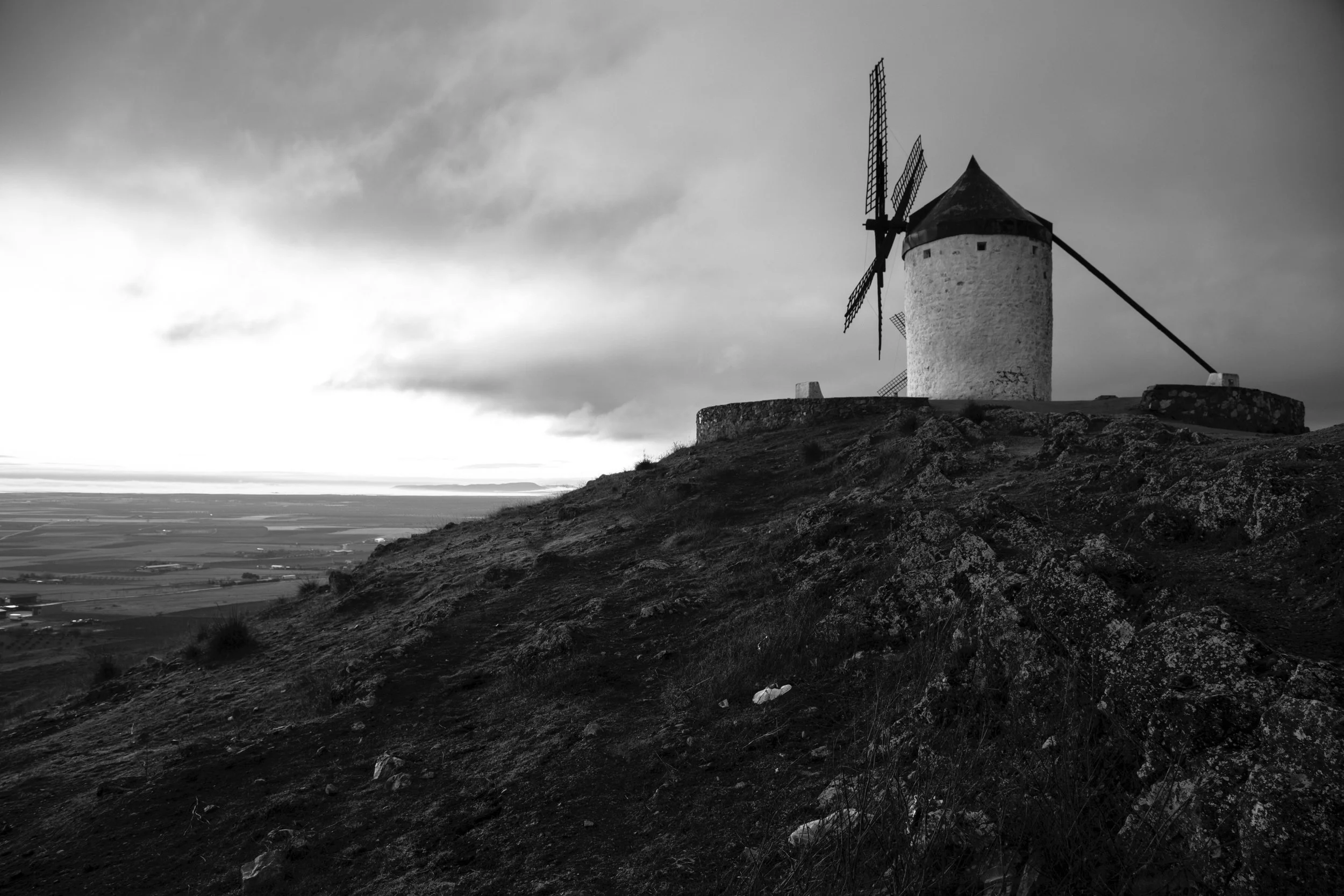
A solitary windmill atop a rocky slope, reflecting Don Quixote's entwined folly and grandeur.
“It is a tender gaze, like that of a father who sees his son’s follies and rejoices at every glimpse of truth amid the fantasies his son has built his life around.”
Guadalupe Arbona - A look at humanity in Don Quixote.
This is the first installment in a series on the great novel of Spanish literature, The Ingenious Gentleman Don Quixote of La Mancha. In the installments to come, Guadalupe Arbona will offer a selection of episodes that illuminate the tender yet powerful gaze with which Miguel de Cervantes created his hero.
Over my many readings of the most famous novel in Spanish literature, The Ingenious Gentleman Don Quixote of La Mancha, I have laughed and cried, learned and gotten angry. But I have never been able to put distance between myself and the character who has kept me asking questions for years, and still does. He is a sane madman: a gentleman who loses his mind reading tales of chivalry and who, believing himself one of their heroes, tries to shape his life after the stories he has read. What is it about Don Quixote of La Mancha? Why do I keep returning to him, hoping to discover something more in each of his adventures, encounters, battles, and conversations? Going back to the source, to his creator, I ask myself: Why does Cervantes lead us through Don Quixote's triumphs and follies? Does he want to show us something hidden in them? If not, the book would be nothing but a farce. And it isn't. The novel springs from a gentle yet powerful gaze on the human condition.
My reading is one of the latest in a long line, because ever since Don Quixote took on a life of his own, everyone who has met him has tried to understand who he is and why he challenges us. The very first readers to witness the explosion of life he embodies, right at the edge of fiction, were already doing so. From the novel's opening pages, the people around him reveal something about themselves whenever they talk about him. His absurd yet tender presence lays their hearts bare; in front of Don Quixote, the characters show who they really are. Their reactions vary. His niece and his housekeeper try to settle him into an orderly life. His friends the priest and the barber want him to come home and stop making a fool of himself. Sancho goes along on his adventures, at first for the promised rewards, until he comes to love him "like the very strings of his heart" (II, 13). These are only the first. Throughout the book, every encounter draws out a different response: the innkeeper hopes to profit; the prostitutes at the inn feel honored; the goatherds are awestruck; the duke and duchess devise all sorts of pranks to mock him; the shepherdess Marcela feels understood; the young poet Don Lorenzo is grateful; Antonio Moreno, in Barcelona, puts his wits to the test; lovers confide their troubles to him; the wretched hope he will set them free; and those offended by his madness beat him up.
And if the characters who react to him are many but countable, the interpretations of readers and critics are beyond counting: from Fyodor Dostoevsky to Paul Auster, from Luigi Pirandello to Miguel de Unamuno, from Jorge Luis Borges to Mario Vargas Llosa, from José Jiménez Lozano to Harold Bloom, from Leonardo Sciascia to Américo Castro, and a very long list of others.
I don't intend to comment on these many fascinating readings. What has led me to write these pages is an interest in the gaze from which Don Quixote was born. I believe that looking at how the author of Don Quixote creates and presents his character offers a fresh way in. Miguel de Cervantes traveled widely, fought at the Battle of Lepanto, spent five years as a captive in Algiers, and knew financial hardship, accusations, and duels. All of it gave him insight into the human condition in the most varied circumstances. His attention to what he lived through and witnessed led him to create a character so flesh-and-blood, so true, that he has become one of the most compelling figures in the history of literature. He has also inspired the most varied interpretations, which shows how inexhaustibly rich he is. Faced with Don Quixote, we readers can't help asking who he really is.
A Preposterous and Beautiful Character
The challenge I face is to take seriously Miguel de Cervantes's creative daring in bringing to life a character who is terribly preposterous and, at the same time, enormously beautiful. My question is what allows these two layers of the Quixotic figure to stay open from the first page of the novel to the last. How are they held together? At times I'd like to pigeonhole him in his madness and failure, but that would reduce him. I'd like to highlight his good intentions, his desire to love and to do good, but that would reduce him too. Cervantes won't let us reduce him either to his follies or to the idea he has of himself. We can get angry at such an unbending character, or we can try to see what he says about us. Cervantes doesn't back down. He embraces that unfinished quality, and he does it brilliantly, slipping masterstrokes into the cracks of Quixotic madness. These masterstrokes appear in the knight's self-awareness and come out in his dialogues.
I don't intend to explain Cervantes's psychology, which, like that of any artist, is complex. I'll try instead to understand what he pays attention to, so as to grasp the result: the adventures of Don Quixote. Cervantes presents us with a real man, a creature who sets out in search of a great life and, confused by the fantastic tales in his head, commits many follies. At the same time, he is a simple, good man who wants nothing more than "to defend maidens, protect widows, and aid orphans and the needy" (I, 11). What drives him from within is beautiful, but he fails to see the gap between what he wants to achieve and the concrete situation he lives in. To make what's in his head real, he replaces what surrounds him. This imaginary substitution does not cancel out his humanity. On the contrary, in the novel his ridiculous follies open up room for his self-awareness: that unbroken current of life that sustains him and surfaces in the middle of the nonsense. Cervantes's genius lies in portraying this character with tenderness. He does not condemn his excesses; he reveals his humanity to us through them. He doesn't try to resolve this difficult combination, and he leans neither toward the sarcasm a madman might provoke nor toward pity for a gullible fool. Don Quixote is ridiculous, and the telling of his absurd deeds makes us laugh. Yet he is wise, because after every failure he offers a counterpoint that carries the reader beyond sheer nonsense. And it all draws us in, because in the harmony of these two elements Cervantes makes us feel the Quixote inside each of us: what makes us human. We laugh with him because he reconciles us with ourselves. Take a simple example. When he arrives at the roadside inn on his first outing, he treats the prostitutes like ladies. Is this nonsense? It is. But it leaves the aftertaste of someone who sees beyond these women's "profession" to their true worth. They feel well treated, and the intelligent reader knows that Don Quixote sees more clearly than those who reduce these women to their trade.
Only a compassionate gaze can bring things together; a divided gaze either condemns or idealizes. By revealing his self-awareness, the character himself embodies the tender gaze of his creator. I'll give two examples, both conversations with Sancho. After a string of adventures that leave them badly battered, Sancho tells Don Quixote that what they've been through aren't adventures but misadventures. Don Quixote answers with complete confidence: "But, despite all this, get on your donkey, good Sancho, and follow me, for God, who provides for all things, will not forsake us, especially since we walk in His service as we do. For He does not forsake the gnats in the air, nor the little worms in the earth, nor the tadpoles in the water; and He is so merciful that He makes His sun rise on the good and the bad, and sends rain on the just and the unjust" (I, 18). The message is clear: in any situation, a person is never without the providence that lets him start again, as the two friends will do. On another occasion, when Sancho doubts he can rise to what will be asked of him as governor of the island, Don Quixote replies: "Entrust it to God, Sancho, for He will give you what suits you best; but do not let your spirit shrink so much that you end up settling for less than being a governor" (I, 7). Don Quixote knows that a person's aspirations come from the One who knows him through and through. In other words, the character himself knows that the unity between his ridiculousness and his aspirations is not something he can achieve on his own. There is a gaze that comes before him and makes him aware of his worth beyond his successes and failures, while honoring the greatness of what his spirit longs for. This gaze reconciles the two levels that make up Don Quixote. It is the mysterious "glue" Cervantes uses to create his character: he places the knight's structural disproportion under the gaze of an Other, who moves him from within despite all his outlandish adventures.
Miguel de Cervantes was a voracious reader. He knew the literature of his time well and found in it the many ways people have of seeing themselves; he knew the ways of telling the human story. He was a true Renaissance man, drawing on the humanist drive to discover what is proper to man. He was steeped in the literature of classical heroes, battered by the gods yet bowing to fate with magnanimity. He also knew the lives of the medieval saints, who fought for the divine without ever faltering. Cervantes is a Christian humanist, and I don't say this merely as a label to pigeonhole him. He is a humanist because he looks at humanity exactly as it lives and expresses itself, in all its facets, without fear of any of them. And he is a Christian because his self-awareness is rooted in dependence on a "merciful" God, who "makes His sun rise on the good and the bad, and sends rain on the just and the unjust" (I, 18). He is both at once. He dares to look human folly in the face and, at the same time, sees it transfigured by the experience of knowing himself a child of a God who, looking on His creature, does not condemn him but esteems him infinitely. Were it not so, he could never have brought to life a character like Don Quixote.
A Tender Gaze
Cervantes creates something new by looking squarely at this humanity, wounded by madness and pierced through by sanity. That is why he doesn't follow earlier models. He doesn't create a character who must suffer and accept whatever the gods have in store, nor a figure who must hide his fragility because it seems at odds with the divine. On the contrary, this disproportion lies at the very origin of the character. It is part of his structure, and for that very reason it cries out for mercy from his very core. If Don Quixote relentlessly insists on submitting himself to a preposterous idea, pouring into it all his faith, his energy, and his whole life without seeing how mad it is, Cervantes works with even greater energy so that his character, from the depths of his folly, shows the evidence of his worth as a person. In Cervantes's eyes, Don Quixote is valuable for what he gives of himself through his fragility. Cervantes never stops looking at him with a greatness of spirit that values everything stirring in a human being, and in his structural disproportion he discovers a possibility of reconciliation with what makes him human. It is a tender gaze, like that of a father who sees his son's follies and rejoices at every glimpse of truth amid the fantasies his son has built his life around. I know I'm repeating myself, but I'll insist: he is like a father who knows well the forces that drive human nature (the longing for adventure, for fame, for a lady's love) and lets his son keep trying to reach them. He doesn't stop him in his follies; he celebrates the glimmers of grace he finds in him. So the figure of Don Quixote is born not of a preconceived idea or of rigidity, but of a father's compassion. How far we are from the image of the creator as a distant god who looks down on his characters as if they were insects or grotesque creatures, as Valle-Inclán would put it three centuries later! Cervantes's gaze, attentive to his character's fragility, brings him to life just as he is, with his limits and his powerlessness, and that is what makes him a man. He is not a grotesque figure, not a puppet worked by who knows whom, not a hero resigned to fate, and not a catalog of virtues.
From this deeply realistic standpoint, Cervantes shows his sharp cultural intelligence in engaging the literary genres of his day. The novel systematically tests, with Cervantes's easy fluency, the different ideas of humanity that shine through the stories of that era, the stories critics would later group into literary genres. Each genre rests on a view of humanity and finds the form best suited to turn it into literature. First and foremost, Cervantes takes aim at the romances of chivalry, which he had read to excess and knew to be full of historical absurdities, magic, and muddled, invented settings and timelines. He knows the pastoral novel, whose idealized shepherds pose as happy or unhappy in their bucolic life. He knows, of course, the degradation of the heroes of the picaresque novel, left at the mercy of the worst circumstances. He knows the sentimental novel, where lovers inevitably die of love or pine away unrequited, and the Moorish novel, which idealized relations between Moors and Christians in Spain and North Africa. Building on these forms, Cervantes creates something new. Fully aware of how the fashionable genres work and of the view of humanity each carries, he reworks them and weaves them into his great novel. But he doesn't let himself be swept away by the idealization of unattainable ways of life (the pastoral Arcadias), nor by the exaltation of impossible models (the romances of chivalry), nor by the tales of characters defined by poverty and injustice (the picaresque), nor by the endless stories of unrequited or impossible love (the courtly-love model), even though his book is full of them. He takes all these cultural references into account, moves through them, and creates something new. Cervantes breaks the mold because his view of humanity goes beyond any model or simplification, above all beyond the two reductive poles of idealization and degradation. No, Don Quixote is not predictable. He cannot be reduced to formulas or theories, and his appeal lies in exactly that irreducibility. Cervantes knows the follies a man can commit when he gets an idea in his head and subjects everything to it. He gives himself a name to create an identity: Don Quixote of La Mancha. He equips himself with armor and a horse, the one rusty, the other skin and bones. He imagines a beloved, but the Dulcinea of his imagination is no beautiful lady; she is a coarse farm girl. He takes on a mission, to aid orphans and the needy, even though he often makes the plight of those he tries to help worse. He seeks fame and glory through his adventures, even though in most of them he ends up battered and bruised. These outlandish ideas, which he returns to again and again, are part of his human journey. Yet that absurdity would define him only if he were not also filled with a persistent longing for beauty that drives him tenaciously from within. He wants his life, his lady, and his adventures to be beautiful and to leave a mark. Here lies Don Quixote's indomitable spirit: however tempted we are to focus on his absurdity, we can't reduce him to it, and if instead we try to idealize his misadventures, we can't do that either.
Ridiculousness and Grace
Don Quixote is conceived as a dramatic character who, madly reaching for the good, fails to realize his ideal. His secret lies in the union of the two levels. He offers us a stubborn witness to the nature of the human being, born of an infinite magnanimity and of a freedom that allows for the greatest absurdities. Hans Urs von Balthasar understands this dramatic tension, which for my part I experience as a kind of reconciliation with my own nature. Often, when I feel my fragility, my failure, my inability to understand or to see things as they are rather than as they are in my head, I go back to Don Quixote and smile to myself. Where is the beauty of my nature? In glimpsing something else that comes to my aid. The theologian puts it this way: "There is a clear coordination between the lower and higher planes: the former is involuntarily ridiculous and farcical, while in the latter the light of grace shines." None of his attempts, and none of his successes or failures, destroys grace. More than that, grace shines through his attempts and in the way he faces both failure and success. That is why, as the Swiss theologian goes on to say, "Don Quixote is like a child playing at something very serious and who, precisely for that reason, cannot be deceived by the reality of the world."¹ His personal seriousness in pursuing chivalric glory will keep him from falling for the deceptions and tricks of others. At times it will even let him glimpse his true merit: his relationship with the Creator.
Miguel de Cervantes not only creates Don Quixote; he also seems to learn from him. For one thing, he is aware that his character shares in a wisdom that doesn't belong to him. Cervantes doesn't feel he owns his work. He says so in the prologue: "But I, who, though I seem to be the father, am the stepfather of Don Quixote, do not wish to follow the custom, nor to beg you, dearest reader, almost with tears in my eyes, as others do, to forgive or overlook the faults you will find in this son of mine." He calls himself only a stepfather. In doing so, he makes room for a gaze that comes before him, recognizing that his voice is an echo. He finds several ways to signal that his character and his book are not his own, but something discovered, a treasure found. He makes this plain in Chapter 9 of Part One, where the narrator says he came across some notebooks in the Alcaná market of Toledo, written in Arabic, and hired a Spanish-speaking Morisco to translate them, driven by curiosity and wonder at the story. By pointing to a discovered manuscript, he shows once more that he is not the owner of his work. This distance could be read in many ways: as false modesty, as a way to win over readers, as pure rhetoric. But it can also be read as the certainty that the work is a gift, and as a gift it is offered to the reader. I believe every writer lives this experience: surprise at stories and characters that, made of human words, exceed every expectation. Thanks to this Cervantine awareness, we watch in real time as Don Quixote gains depth and intelligence as the story unfolds. Letting the character speak for himself is part of Cervantes's view of humanity.
The Question of the Name
Here is an example of this Cervantine effort to let the character speak for himself, name himself, define himself, make mistakes, and search for himself: the question of his name. Who Don Quixote is remains an open question from the novel's first pages to its last. The gentleman Alonso Quijano, known as "the Good," wants to forge a new identity by immersing himself in romances of chivalry: "he spent his nights reading from dusk to dawn, and his days from dawn to dusk" (I, 1). In other words, he thinks of nothing else, day or night. It takes him eight days to come up with the name he wants. At last he finds it: he will be Don Quixote of La Mancha, and so he goes on embodying the heroes of the books he has read. Once he has chosen his name, he is determined to make it stick. After every adventure, he insists on being named as the author of the feat and on receiving fame and glory for it. Again and again he orders that his story, and the name of the one who achieved it, be carried to his beloved Dulcinea del Toboso. The image he tries to project is so comical that when he declares "I know who I am" (I, 5), people laugh, because far from knowing it, he surrenders his self to the characters he has read about. He identifies with Amadís of Gaul, with Ariosto's Orlando, with Lancelot of the Lake, with Palmerín of England, and with a long list of others: heroes of the popular novels of the day who, far from revealing his identity to him, lead him into a ridiculous way of life.
Later he will also call himself the Knight of the Sorrowful Countenance and the Knight of the Lions. Both names come from the mind of a seeker, and at the same time they grow out of adventures he has actually lived. The first comes after he charges a funeral procession by night (I, 19). Sancho, looking at his master, battered and missing teeth from an earlier stoning, tells him he has the saddest face he has ever seen, and Don Quixote takes the name for his own. The second comes in Chapter 17 of Part Two, when he faces a caged lion being sent as a gift to the king. Don Quixote challenges the beast, which merely turns its back and lies down again. Even so, he renames himself the Knight of the Lions, hoping news of his feat will reach the king's ears. Both names share something striking: besides springing from real adventures, they show his character emerging, whether through his success with the lions or through his failure, marked by the sad traces his misadventures have left on him.
And so we come to the end. Back in his village and ill, Don Quixote hears Sancho try to revive him with the pastoral dream they had imagined together, in which he would become the shepherd Quixotiz, and with it the hope of a new adventure. The squire believes this will lift his master's spirits. But the many adventures and the many names have taught him something, and it is Sancho himself who says it about his master: "welcome back your son Don Quixote, who, though he comes home defeated by the arms of another, comes home the conqueror of himself; for, as he has told me, that is the greatest victory one could wish for" (II, 72). Cervantes, Don Quixote's "stepfather," lays bare the many identities his hero tries on. With Sancho's remark, a new possibility opens that remains unresolved for us: what does it mean to be a conqueror of oneself? Cervantes doesn't resolve it. Instead, he confronts readers with the absurdity of trying to know oneself by taking on so many other selves. When Don Quixote proclaims himself greater than "the Twelve Peers of France and even all the Nine Worthies" (I, 5), or says of himself, "I am worth a hundred" (I, 15), we wonder whether those twelve, those nine, that hundred, and all the knights he turns to in order to be himself have ever been enough to make him a conqueror of himself. Who is Don Quixote? Is he each and every one of his inventions, or something more? Cervantes hands us, today's readers, the task of looking into the self.
Cervantes's genius points to this very question: the inquiry into the human condition. The novel's 126 chapters, 52 in Part One and 74 in Part Two, are an invitation to savor his creative gaze. With that in mind, I propose to read a selection of episodes in which this gaze on humanity takes root in the ridiculousness and the wit so typical of Don Quixote. After this introduction, I will offer my reading of various episodes, adventures, and characters from Don Quixote that let us appreciate it.
¹ Hans Urs von Balthasar, The Glory of the Lord: A Theological Aesthetics [volume and page to confirm; the source cites the 1996 Spanish/Italian edition, 161 ff.].
-
Leggi qui.
-
-
Don Quichotte, un regard sur l’humain – I
Guadalupe Arbona
Don Quichotte, un regard sur l’humain est le premier volet d’une série d’articles consacrés au célèbre roman de la littérature espagnole, L’Ingénieux hidalgo Don Quichotte de la Manche. Dans les prochains volets, Guadalupe Arbona présentera une sélection d’épisodes. Ceux-ci proposent une lecture du regard à la fois tendre et puissant avec lequel Miguel de Cervantes crée son personnage, Don Quichotte de la Manche.
Au fil de mes différentes lectures du roman le plus célèbre de la littérature espagnole, L’ingénieux hidalgo Don Quichotte de la Manche, j’ai ri et pleuré, j’ai appris et je me suis mise en colère, mais je n’ai pas pu me détacher de ce personnage qui m’interpelle depuis des années. Et qui continue de le faire. C’est un fou sensé, un hidalgo qui perd la raison en lisant des romans de chevalerie et qui, se prenant pour l’un de leurs protagonistes, tente de se conformer aux histoires qu’il a lues. Qu’est-ce que ce personnage, Don Quichotte de la Manche, a de particulier ? Pourquoi y reviens-je, cherchant à découvrir quelque chose de plus dans chacune de ses aventures, rencontres, batailles et conversations ? En remontant à la source, à son créateur, je me demande : pourquoi Cervantes nous fait-il traverser les réussites et les absurdités de Don Quichotte ? Veut-il nous montrer quelque chose qui s’y cache ? Si ce n’était pas le cas, l’œuvre se réduirait à une pièce burlesque. Il n’en est rien : le roman naît d’un regard à la fois doux et puissant sur l’humain.
Ma lecture est l’une des dernières d’une longue file de lecteurs, car depuis que Don Quichotte a pris vie, tous ceux qui le croisent cherchent à comprendre qui il est et pourquoi il nous interpelle. C’est déjà ce qu’ont fait les premiers témoins de cette explosion de vie que le personnage incarne aux marges mêmes de la fiction. Dès les premières pages du roman, ceux qui l’entourent se dévoilent chaque fois qu’ils parlent de lui. Sa présence à la fois absurde et tendre met les cœurs à nu. Les personnages se révèlent face à Don Quichotte. Les réactions sont diverses : la nièce et la gouvernante du chevalier tentent de le convaincre de se contenter d’une vie ordonnée ; ses amis, le curé et le barbier, veulent qu’il rentre chez lui et cesse de commettre des folies ; Sancho l’accompagne dans ses aventures et passe de l’idée d’agir dans l’espoir d’une récompense à celle de l’estimer plus que les « tissus de son cœur ». Ce sont là les premiers, mais tout au long de l’œuvre, chaque rencontre suscite des réactions différentes : l’aubergiste espère en tirer profit ; les prostituées de l’auberge se sentent honorées ; les chevriers sont admiratifs ; les ducs lui tendent toutes sortes de pièges pour se moquer de lui ; la bergère Marcela se sent comprise ; Lorenzo, le poète, lui est reconnaissant ; Antonio Moreno, à Barcelone, met son intelligence à l’épreuve ; les amants lui confient leurs aventures ; les malheureux espèrent qu’il les libérera ; ceux qui sont agressés par sa folie le rouent de coups, et ainsi de suite.
Et si les personnages qui réagissent face à lui sont nombreux, mais dénombrables, les interprétations des lecteurs et des critiques sont innombrables : de F. Dostoïevski à Paul Auster, de L. Pirandello à Miguel de Unamuno, de J.L. Borges à M. Vargas Llosa, de J. Jiménez Lozano à H. Bloom, de L. Sciascia à Américo Castro, et la liste est encore très longue.
Je ne prétends pas commenter ces nombreuses et savoureuses interprétations ; ce qui m’amène à écrire ces pages, c’est l’intérêt que suscite le regard dont est né Don Quichotte. Il me semble qu’il est intéressant d’examiner comment l’auteur de Don Quichotte crée et présente son personnage. Miguel de Cervantes a beaucoup voyagé, il a combattu à la bataille de Lépante, a passé cinq ans dans une prison algérienne, a connu des difficultés financières, des poursuites judiciaires et des duels, ce qui lui a permis d’observer la condition humaine dans les circonstances les plus diverses. L’attention qu’il a portée à ce qu’il a vécu et vu l’a conduit à créer un personnage si charnel et si vrai qu’il est devenu l’une des figures les plus marquantes de la littérature de tous les temps. Mais aussi l’une des plus variées en termes d’interprétations, ce qui témoigne de sa richesse inépuisable. Face à Don Quichotte, nous, lecteurs, nous nous interrogeons.
Un personnage absurde et magnifique
Et le défi auquel je suis confronté est celui de rendre justice à l’audace créatrice de Miguel de Cervantes, qui a donné vie à un personnage terriblement absurde et en même temps extrêmement magnifique. La question que je me pose vise à découvrir ce qui permet de maintenir ces niveaux ouverts de la figure de Don Quichotte tout au long de la lecture du roman. Comment ces deux niveaux s’accordent-ils ? Par moments, j’aimerais pouvoir cantonner le personnage à sa folie et à son échec, mais cela reviendrait à le réduire ; j’aimerais mettre en avant ses bonnes intentions d’aimer et de faire le bien, mais cela reviendrait également à le réduire. Cela montre que Cervantes ne nous permet ni de le réduire à ses folies, ni à l’idée qu’il se fait de lui-même. Nous pouvons nous irriter face à un personnage aussi irréductible ou essayer de voir ce qu’il révèle de nous-mêmes. Cervantes ne cède pas et intègre cette nature incomplète, et il le fait de manière prodigieuse, en introduisant dans les fissures de la folie quichottesque des coups de grâce. Ces derniers apparaissent dans sa conscience et se traduisent par des mots dans ses dialogues.
Et le défi auquel je suis confronté est celui de rendre hommage à l’audace créatrice de Miguel de Cervantes lorsqu’il donne vie à un personnage terriblement farfelu et en même temps d’une immense beauté
Je n’ai pas l’intention d’expliquer la psychologie cervantine, d’ailleurs aussi complexe que celle de tout artiste, mais je vais tenter de comprendre ce à quoi il prête attention afin de pouvoir appréhender le résultat, c’est-à-dire les aventures de Don Quichotte. Cervantes nous offre un homme réel, une créature qui part à la recherche d’une vie grandiose et qui, désorienté par les fictions qu’il porte dans sa tête, commet de nombreuses folies. En même temps, c’est un homme simple et bon qui ne poursuit d’autre but que « de défendre les demoiselles, de protéger les veuves et de secourir les orphelins et les nécessiteux » (I, XI). Ce qui l’anime de l’intérieur est beau, mais il ne se rend pas compte de la différence entre ce qu’il souhaite atteindre et la situation concrète dans laquelle il vit. Pour rendre possible ce qu’il a en tête, il supplante ce qui l’entoure. Ce remplacement imaginaire n’annule pas son humanité. Au contraire, dans le roman, ses absurdités ridicules ouvrent des brèches à la conscience qu’il a de lui-même, ce courant ininterrompu de vie qui le soutient et qui émerge au milieu de ces folies. Le génie de Cervantes réside dans le fait de concevoir ce personnage avec tendresse, c’est-à-dire qu’il ne condamne pas ses excès, mais qu’il nous révèle à travers eux son humanité. Il ne cherche pas à résoudre cette combinaison difficile, il ne penche ni vers le sarcasme qu’un fou peut susciter, ni vers la compassion face à la simplicité d’un naïf. Don Quichotte est ridicule, et la description de ses exploits absurdes nous fait rire ; et il est sage car, derrière chaque échec, il offre un contre-coup qui transporte le lecteur vers un territoire qui va au-delà de la pure absurdité. Tout cela est rendu de manière captivante car, dans l’harmonie de ces deux aspects, Cervantes parvient à nous faire ressentir ce que nous avons tous de Don Quichotte, c’est-à-dire ce qui nous rend humains. Et avec lui, nous rions parce qu’il parvient à nous réconcilier avec nous-mêmes. Je vais donner un exemple simple : lorsqu’il arrive à l’auberge au bord de la route lors de sa première sortie, il traite les prostituées comme des dames. Est-ce une folie ? Oui, mais ce regard laisse l’impression de quelqu’un qui voit au-delà du métier de ces femmes « de bonne vie ». Elles se sentent bien traitées et le lecteur avisé sait que Don Quichotte voit mieux que ceux qui réduisent ces femmes à leur métier.
Seul un regard compréhensif peut rassembler ; à l’inverse, celui qui divise condamne ou idéalise. Le personnage lui-même, en manifestant la conscience qu’il a de lui-même, participe à ce regard tendre, celui de son Créateur. Je cite deux exemples tirés du roman. Il s’agit de deux conversations avec Sancho. Après une série d’aventures au cours desquelles les personnages ont été mis à rude épreuve, Sancho dit à Don Quichotte que ce qu’ils ont enduré n’est pas des aventures chevaleresques mais plutôt des mésaventures ; Don Quichotte répond, avec une totale assurance : « Mais, malgré tout cela, monte sur ton âne, bon Sancho, et viens derrière moi, car Dieu, qui pourvoit à tout, ne nous fera pas défaut, d’autant plus que nous marchons à son service comme nous le faisons, puisqu’il ne manque rien ni aux moustiques de l’air, ni aux petits vers de la terre, ni aux têtards de l’eau, et qu’il est si miséricordieux qu’il fait lever son soleil sur les bons et les mauvais, et qu’il fait pleuvoir sur les injustes et les justes » I, XVIII. Le message est clair : quelle que soit la situation, l’homme ne manque jamais de ce regard providentiel qui lui permet de repartir à zéro, comme le feront d’ailleurs les deux amis. Et à une autre occasion où Sancho doute d’être à la hauteur de ce qu’on lui demandera en tant que responsable du gouvernement de l’île, Don Quichotte répond : « Confie cela à Dieu, Sancho — répondit Don Quichotte —, car Il te donnera ce qui te conviendra le mieux ; mais ne te décourage pas au point de te contenter de moins que d’être gouverneur » I, VII. Don Quichotte est parfaitement conscient que l’aspiration qui anime une personne naît de celui qui la connaît bien. Autrement dit, le personnage lui-même sait qu’il ne peut résoudre lui-même la contradiction entre son ridicule et son aspiration. Il existe un regard qui le précède et qui lui fait prendre conscience de sa valeur au-delà de ses succès et de ses échecs ; en même temps, ce regard apprécie la grandeur de l’aspiration de son âme. C’est ce regard qui réconcilie les deux niveaux qui constituent Don Quichotte et qui constituent le « ciment » mystérieux utilisé par Cervantes pour créer son personnage, c’est-à-dire en plaçant sa disproportion structurelle sous le regard d’un Autre qui le fait agir de l’intérieur, malgré ses aventures farfelues.
Les absurdités ridicules de Don Quichotte ouvrent des espaces à la conscience qu’il a de lui-même, ce courant ininterrompu de vie qui le soutient et qui émerge au milieu de ces folies
Miguel de Cervantes était un grand lecteur, il connaissait bien la littérature de son temps et, en elle, il trouvait les différentes manières de se regarder. Il est familier avec les façons de raconter l’humain. C’est un homme pleinement de la Renaissance. Il s’imprègne de cet élan humaniste qui cherche à découvrir ce qui est propre à l’homme. En bon homme de la Renaissance, il est imprégné de la littérature des héros classiques, malmenés par les dieux et qui se soumettaient avec grandeur d’âme au destin ; il connaît également les hagiographies consacrées aux saints médiévaux, qui luttaient pour le divin sans jamais faiblir. Cervantes est un humaniste chrétien ; je ne dis pas cela comme une étiquette sous laquelle on voudrait enfermer l’écrivain. Il est humaniste parce qu’il regarde l’humanité telle qu’elle vit et s’exprime sous toutes ses facettes, sans craindre aucune d’entre elles ; et il est chrétien dans la mesure où sa conscience repose sur la dépendance à un Dieu « miséricordieux, qui fait lever son soleil sur les bons et les mauvais, et qui fait pleuvoir sur les injustes et les justes » I, XVIII. Il est les deux à la fois : il ose regarder en face le ridicule humain et, en même temps, il le voit traversé par l’expérience de se savoir fils d’un Dieu qui, en regardant sa créature, ne la condamne pas, mais l’estime infiniment. S’il n’en était pas ainsi, il serait impossible de donner naissance, comme le fait Cervantes, à un personnage tel que Don Quichotte.
Un regard tendre
Cervantes crée quelque chose de nouveau en regardant en face cette humanité blessée par la folie et traversée par la raison. C’est pourquoi il ne se soumet pas aux modèles antérieurs. Il ne crée pas un personnage qui doive souffrir et accepter ce que les dieux lui réservent, ni une figure qui doive cacher sa fragilité car elle semble opposée au divin. Au contraire, la disproportion est à l’origine même du personnage, elle fait partie de sa structure et, de ce fait, elle crie de toutes ses forces, depuis ses racines, le besoin de clémence. Si Don Quichotte s’obstine sans relâche à se soumettre à une idée absurde à laquelle il accorde toute sa confiance, toute son énergie et toute sa vie, sans avoir conscience de la folie de son intention, Cervantes s’efforce avec encore plus d’énergie de faire en sorte que son personnage, du plus profond de son absurdité, montre la preuve de sa valeur en tant que personne. Don Quichotte est précieux, aux yeux de Cervantes, par ce qu’il offre de lui-même à travers sa fragilité. Cervantes ne cesse de le considérer avec la grandeur de celui qui apprécie tout ce qui anime la personne et découvre dans sa disproportion structurelle une possibilité de réconciliation avec ce qui le rend humain. C’est un regard tendre, semblable à celui d’un père qui voit les folies de son fils et se réjouit de chaque découverte de vérité au milieu des fabulations auxquelles celui-ci soumet sa vie. Et je sais que je me répète en insistant : c’est comme le père qui, connaissant bien la dynamique qui anime l’humain – soif d’aventure, de gloire, d’amour d’une dame –, le laisse poursuivre ses tentatives pour y parvenir, ne l’arrête pas dans ses folies, mais célèbre les lueurs de grâce qu’il trouve chez son fils. Ainsi, la figure de Don Quichotte émerge non pas d’une idée préconçue ni d’une rigidité, mais d’une piété semblable à celle d’un père. Que sommes-nous loin de ce regard du créateur, tel un dieu distant qui observe ses personnages d’en haut comme s’il s’agissait d’insectes ou de créatures grotesques, comme le dira Valle Inclán des siècles plus tard ! Le regard de Cervantes, conscient de la fragilité de son personnage, le fait vivre tel qu’il est, conscient de son incapacité et de son impuissance ; et c’est cela qui fait de ce personnage un homme. Ni une créature grotesque, ni une marionnette manipulée par on ne sait qui, ni un héros résigné à son destin, pas plus qu’un florilège de vertus.
Si Don Quichotte s’obstine sans relâche à se soumettre à une idée absurde, Cervantes s’efforce avec encore plus d’énergie de faire en sorte que son personnage, au plus profond de sa folie, montre clairement sa valeur en tant que personne.
À travers ce regard si réaliste, Cervantes fait preuve d’une intelligence culturelle aiguë lorsqu’il aborde également d’autres genres littéraires de son époque. Autrement dit, le roman passe en revue, de manière systématique et avec l’aisance propre à la plume de Cervantes, les différentes conceptions de l’humain qui transparaissent dans les récits de l’époque. Cervantes met à l’épreuve les dynamiques qui alimentent les récits de l’époque, c’est-à-dire ces histoires, regroupées par la suite dans ce que nous, critiques, appelons des genres littéraires. Ces genres s’appuient sur une vision de l’humain qui trouve la forme d’expression la plus appropriée pour en faire de la littérature. Cervantes critique avant tout et fondamentalement les romans de chevalerie, dont il s’est gavé ; il sait qu’ils regorgent d’inepties historiques, d’éléments magiques, de lieux et d’époques confus et fallacieux. Il connaît également l’idéalisation des protagonistes de la vie bucolique qui se font passer pour heureux ou malheureux dans le roman pastoral. Et, bien sûr, il s’est familiarisé avec la dégradation des protagonistes du roman picaresque, romans dans lesquels les héros sont à la merci des pires circonstances. Il connaît le roman sentimental dans lequel les amants mouraient irrémédiablement d’amour ou souffraient d’amours non partagés. Ou encore, il connaît le roman morisque qui idéalisait les relations entre morisques et chrétiens dans la péninsule et en Afrique du Nord. À partir de ces formes, Cervantes crée quelque chose de nouveau. Très conscient des dynamiques des genres en vogue à l’époque et du regard sur l’humain qu’ils renferment, il les revisite et les intègre dans son grand roman, mais il ne se laisse pas emporter ni par l’idéalisation de modes de vie irréalisables (les arcadies pastorales), ni par la dégradation de modèles impossibles (roman de chevalerie), ni par les récits de personnages déterminés par la pauvreté et l’injustice (roman picaresque) ; son œuvre regorge d’histoires d’amour non partagé ou d’amours impossibles (modèles d’amour courtois). Il prend en compte toutes ces références culturelles, les traverse et crée quelque chose de nouveau. Cervantes brise les codes car son regard sur l’humain va au-delà de tout modèle ou simplification. Surtout, au-delà de ces deux pôles réducteurs : l’idéalisation contre la dégradation. Non, Don Quichotte n’est pas prévisible. C’est une figure qui ne se réduit ni à des formules ni à des thèses. C’est dans cette irréductibilité que réside son attrait. Cervantes connaît bien les folies dont peut se rendre coupable un homme qui a en tête une idée à laquelle il soumet tout. Qu’il s’agisse de se donner un nom pour se forger une identité – Don Quichotte de la Manche –, de s’équiper d’une armure et d’un cheval – la première rouillée, le cheval décharné –, ou d’imaginer une bien-aimée – la Dulcinée de son imagination n’est pas une belle dame, mais une paysanne rustre. De plus, il se fixe une mission – venir en aide aux orphelins et aux nécessiteux –, alors qu’il aggrave souvent les souffrances de ceux qu’il tente de secourir ; il recherche la renommée et la gloire de ses aventures, bien que la plupart d’entre elles se soldent par des revers. Ces idées farfelues auxquelles il revient sans cesse font partie de son aventure humaine. Mais ce ridicule ne définit pas Don Quichotte s’il n’était pas en même temps animé d’une aspiration obstinée à une beauté qui le pousse avec ténacité de l’intérieur : il veut que sa vie, sa bien-aimée, ses aventures soient belles et laissent une trace. Voilà l’irréductibilité de Don Quichotte : même si nous voulons nous en tenir à son ridicule, nous ne pouvons le réduire à cela, et si, au contraire, nous voulons idéaliser ses péripéties, nous ne le pouvons pas non plus.
Le ridicule et la grâce
Don Quichotte est conçu comme un personnage dramatique qui, aspirant follement au bien, ne parvient pas à concrétiser son idée. C’est dans cette combinaison des deux niveaux que réside son secret. Don Quichotte nous offre une évidence obstinée sur la nature de l’humain, créée à partir d’une magnanimité infinie et d’une liberté qui permet les plus grandes absurdités. Von Balthasar comprend cette tension dramatique que, d’ailleurs, je ressens comme une forme de réconciliation avec ma propre nature. Souvent, lorsque je ressens ma fragilité, mon échec, mon incapacité à comprendre ou à voir les choses telles qu’elles sont et non telles que je les imagine, je reviens à la figure de Don Quichotte et je souris en mon for intérieur. Où réside la beauté de ma nature ? Dans le fait d’entrevoir autre chose qui vient à mon secours. Le théologien l’exprime ainsi : « Il existe une coordination évidente entre le plan inférieur et le plan supérieur : le premier est involontairement ridicule et burlesque, tandis que sur le second brille la lumière de la grâce. » Aucune de ses tentatives, pas plus que aucun de ses succès ou de ses échecs, n’anéantit la grâce. Plus encore, c’est à travers ces tentatives, dans la manière d’affronter les échecs et les succès, que resplendit la grâce. C’est pourquoi, poursuit l’Allemand, « Don Quichotte est comme un enfant qui joue à quelque chose de très sérieux et qui, précisément pour cette raison, ne peut être trompé par la réalité du monde » (Gloria. Une esthétique théologique, 1996, p. 161 et suivantes). Le sérieux avec lequel il poursuit sa quête de gloire chevaleresque l’empêchera de succomber aux tromperies et aux ruses des autres, et lui permettra ainsi d’entrevoir par moments son mérite : celui de sa relation avec le Créateur.
Cervantes sort des sentiers battus car son regard sur l’humain va au-delà de tout modèle. Don Quichotte est une figure qui ne se réduit ni à des formules ni à des thèses. C’est dans cette irréductibilité que réside son attrait
D’autre part, Miguel de Cervantes ne se contente pas de créer Don Quichotte, il semble aussi apprendre de lui. Tout d’abord, parce qu’il est conscient que son personnage participe lui aussi d’une sagesse qui ne lui appartient pas. Cervantes ne se sent pas maître de son œuvre. Il l’affirme ainsi dans le prologue : « … mais moi, qui, bien que je passe pour le père, ne suis que le beau-père de Don Quichotte, je ne veux pas suivre la coutume, ni te supplier, les larmes aux yeux, comme le font d’autres, cher lecteur, de pardonner ou de fermer les yeux sur les défauts que tu verras chez ce fils à moi… ». Il ne se reconnaît que comme beau-père ou père à demi. Il laisse ainsi place à une perspective qui le précède, reconnaissant que sa voix n’est qu’un écho. En effet, il imagine différentes façons d’indiquer que son personnage et son œuvre ne lui appartiennent pas, mais constituent plutôt une découverte et un trésor retrouvé. Et il le précise clairement au chapitre IX de la Première partie, où le narrateur raconte avoir trouvé, à l’Alcaná de Tolède, des cahiers écrits en aljamiado et avoir engagé un morisque pour les traduire, poussé par la curiosité et l’émerveillement que suscite l’histoire. En se référant au manuscrit trouvé, il démontre encore davantage qu’il n’est pas le propriétaire de son œuvre. Cette distance, qui pourrait être interprétée de bien des façons différentes – comme une fausse humilité, comme un moyen de gagner la sympathie des lecteurs ou comme de la pure rhétorique –, peut également être interprétée comme la certitude que l’œuvre est un don et, en tant que telle, qu’elle est offerte au lecteur. C’est cette expérience que, je crois, vit tout écrivain, c’est-à-dire la surprise face aux histoires et aux personnages qui, créés avec des mots humains, dépassent toute prévision. Grâce à cette conscience cervantienne, nous pouvons découvrir en temps réel comment Don Quichotte acquiert de la profondeur et de l’intelligence au fur et à mesure que l’histoire avance. En même temps, laisser le personnage parler de lui-même fait partie de son regard sur l’humain.
La question du nom
Je vais donner un exemple qui éclaire cette volonté cervantienne de laisser le personnage parler de lui-même, se nommer, se définir, se tromper, se chercher. Il s’agit de la question du nom. « Qui est Don Quichotte ? » est une question ouverte dès les premières pages du roman et qui reste ouverte jusqu’à la fin. L’hidalgo Alonso Quijano, surnommé « le Bon », souhaite se forger une nouvelle identité en s’inspirant de ses lectures de romans de chevalerie : « il passait ses nuits à lire d’un bout à l’autre, et ses jours d’une page à l’autre » (I,1), c’est-à-dire sans penser à autre chose, jour et nuit. Il lui faut huit jours pour trouver le nom qu’il souhaite se donner. Finalement, il le trouve : il s’appellera Don Quichotte de la Manche, et c’est ainsi qu’il incarne les modèles des romans qu’il a lus. Après avoir choisi son nom, il s’efforce de l’affirmer et, c’est pourquoi, chaque fois qu’il achève une aventure, il demande qu’on le désigne comme l’auteur de l’exploit et qu’on lui accorde renommée et gloire ; il répète sa demande : que son récit et le nom de son auteur soient transmis à sa bien-aimée Dulcinée du Toboso pour qu’elle en prenne connaissance. Ce qu’il cherche à faire de lui-même est si comique qu’il répète « je sais qui je suis » avec une assurance qui fait rire car, loin de le savoir, il soumet son moi à différents personnages qu’il a lus. Il s’identifie à Amadis de Gaule, ou à l’Orlando d’Ariosto, ou à Lanzarote du Lac, à Palmerin d’Angleterre et à une très longue liste encore. Tous sont des héros tirés des romans à la mode de l’époque qui, loin de lui révéler son identité, le poussent à adopter une vie ridicule.
Il se fera également appeler plus tard le Chevalier à la Triste Figure ou le Chevalier des Lions. Ces deux derniers surnoms trouvent leur origine dans l’esprit d’un chercheur et naissent en même temps des aventures vécues. La première survient après qu’il eut été lapidé pour s’être opposé à un cortège funèbre. Sancho, voyant la défaite de son maître, lui dit que sa silhouette est triste, et Don Quichotte décide d’adopter ce nom. En contraste avec ce nom, au chapitre XVII de la deuxième partie, il affronte un lion en cage, offert en cadeau au roi. Don Quichotte affronte la bête, qui prend la fuite ; c’est pourquoi il décide de changer de nom pour devenir le Chevalier des Lions ; il souhaite ainsi que son exploit et son héroïsme parviennent aux oreilles du roi. Il y a également quelque chose de très intéressant dans ces deux surnoms : outre le fait qu’ils découlent de deux aventures vécues, on y voit émerger sa personnalité, que ce soit dans le succès face aux lions ou dans l’échec marqué par les traces de tristesse que les mésaventures successives ont laissées en lui.
Et nous arrivons à la fin : de retour dans son village et malade, c’est Sancho qui tentera de redonner du courage à son maître en lui donnant un nouveau nom : le berger Quijotiz, et en l’incitant à se lancer dans une aventure pastorale. L’écuyer pense qu’il pourra ainsi redonner du courage à son maître ; cependant, les nombreuses aventures, les nombreux noms, lui ont révélé une chose que Sancho lui-même dit de son maître : « … accueille aussi ton fils Don Quichotte, qui, s’il revient vaincu par les bras d’autrui, revient vainqueur de lui-même ; car, selon ce qu’il m’a dit, c’est là la plus grande victoire que l’on puisse souhaiter » (Partie II, chapitre LXXII). Cervantes, le « beau-père » de Don Quichotte, met noir sur blanc les multiples formes d’identité auxquelles Don Quichotte a recours et, lorsqu’il en arrive à cette remarque finale de Sancho, une nouvelle possibilité s’ouvre, qui ne nous est pas résolue : celle de savoir ce que signifie être vainqueur de soi-même. Cervantes ne la clôt pas ; il met les lecteurs face au ridicule de se connaître soi-même, alors qu’on s’adapte à tant d’autres. Et lorsque Don Quichotte proclame être plus que « les douze Pairs de France et les neuf de la Renommée » (I, V), ou qu’il dit de lui-même « Je vaux cent » (I, XV), nous nous demandons si ces douze, ces cent, ces neuf ou ces nombreux chevaliers auxquels il a recours pour être lui-même lui ont suffi pour se considérer comme vainqueur de lui-même. Qui est Don Quichotte ? L’ensemble de ses fictions, ou quelque chose de plus ? Cervantes nous sert sur un plateau, à nous lecteurs d’aujourd’hui, la réflexion sur le moi
C’est vers cette question que tend le génie de Cervantes, c’est-à-dire vers l’interrogation sur l’être humain. Les CVI chapitres du roman, répartis en deux parties (LII pour la première partie et LXXIV pour la seconde), constituent une invitation à savourer ce regard créateur de Cervantes. Dans cette optique, je propose une lecture d’une sélection d’épisodes dans lesquels ce regard sur l’humain s’appuie sur le ridicule et la grâce quichottesques. Dans le prolongement de cette introduction, je proposerai ma lecture de différents épisodes, aventures ou personnages de Don Quichotte qui permettent d’apprécier ce regard.