Perceiving the Sacred
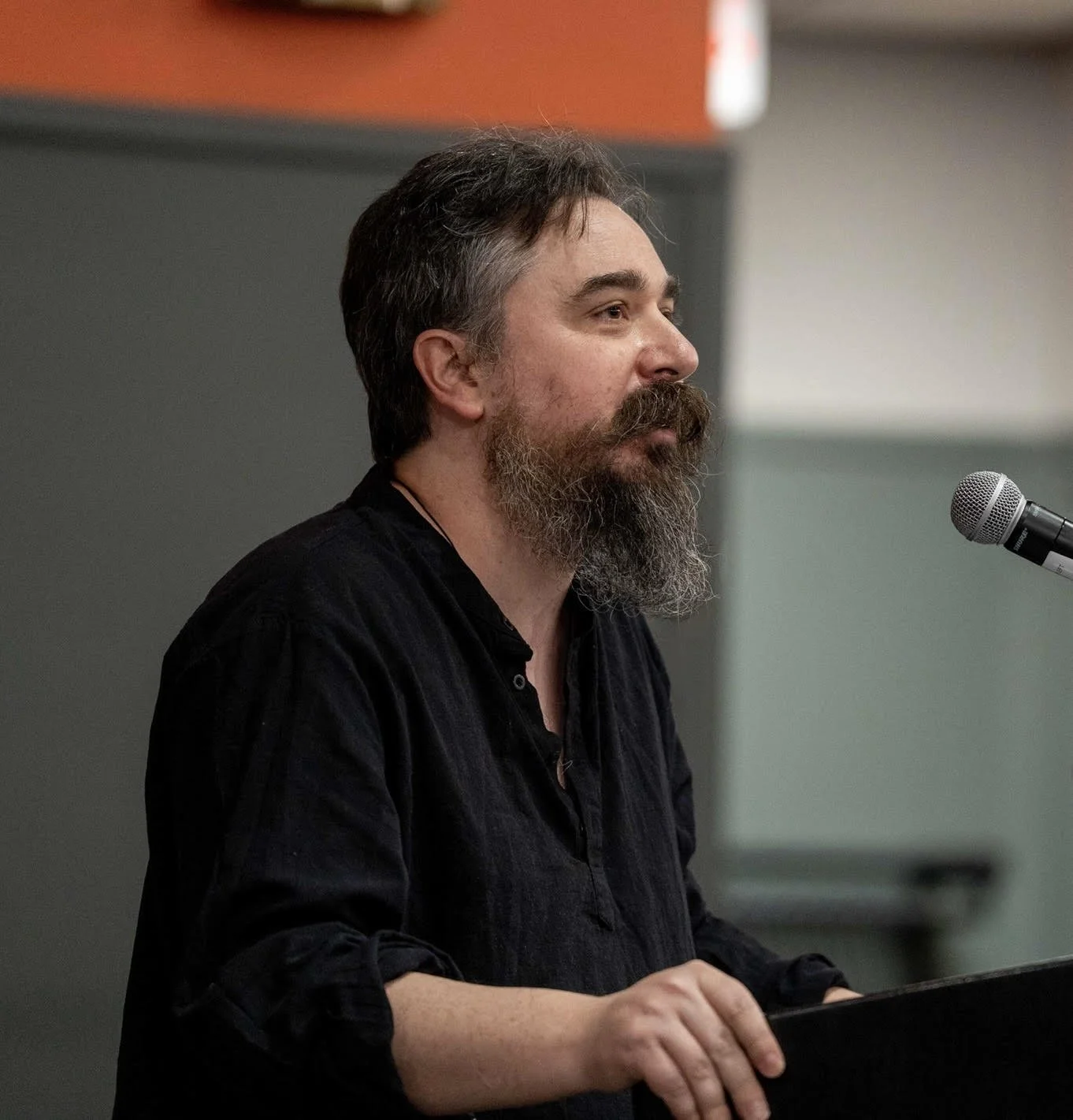
Poet Joseph Fasano
“Humanity is the universe perceiving its own sacredness, and poetry is one way to exercise that capacity.”
Maurizio Capuzzo - Poet Joseph Fasano on surviving the age of AI, democratizing art without compromise, and the radical empathy needed to truly find each other.
Five collections, three novels, a book of prompts, and poems that travel far past the people who read poetry. In April he wrote that poetry became marginal in America because its poets turned away from the people. We asked him what turning back would look like.
We found him in April, on X. The post ran to four parts and it was not a poem; it was an argument, and a fiery one. Poetry became marginalized in the United States, he wrote, partly because our poets long ago felt understandably angry about being ignored by American culture, and took their unconscious vengeance by turning away from the people. We read it twice. Then we wrote to him, with the “i” missing from “interview” in the subject line, which is the sort of first impression you cannot take back. He answered anyway.
Joseph Fasano is forty-four. He studied philosophy at Harvard and took an MFA at Columbia, where he taught for nearly two decades before leaving to form his own Academy; he has published five collections of poems, two novels, and The Magic Words, a book of writing prompts for children. He won the Rattle Poetry Prize at twenty-six. He also has a four-year-old son, and halfway through this conversation a white-tailed deer walked across his backyard and he stopped to tell us about it. We talked about craft, the sacred, AI, his father, Whitman. He is the first American to appear in this section. Let’s begin.
* * *
In April you wrote on X: “The practice of poetry has always been about understanding others, fathoming the human heart and its desires, the human mind and its structures, and a poet should focus on mastering his craft so that he can create what resonates with anyone—with everyone—who thirsts to be all of what she is.” How does poetry do that?
We live in a time of false dichotomies. In the world of poetry, some poets have turned their back on the people, resulting in an insular, academic kind of poetry, which really is very afraid to feel. On the other hand, we have a great deal of poetry, mostly online, that doesn’t care too much about craft. What I’m trying to do is find that great space that poetry has always occupied in cultures that truly value it. I believe the poet should become so adept at his craft that the craft becomes nearly invisible for average readers, in much the same way that such an audience could listen to a successful sonata, without knowing too much about the structure the artist has used, and still be moved by it very deeply. It’s the idea that we need to democratize art while not compromising its quality.
Those false dichotomies, here in America, are often simply the good and the evil, and everything else is lost. Why doesn’t poetry fall into that temptation?
There are two ways to look at the world: there is the “should,” and there is the “is.” You can look at the world and judge what something should be, or you can ask: regardless of what it should be, what is it? What’s interesting about poetry is that it leads with the “is.” However, if a poet can do the “is” clearly enough, depicting the drama of an event or situation, he can guide the reader toward their own “should.” I wrote a poem once called “Words Whispered to a Child Under Siege,” which came from my feelings as a father. I have a young son who’s only four, and I wanted to write about what I would possibly say to him if we didn’t have the immense privilege of living where we don’t have to worry about bombs falling on us. There’s no part in that poem where I say, “Isn’t this horrible, that the bombs are falling on people?” I simply go into the humanity of the situation and depict how it is for some people in this world, as humbly and clearly as I can. If a piece of writing can do that clearly, it allows the reader to step in and be the moral hero. It’s the reader who says: this should not be.
We live in dramatic times. Injustice, wars, and now AI, which if it becomes intelligent enough could destroy humanity. Does poetry heal?
It is healing insofar as it is instruction in empathy. We’re born with empathy, but we’re also born with muscles in our arms: if we don’t use them, they atrophy. Empathy needs to be exercised, and our institutions, especially in the Western world, don’t give us many opportunities to do that. Our system even makes a virtue out of curtailing our empathy: “Oh,” we hear, “he’s a great businessman, because he’s able to ignore his heart.” You are the first journalist I’ve spoken with about this[C1] , but I’m writing a book now that is not a book of poems. It’s a prose book about what we can really do as human beings to survive the advent of AI. One of the things I propose is that our fundamental gift as human beings is our ability to perceive things as “sacred”. And I don’t mean sacred in any strict religious sense: a person can touch his father’s baby shoes, for example, and feel in them something a computer cannot feel. I believe that humanity is the universe perceiving its own sacredness, and poetry is one way to exercise that capacity.
So the sacred is almost the door to our inner, true self. In “Instructions for Having a Soul” you write: “Read a book to a blind man, to your father.” Why does that matter so much?
What is the soul? I have a functional approach to it. If you spend your day without nourishing certain parts of yourself, you begin to feel empty. You begin to feel detached. We can argue all we want, like medieval philosophers, about whether the soul exists, but human beings a hundred thousand years ago knew nothing about what water is, and yet they knew that when they drank it they felt better. Maybe we just don’t know what the soul is, and we never will. We should give up a little on the game of trying to define it, and simply start nourishing it again.
In “Mahler in New York,” the poem that won you the Rattle Prize, you write that if you carry your father with you, it is the way a horse carries autumn in its mane. Who is the father for you today, or for your son?
I had my son somewhat later in life. I had him when I was forty, and I’m very grateful that I did, because I think I had a lot of growing up and changing to do. I don’t think there’s anything in my life that has made me wake up more than being a father. When a father looks at his son, he’s staring into the eyes of the future. Of course a father asks himself what kind of world he’s leaving for his child. And when I look at my child, I think about the ways all my theories—in education, in poetry—come back to this one command I live by, which is “be the whole human being, and help others do the same.” We so often forget to do that, and our culture has a vested interest in keeping us broken. We identify, for example, with our jobs, or with only the rational sides of ourselves, or with the parts of ourselves that are immediately “useful.” We’re taught to disregard, even to silence enormous parts of ourselves, parts that can feel mystery and wonder, parts that hear little scraps of poetry in the night, parts that truly know how to empathize and feel for others and love. When I look at my son, I think: here is this beautiful creature, this fresh gift of a person who was born, like all people, knowing something our society wishes him to forget. Why would I want any part of him to be silenced?
What gives a poet the right to imagine an experience of suffering that is not his own?
I’m going to reply with another question: what gives a poet the right not to imagine the suffering of others? We live in a time when a lot of ethical conversations begin in good faith and become corrupted by market forces. Writing a poem in the voice of somebody who is going through a suffering the poet hasn’t experienced could indeed be transgressive, if the poet doesn’t do it well. That of course leads to the question: what does it mean to do it well? Well, it’s quite like the Supreme Court’s definition of obscenity—you know it when you see it. And we’ve seen it done well so many times. I don’t think Shakespeare worried about whether he was allowed to imagine the inner world of his characters, except insofar as he worried about whether he was doing it well, with all the humanity he could muster. What we can’t do is let our conversations that begin in good faith cross over, ironically, into more oppression of our imagination, of our whole selves; that’s how an oppressive society quietly wins: by silencing us, by pitting artists against artists, by making us the oppressors of our own imaginations while we call that self-oppression a virtue. Consumerism creeps into our ethical conversations, and people start to say, unconsciously, “My pain is my product, and your pain is your product; stay in your lane, and I’ll stay in mine.” A poet has to use his imagination with great ethical awareness, but he has the enormous opportunity and obligation to imagine the reality of another human being. If we let those good-faith conversations about otherness turn into prohibitions against our imagination, then the great irony will be that there will be an authoritarianism within the world of art.
In “For a Student Who Used AI to Write a Paper” you ask what we are trying to be free of—"the living, the miraculous task of it”—and you end: “Love is for the ones who love the work.” What is that love?
Wonder and love are related insofar as both of them require and enjoy a state of openness. There are so many reasons to close down. We’re overstimulated, bombarded by so many things, tempted to shut ourselves away. To preserve our wonder, we need to unplug sometimes. We need to experience nature, to experience each other. Wonder is that state of being open. And love is an action. Love is the state of being open to listening to whoever is in front of you. In that poem you mentioned, I’m writing to a student who used AI to write a paper, and I try to begin with compassion: I know this life is hard now. When I say love is for the ones who love the work, I’m not talking about homework. I’m taking about a world in which we begin to take so many shortcuts that when, at last, we look into the eyes of someone in front of us, we think, catastrophically, “I don’t know how to do the work anymore.” And what is that work? It’s the work of listening, of being attentive, of holding each other’s complexities. Simone Weil once wrote, “The love of our neighbor in all its fullness simply beings meaning able to say to him, ‘What are you going through?”
I was in Italy once, in front of Mont Blanc, and I was in wonder—but that openness was created simply by standing there. Is wonder something the poet produces, or something he receives? And what is a poet’s relationship with hope?
Wonder, especially in our world, is a triumph. Many people have the misconception that the poet is born with the capacity to open his arms and blissfully look at the world, and everything is roses and puppy dogs and ice cream. In my experience, it’s the opposite. A poet is often—and I’ll speak about my own case—someone who has had every reason to close down, who has had traumas, horrible experiences, just like many people. But because of that, he feels a deep desire to experience the triumph of opening. My own struggles with profound difficulties have made for moments when I couldn’t stand in front of a mountain and feel wonder. Instead I felt tremendous fear, tremendous agony. If people experience in my poetry this ability to have wonder and to open up, it’s because I’ve worked for it. It’s my obligation toward my son to guide him into wonder. As for hope: there’s a poem by the late American poet Randall Jarrell called “90 North,” that being the location of the North Pole. On the surface it’s a poem about a middle-aged man who feels he has reached his peak, and that everything from here is a descent. At the end he has what I think are some of the darkest, seemingly most hopeless lines in poetry: “Pain comes from the darkness / And we call it wisdom. It is pain.” There is nothing hopeful in those lines, and yet when we read them—because the poet has put it into language, expressed it—we have a shiver of beauty, I would even say a shiver of hope. Even when the content seems hopeless, the act of putting it into language is the triumph; the form is the hope.
A horrible question, and I’ll ask it anyway. What is your favorite poem?
It’s almost impossible to decide. But right now, as I’m talking to you, the thing closest to my desk is Whitman’s work. And although Whitman is inimitable, and my goals and approaches are nothing like his, there’s something in “Song of Myself” that I love, and I’m not sure why it’s so often overlooked: that great poem begins with the word “I”—"I celebrate myself, and sing myself”—and all those lines later it ends with the word “you”: “I stop somewhere waiting for you.” Whitman is often seen as the great poet of selfhood, of being oneself. But he understands that the act of encountering himself is what will allow him to find the other, and that will allow the other to find him. That is the fundamental faith of lyric poetry: if I go deep enough into myself, I will find you. We’re sold a very cheap version of selfhood in our world today. As I sit here—what is this thing beside me called, an “i”-Phone?—I’m sold a version of myself that has everything to do with my immediate gratification and nothing to do with a profound encounter with the otherness within me. That encounter would be dangerous to the status quo, and that is why we must go there, both in art and in life. That is our miraculous task, and something deep in our humanity knows exactly how to do it. Let’s let poetry remind us of that great truth: if we go deeper into ourselves, we can find each other.
We’re sold a very cheap version of selfhood…If we go deeper into ourselves, we can find each other.
-
-
-
Si je m’enfonce suffisamment, je te trouverai
Maurizio Capuzzo
Le poète Joseph Fasano évoque Whitman et la paternité, l’émerveillement compris comme une conquête et non comme un don, et explique pourquoi le chemin qui descend jusqu’au plus profond du « soi » est le seul qui mène au « toi ». Joseph Fasano, photo gracieusement fournie par l’East Central University
Cinq recueils, deux romans, un livre d’exercices d’écriture, et des poèmes qui dépassent largement le cercle des lecteurs de poésie. En avril, il a écrit qu’aux États-Unis, la poésie était restée en marge parce que ses poètes avaient tourné le dos au peuple. Nous lui avons demandé comment inverser cette tendance.
Nous l’avons rencontré en avril, sur X. Le billet était divisé en quatre parties et ce n’était pas un poème : c’était un argumentaire, et plutôt passionné. La poésie a été marginalisée aux États-Unis, écrivait-il, en partie parce que nos poètes ont éprouvé il y a longtemps — et c’est compréhensible — de la colère à se voir ignorés par la culture américaine, et ils se sont vengés, sans s’en rendre compte, en s’éloignant du peuple. Nous l’avons lu deux fois. Puis nous lui avons écrit, en oubliant le « i » du mot « interview » dans l’objet de l’e-mail : ce genre de première impression qui ne laisse pas de place à une seconde chance. Il a néanmoins répondu.
Joseph Fasano a quarante-quatre ans. Il a étudié la philosophie à Harvard et obtenu un doctorat en écriture créative — un MFA — à Columbia, où il a enseigné pendant près de deux décennies avant de partir fonder sa propre école d’écriture. Il a publié cinq recueils de poésie, deux romans et The Magic Words, un livre d’exercices d’écriture pour enfants. Son troisième roman paraîtra en mars 2027, How to survive, a guide to being human in a time of AI. Il a remporté le prix Rattle de poésie à l’âge de vingt-six ans. Il a également un fils de quatre ans et, au milieu de la conversation, un cerf a traversé le jardin de sa maison, s’est arrêté, et il nous en a parlé. Nous avons parlé du métier, du sacré, de l’IA, de son père et de Whitman. C’est le premier Américain à figurer dans cette rubrique. Commençons.
En avril, tu as écrit sur X : « La pratique de la poésie a toujours consisté à comprendre les autres, à dévoiler le cœur humain et ses désirs, l’esprit humain et ses structures ; et un poète devrait s’attacher à maîtriser son art afin de pouvoir créer quelque chose qui trouve un écho chez quiconque — chez tous ceux — qui souhaitent être pleinement eux-mêmes ». Comment la poésie y parvient-elle ?
Nous vivons à une époque de fausses dichotomies. Dans le monde de la poésie, certains poètes ont tourné le dos au public, ce qui a donné naissance à une poésie isolée, académique, qui, au fond, a très peur de laisser transparaître des émotions. D’un autre côté, nous avons une quantité énorme de poésie, surtout en ligne, qui ne s’intéresse pas beaucoup au métier. Ce que j’essaie de faire, c’est de retrouver cette vaste place que la poésie a toujours occupée dans les cultures qui la valorisent véritablement. Je crois que le poète doit maîtriser son art au point de le rendre presque invisible pour le lecteur lambda, tout comme ce même public peut écouter une sonate magistrale sans rien savoir de la structure utilisée par le musicien et en être profondément ému. L’idée est de démocratiser l’art sans en compromettre la qualité.
Ici, aux États-Unis, ces fausses dichotomies finissent par se réduire au bien contre le mal, et tout le reste est perdu de vue. Pourquoi la poésie ne tombe-t-elle pas dans ce piège ?
Il y a deux façons de regarder le monde : celle du « devoir être » et celle de « l’être ». On peut regarder le monde et juger comment il devrait être, ou bien se demander : indépendamment de ce qu’il devrait être, qu’est-il ? Ce qui est intéressant dans la poésie, c’est qu’elle part de l’« être ». Et pourtant, si un poète parvient à transmettre l’« être » avec suffisamment de clarté — en représentant le drame d’un fait ou d’une situation —, il peut conduire le lecteur vers son propre « devrait être ». J’ai un jour écrit un poème intitulé Mots murmurés à un enfant assiégé, qui naît de ce que je ressens en tant que père. Mon fils n’a que quatre ans, et je voulais écrire ce que je lui aurais dit si nous n’avions pas l’immense privilège de vivre là où les bombes ne tombent pas. À aucun moment dans ce poème je ne dis : « N’est-ce pas horrible que des bombes tombent sur les gens ? ». J’explore simplement l’humanité de la situation et je décris ce qu’est la vie pour certaines personnes dans ce monde, avec toute l’humilité et la clarté dont je suis capable. Si un texte parvient à transmettre cela avec clarté, il permet au lecteur de s’immerger dans l’histoire et de devenir lui-même le héros moral. C’est le lecteur qui dit : « Ça ne devrait pas être comme ça ».
Nous vivons une époque dramatique. Les injustices, les guerres et désormais l’intelligence artificielle, qui, si elle devenait suffisamment intelligente, pourrait détruire l’humanité. La poésie est-elle un remède ?
Elle guérit dans la mesure où elle enseigne l’empathie. Nous naissons avec l’empathie, mais nous naissons aussi avec les muscles de nos bras : si nous ne les utilisons pas, ils s’atrophient. L’empathie doit être exercée, et nos institutions — surtout en Occident — ne nous offrent pas beaucoup d’occasions de le faire. Notre système va même jusqu’à transformer en vertu le fait de la limiter : on entend dire que quelqu’un est un grand homme d’affaires parce qu’il sait ignorer son cœur. Tu es le premier journaliste à qui j’en parle, mais j’écris actuellement un livre qui n’est pas un recueil de poèmes. C’est un ouvrage en prose sur ce que nous pouvons réellement faire, en tant qu’êtres humains, pour survivre à l’avènement de l’IA. L’une des idées que j’avance est que notre don fondamental réside dans la capacité à percevoir les choses comme sacrées. Et je ne parle pas du sacré au sens strictement religieux : on peut toucher les chaussons de bébé de son propre père, par exemple, et y percevoir quelque chose qu’un ordinateur ne peut pas percevoir. Je crois que l’humanité est l’univers qui perçoit sa propre sacralité, et la poésie est un moyen d’exercer cette capacité.
Le sacré est donc en quelque sorte la porte d’accès au vrai moi. Dans Instructions pour avoir une âme, tu écris : « Lis un livre à un aveugle. À ton père. » Pourquoi est-ce si important ?
Qu’est-ce que l’âme ? Je la considère en termes fonctionnels. Si tu passes ta journée sans nourrir certaines parties de toi-même, tu commences à te sentir vide. Tu commences à te sentir éloigné de tout. On peut discuter autant qu’on veut — comme les philosophes médiévaux — de l’existence ou non de l’âme, mais les êtres humains d’il y a cent mille ans ne savaient pas ce qu’était l’eau et savaient parfaitement qu’en la buvant, ils se sentaient mieux. Peut-être ne savons-nous pas ce qu’est l’âme et ne le saurons-nous jamais. Nous devrions mettre un peu de côté ce jeu qui consiste à la définir et revenir, simplement, à la nourrir.
Dans Mahler à New York, le poème avec lequel tu as remporté le Prix Rattle, tu écris que tu emmènes ton père avec toi comme un cheval porte l’automne dans sa crinière. Qui est aujourd’hui le père pour toi, ou pour ton fils ?
Je suis devenu père assez tard. J’ai eu mon fils à quarante ans, et j’en suis très reconnaissant, car je crois que j’avais encore beaucoup à mûrir et à changer. Je ne crois pas qu’il y ait quoi que ce soit dans ma vie qui m’ait autant éveillé que le fait d’être père. Quand un père regarde son fils, il regarde l’avenir dans les yeux. Et bien sûr, un père se demande quel monde il lui lègue. Quand je regarde mon fils, je pense à la façon dont toutes mes théories — sur l’éducation, sur la poésie — se résument à un seul principe qui me guide : sois un être humain à part entière et aide les autres à l’être. Nous l’oublions sans cesse, et notre culture a tout intérêt à nous maintenir fragmentés. Nous nous identifions à notre travail, par exemple, ou uniquement à la partie rationnelle de nous-mêmes, ou encore aux aspects qui s’avèrent immédiatement « utiles ». On nous apprend à ignorer — voire à faire taire — d’énormes parties de nous-mêmes : celles qui sont capables de percevoir le mystère et l’émerveillement, celles qui, la nuit, saisissent de petits fragments de poésie, celles qui savent véritablement se mettre à la place de l’autre, éprouver de l’empathie pour lui et l’aimer. Quand je regarde mon fils, je me dis : voici cette créature merveilleuse, ce cadeau qui vient d’arriver, une personne qui est née, comme tout le monde, en sachant quelque chose que notre société veut qu’elle oublie. Pourquoi voudrais-je qu’une partie quelconque de lui soit réduite au silence ?
De quel droit un poète peut-il imaginer une souffrance qui n’est pas la sienne ?
Je réponds par une autre question : de quel droit un poète ne peut-il pas imaginer la souffrance des autres ? Nous vivons à une époque où de nombreux débats éthiques partent de bonnes intentions et finissent par être corrompus par les forces du marché. Écrire un poème du point de vue de quelqu’un qui éprouve une souffrance que le poète n’a pas connue pourrait en effet être une ingérence… si le poète ne s’y prend pas bien. Ce qui nous amène à la question suivante : qu’est-ce que cela signifie de bien le faire ? Eh bien, cela ressemble beaucoup à cette définition de l’obscénité donnée par la Cour suprême des États-Unis : on la reconnaît quand on la voit. Et cela a été bien fait mille fois. Je ne pense pas que Shakespeare se soit soucié d’avoir la permission d’imaginer le monde intérieur de ses personnages, si ce n’est dans la mesure où il tenait à le faire bien, avec toute l’humanité dont il était capable. Ce que nous ne pouvons pas permettre, c’est que certaines discussions qui partent de bonne foi finissent, ironiquement, par opprimer encore davantage notre imagination, tout notre être ; c’est ainsi qu’une société oppressive s’impose, sans bruit : en nous réduisant au silence, en dressant les artistes les uns contre les autres, en nous transformant en oppresseurs de notre propre imagination et en qualifiant cette auto-oppression de vertu. Le consumérisme s’insinue dans nos conversations éthiques et les gens commencent à dire, sans s’en rendre compte : ma douleur m’appartient et la tienne t’appartient ; ne sors pas de ton domaine et je ne sortirai pas du mien. Un poète doit faire usage de son imagination avec une grande conscience éthique, mais il a l’immense opportunité et le devoir d’imaginer la réalité d’un autre être humain. Si nous laissons ces conversations de bonne foi sur l’altérité se transformer en restrictions à l’imagination, la grande ironie sera que l’autoritarisme finira par s’enraciner dans le monde de l’art.
Dans À un étudiant qui a utilisé l’IA pour rédiger un devoir, tu te demandes de quoi nous essayons de nous libérer — « la tâche vivante et miraculeuse que cela implique » — et tu conclus :
« L’amour, c’est pour ceux qui aiment le travail ». De quel amour s’agit-il ?
L’émerveillement et l’amour sont apparentés dans la mesure où tous deux exigent un état d’ouverture et s’en nourrissent. Il y a tant de raisons de se refermer sur soi-même. Nous sommes surstimulés, bombardés, tentés de nous isoler. Pour conserver le sens de l’émerveillement, il faut se déconnecter de temps à autre. On a besoin de la nature, on a besoin de se rencontrer les uns les autres. L’émerveillement, c’est justement cet état d’ouverture. Et l’amour est une action. L’amour, c’est être disposé à écouter celui qui se trouve en face de soi. Dans ce poème que tu cites, j’écris à un élève qui a utilisé l’intelligence artificielle pour rédiger un devoir, et j’essaie de commencer par faire preuve de compassion : je sais que la vie est dure en ce moment. Quand je dis que l’amour est pour ceux qui aiment le travail, je ne fais pas référence aux devoirs scolaires. Je parle d’un monde où nous prenons tellement de raccourcis que, lorsque nous regardons enfin dans les yeux celui qui se trouve devant nous, nous pensons, avec un sentiment de catastrophe : je ne sais plus faire ce travail. Et quel est ce travail ? Celui d’écouter, celui d’être attentif, celui d’accepter la complexité de l’autre. Simone Weil a écrit : « La plénitude de l’amour du prochain consiste simplement à être capable de lui demander : “Quel est ton tourment ?” ».
Un jour, je me trouvais en Italie, face au Mont Blanc, et j’ai été envahi par l’émerveillement ; mais cet émerveillement ne m’est venu que du simple fait de me trouver là. L’émerveillement, le poète le crée-t-il ou le reçoit-il ? Quel est le rapport du poète à l’espoir ?
L’émerveillement, surtout dans notre monde, est un triomphe. Beaucoup de gens ont l’idée erronée que le poète naît avec la capacité d’ouvrir les bras et de regarder le monde avec joie, et que tout n’est que roses et fleurs. D’après mon expérience, c’est exactement le contraire. Un poète est souvent — et je parle pour moi — quelqu’un qui a eu toutes les raisons de se renfermer sur lui-même, qui a porté en lui des traumatismes et des expériences horribles, comme tant de gens. Et c’est précisément pour cela qu’il éprouve un profond désir de faire l’expérience du triomphe de l’ouverture. Mes propres luttes contre des difficultés très profondes m’ont conduit à des moments où je ne parvenais pas à me tenir face à une montagne et à éprouver de l’émerveillement. Je ressentais une peur immense, une agonie immense. Si les gens trouvent dans ma poésie cette capacité d’émerveillement et d’ouverture, c’est parce que j’ai travaillé pour y parvenir. Et c’est mon devoir, envers mon fils, de le guider vers l’émerveillement.
Quant à l’espoir : il existe un poème du poète américain Randall Jarrell intitulé 90 North, du nom de la position du pôle Nord. À première vue, c’est un poème sur un homme d’âge mûr qui a le sentiment d’avoir atteint le sommet et que, de là, tout n’est plus qu’une descente. À la fin, il écrit ce qui me semble être certains des vers les plus sombres et, en apparence, les plus dépourvus d’espoir de la poésie : « La douleur vient des ténèbres / et nous l’appelons sagesse. C’est de la douleur. » Il n’y a rien d’encourageant là-dedans, et pourtant, en les lisant — précisément parce que le poète l’a exprimé avec des mots, l’a dit —, nous ressentons un frisson de beauté ; je dirais même d’espoir. Même si le contenu semble dépourvu d’espoir, le fait même de l’exprimer avec des mots est un triomphe : la forme, c’est l’espoir.
Une question terrible… Quel est ton poème préféré ?
C’est presque impossible de se décider. Mais en ce moment même, alors que je te parle, celui que j’ai le plus à portée de main sur mon bureau, c’est Whitman.
Et bien que Whitman soit inimitable, et que mes objectifs et ma façon de travailler ne ressemblent en rien aux siens, il y a quelque chose dans Chant de moi-même que j’adore et que je ne comprends pas comment on puisse si souvent négliger : ce grand poème commence, en anglais, par le mot I, « je » — « Je me célèbre et je chante moi-même » —, et après tous ces vers, il se termine par le mot you, « toi » : « Je m’arrête quelque part, en t’attendant ». Whitman est considéré comme le grand poète de l’individualité, de l’être soi-même. Mais il comprend que le fait de se trouver soi-même est ce qui lui permettra de trouver l’autre, et ce qui permettra à l’autre de le trouver. Telle est la foi fondamentale de la poésie lyrique : si je m’enfonce suffisamment en moi-même, je te trouverai. Aujourd’hui, on nous vend une version très médiocre de l’individualité. Alors que je suis assis ici — comment s’appelle cet engin que j’ai à côté de moi, un « i »Phone ? —, on me vend une version de moi-même qui n’a que faire de ma gratification immédiate et n’a rien à voir avec une rencontre sérieuse avec l’altérité que je porte en moi. Cette rencontre serait dangereuse pour le statu quo, et c’est pourquoi il faut s’y aventurer, dans l’art comme dans la vie. Telle est notre mission miraculeuse, et quelque chose au plus profond de notre humanité sait exactement comment l’accomplir. Que la poésie nous rappelle cette grande vérité : si nous nous enfonçons davantage en nous-mêmes, nous pourrons nous rencontrer les uns les autres.
« On nous vend une version très médiocre de l’individualité. Si nous nous enfonçons davantage en nous-mêmes, nous pourrons nous rencontrer les uns les autres. »