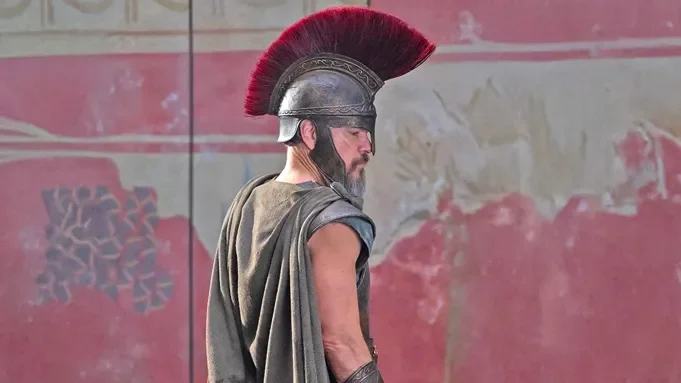
“The throne isn’t empty; her waiting fills it, and it will take no king but Odysseus.”
Fernando DeHaro: Nolan's Odysseus and the Lesson of the I
Christopher Nolan's The Odyssey is a runaway success, and his reading of Odysseus is genuinely striking.
Christopher Nolan's The Odyssey has left no one indifferent. That's a good sign. Audiences certainly aren't indifferent: the film has set a box office record. In an age of streaming and small screens, people went looking for the big one — IMAX if they could get it. And they come out saying they spent three hours without a wasted minute, three hours holding everything that makes a story great. Watching Nolan's latest, it's hard not to be moved, hard not to suffer and rejoice and think. At this stage of his career he is no longer the cool, detached director of Dunkirk.
Does the film's success prove that Homer, 2,800 years on, is more alive than ever? The Economist has noted that this new Odysseus looks less like a figure out of ancient Greece than one out of modern Western thought. The New Yorker faults him for losing his cunning, his wit, his charm, and for carrying too much guilt. The purists have a point. But who decided that being modern, or reinterpreting the Odyssey, is a sin? Dante and Tennyson did exactly that in their own centuries.
No one, though, has anything bad to say about the Penelope that Anne Hathaway gives us, and she matters to this story as much as Odysseus does. Homeric or modern, Penelope is not the wife of the king of Ithaca who waits. She is the waiting itself. A wait so unbroken that twenty years of absence never amount to proof that her husband is dead. A wait that outlasts even the doubt stirred up by travelers with stories of a living Odysseus who never shows up.
That's why we all recognize ourselves in her. We wait because we know — even when we can't say it — that absence is a form of presence, that an absence is inhabited. It is always the absence of someone.
And we know, as she does, that the size of our humanity depends on whether we can take on that waiting for Odysseus everyone keeps talking about. Nolan builds an atmosphere thick with it, setting the suitors' abuse and impatience and violence against Penelope's steadiness. The queen of Ithaca has no interest in getting back to normal. She ignores everyone who tells her the island needs a king. The throne isn't empty; her waiting fills it, and it will take no king but Odysseus.
Twenty years is a long time, and time weaves a shroud on Penelope's loom. Her waiting unravels it overnight. Dawn after dawn, she takes back the present.
Nolan's Odysseus, modern beyond question, can still say “I” in the face of the gods' decree and the weight of what he has done. Homer's hero feels nothing over the destruction of Troy. Nolan's does. It doesn't stop him from heading home.
In the film, the sirens' song that Odysseus is desperate to hear — lashed to his own mast — “said that what you wanted most was what you could least have, and that what you could least have was what you already possessed and had lost. It was a song of all the promises I failed to keep. And it told me that, in truth, I didn't want to go home.”
Nolan's sirens try to trap him by denying his desire, throwing in his face everything dear to him that he lost and the misfortune that dooms him to failure. They are the same old sirens with the same diabolical song, the one that denies desire and empties waiting of its meaning. Sirens of power, telling you what you may and may not want.
On the island of Thrinacia, Nolan stages a confrontation between Athena and Odysseus, drawing on a rebuke Homer puts in the goddess's mouth elsewhere. Athena, who has done so much for him along the way, scolds him for wanting to defy the immortals and a fate already written. And here — far more than in his cunning or his skill in a fight — Odysseus shows his stature as a hero.
The hero says “I.” He is free, and so he answers to his men. He also accepts the wound — Nolan's addition, not Homer's — for the harm he has caused. Crouched in a beggar's rags before a Penelope who senses him before she recognizes him, he opens his heart in a confession that costs him everything.
Too modern? Modern the way an endless wait is modern in a world coming apart. Modern like an “I” that stakes its desire against catastrophe and against a fate the gods have already handed down.
Source:https://www.ilsussidiario.net/editoriale/2026/7/28/la-lezione-sullio-dellulisse-di-nolan/2985206/