The Paradox of Freedom
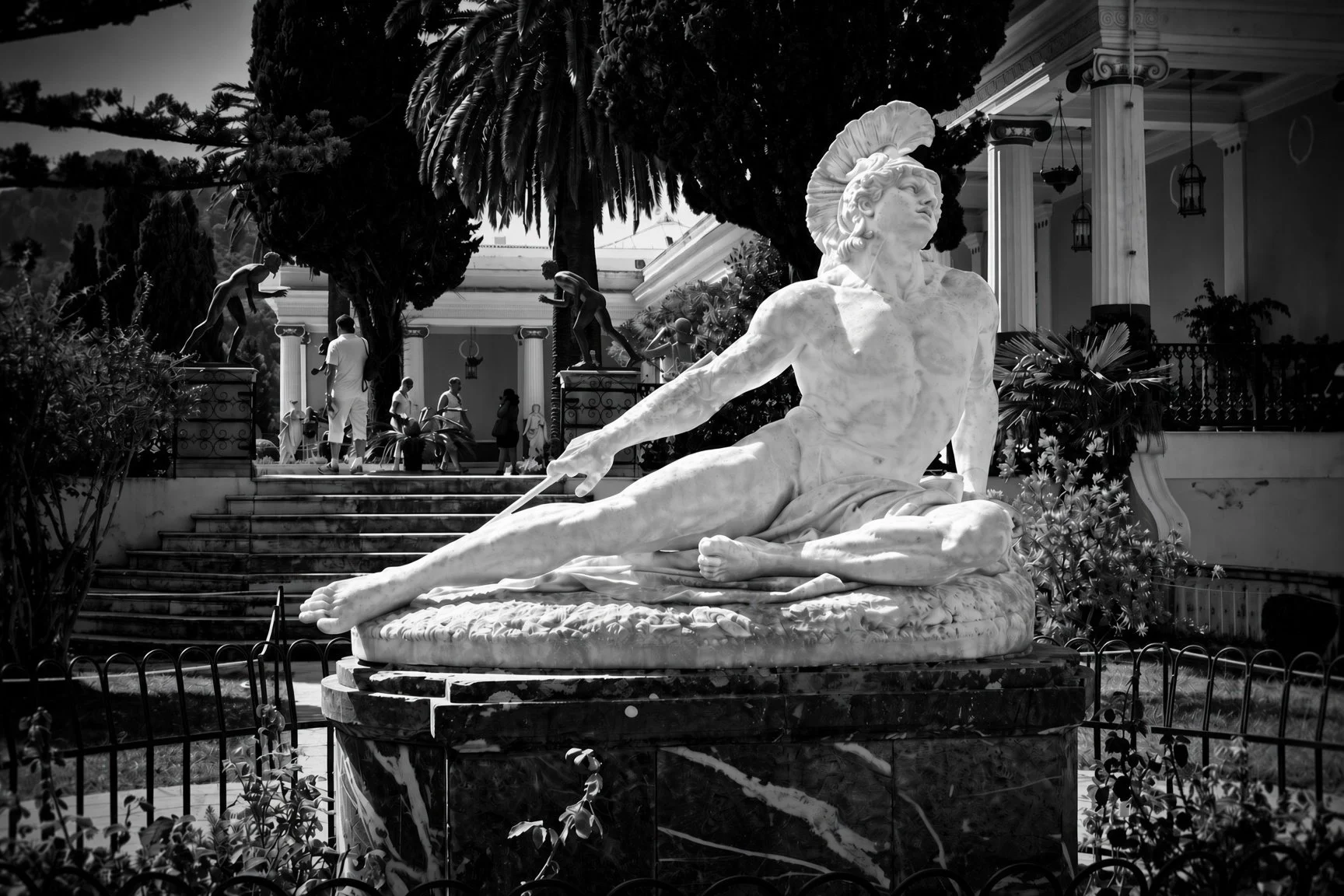
Dying Achilles Statue – Black and White | Paradox of Force and Freedom
“Weakness, which inevitably marks us all, is precisely the way each of us lives and experiences our own specific strength.”
Costantino Esposito - The Paradox of Freedom
Weakness, which inevitably marks us all, is precisely the way each of us lives and experiences our own specific strength. Between human illusions and existential discoveries, a journey from Homer to the present day.
This is what is so terrifying about strength: it appears to us as something we cannot resist, the law of an inescapable necessity. And what is unsettling is that it does not belong solely to the nature that dominates us from the outside, or to the rule of a political regime, but is also a constitutive factor of our very nature. Herein also lies the drama of force: it inevitably imposes itself in the face of—and often against—human freedom. And this holds true even for those who might consider our freedom an illusion, yet cannot help but feel it or seek it within themselves. And if we then consider that this freedom, too, is in its own way a “force” that springs from within, the picture becomes incredibly complicated—yet, at its core, it also comes full circle: what else would our life be if not a “force field” in search of its own possible—or impossible—equilibrium? And what happens when that equilibrium is disrupted—and is constantly being disrupted?
This ambiguity of force—its being something that necessarily determines us, even if we do not want it to, and at the same time something we go along with because it sets us free—is never an either/or choice or a Manichean alternative, as both determinists and moralists would have it, but a tension that permanently inhabits our lives, one that profoundly shapes our way of being in the world.
The problem arises when we discover—and we discover it all too soon through our own experience—that there are forces we cannot escape, and this impossibility of escape accompanies the feeling of our existence like a muffled basso continuo, determining the “quality” and “tone” of our self-awareness. This is an existential discovery that concerns us personally, but one that can lead to the metaphysical suspicion that the entire human life depends on factors that humans illusorily believe they can dominate, yet by which they are in reality dominated from top to bottom.
Simone Weil demonstrates this with poignant clarity in her essay “The Iliad: A Poem of Force,” written between 1939 and 1941. The great Homeric poem expresses, with an intensity of vision that remains unmatched, a definitive truth: that “force turns anyone who is subject to it into a thing […], in the most literal sense of the word, because it transforms them into a corpse.” This effect of petrification that force produces on a person who is subject to it—that is, on all people, not only those defeated in battle but also the victors—does not necessarily coincide with physical death, because it also affects those who continue to live, but no longer as “living flesh,” rather as a dead thing.
This dominion of force “extends as far as that of nature”: as in the case of the maternal love nurtured by Niobe, who, exhausted after the death of her twelve sons—left unburied by the will of the gods—“thought of eating when she was weary of tears,” because she had been rendered “incapable even of feeling her own misery,” subject to a command “just as cold [...] and harsh as if it were exerted by inert matter.” That same force “crushes just as mercilessly” those who fall under its yoke as it “mercilessly intoxicates those who possess it or believe they possess it.” Not only Hector, but also Achilles; not only Achilles, but also Priam; not only the Trojans but also the Achaeans: “by virtue of being blind, fate establishes a sort of justice, blind itself,” and those who kill will in turn be killed with equal measure. Her name is Nemesis. She is the one for whom “executioners and victims are equally innocent,” like brothers in the same misery.
For the protagonists of the Iliad, being aware of death as the sole destiny—as the very “future” of life—means something quite different from the mere acceptance of life’s natural finitude: rather, it means living “subjugated to the yoke of war,” driven by a genuine “need for death”—a need for a terrible fulfillment, in which only destruction can bring liberation from the constant fear that petrifies the passage of life. Thus, though they are alive, these men belong to “a race different from that of the living,” having fallen, as they have, to the level of inert matter, pure passivity driven by the impetus of blind forces.
And yet—and here Weil’s gaze becomes vibrant in its delicacy—in the Iliad there resounds, almost imperceptibly, a “note” of pure and poignant regret for what force will lead to destruction. The note of love “of the son for his parents and of the father and mother for their son,” or that of conjugal love; the note of friendship among comrades in arms and—“an even greater miracle”—that of the friendship that can bind even mortal enemies together. This “bitterness that springs from tenderness,” this extreme regret for what is lost but could have been lived, is what makes one feel the rare “moments of grace” in the poem, and even more so in the fate of force. Everything that “escapes the dominion of force” in the soul and in human relationships is “loved, but loved painfully, because of that ever-present danger of destruction.” This supreme “Greek genius,” which we first encounter in the Iliad, will be inherited, according to Weil, only by Attic tragedy (especially Aeschylus and Sophocles) and will find its ultimate expression in the Gospel itself. In particular, during his Passion, Christ “trembles before suffering and death”; he feels separated from humanity and even abandoned by God, thereby revealing the most acute understanding and expression of the dominion of force—that is, of the common fate of human misery. To look this fate in the face, without illusions or justifications, means “to suffer force” by allowing it to strike “down to the soul.” And while grace—purely human in Homer’s poem, even divine in the Gospels—can prevent one from being corrupted and destroyed by the “blow” of force, “it cannot, however, prevent the wound.”
It is this wound that enables a man “reified” by force to become a living human being once more, a being of flesh. Free again, or perhaps free for the first time. Here the true stakes become clear in the unstoppable dominion of force—more radical than the necessary laws of physical and biological nature, and yet, as if within them, even more profound than the ideological conflicts surrounding force as the domain of political power. At stake is the possibility that that touch of tenderness and love—that extreme, dramatic sharing of human misery—might ultimately arise and act as a true “force” in its own right.
This is clearly not a matter of “masking” the invincibility of force—as we have outlined it so far—with edifying narratives, or of taming and making more bearable the tragic outcomes it brings about in human existence, which is, as such, always bent under its yoke. Rather, it is a matter of traversing its dominion, sensing—even more than the inescapable tragedy arising from the fate of death—the drama it provokes when it intersects and intertwines with that other force: the irreducible desire of the human soul—the desire to exist and to fulfill oneself, that is, to be happy.
This desire has often been interpreted as a mere biological force, a physiological impulse that falls within the realm of the “psychic,” yet one that is always on the verge of turning into a pathological experience. As if it were the individual manifestation, within the conscious self, of an unconscious power: what Freud, drawing on Georg Groddeck, had termed the impersonal, necessary “Id.” We still find ourselves in the full grip of the dark, blind force of nature, which now, however, evolves almost seamlessly into “culture” and “history.” Yet it remains the relentless force we know, perhaps merely managed and processed within bourgeois salons. Or, in only an apparent contrast, it unfolds as a revolutionary and/or reactionary force in the history of classes and states, of capital and labor power, of markets and finance.
All of these are forms—despite their radical differences—of the great force—both natural and political—that we delude ourselves into thinking we can control and manage on our own, whether as individuals or in association, but which in the end inevitably plays us all. The force-necessity whose canon was established with geometric rigor once and for all by Spinozist rationalism, which advances the “scientific” claim to finally resolve the most burning problem of the human condition—that of the freedom of the self—simply by dissolving it into the inevitable acceptance of the necessity of force. The truly fulfilled—that is, happy—person is one who, through intellectual exercise, has learned to free themselves from compulsion, even from the extreme form represented by death, and to no longer fear it, because they intuit that even destruction “divinely” falls within the homeostasis of man’s natural forces.
Here is the verdict of insurmountable force: the desire of the self that becomes the simple “conatus” (Spinoza again) through which the human being tends to preserve its vital force, as a survival instinct. But perhaps not everything is “held together” by this force, and homeostasis is ultimately always at risk. It is that happy instability in which the system of tendencies and counter-tendencies leaves room for an asymmetry with respect to the cycle of actions and reactions.
This asymmetry has made itself known through its own power in the Judeo-Christian experience of the self and the world. The decisive—and in this case truly revolutionary—principle is that all the forces of the universe encounter a point of incredible resistance at the heart of the human being, and in his decision—seemingly of no consequence in relation to the cosmic and political order—to “will” the good or to reject it; that is, to open himself or, respectively, to close himself off to grace. And the latter is a strange force, because although it is radically “other” than human decisions or merits, it calls—and I would almost say awaits—the assent of mortals. It is distinct from our freedom, yet it can be given and manifested only to a free being. Its order is no longer that of mere imposition from above, but of a call from the heart itself. This is what Paul of Tarsus (Letter to the Romans) identified in the conflict between the Law—closely bound to the slavery of sin—and the Spirit of God, who reveals to us that we are no longer slaves but “children.” This means we are capable of welcoming another force that acts in a personal—and responsible—way within our own hearts.
This is clearly seen in Augustine’s discovery of the decisive and, until then, previously unrecognized role of the human will with regard to evil. Significantly, in contrast to the Manichaean view—for whom evil is a metaphysical “force” opposed to good on a cosmic level, and against which the individual can do nothing nor is held accountable for anything—Augustine insists on attributing the responsibility for evil to the “perverse” use of the human will, in which also lies the possibility of changing course and “converting” the will’s gaze toward being and the good.
From that moment on, the true center of power shifts its location, taking root in the human heart. And not because the heart is capable of halting or nullifying the forces that inexorably determine the course of nature and the events of history, but because it is capable of questioning their meaning. Indeed, because it discovers its need for meaning. This need is its true power. It is no cheap solution; indeed, ever since then we have been continually tempted—and at times compelled—to say that there is nothing we can do in the face of the fate that looms over us, even when we improperly call this mortal fate the “will of God.” But every time we think this, we reaffirm, through that very thought, a strength within us that does not yield. This strength of resistance always coincides with the intuition—often a simple suggestion, in some cases merely a fleeting suspicion born of the very fabric of experience—that we are children rather than slaves. The hallmark of sonship is a generation that does not predetermine existence, but rather gives it the vital space to unfold on its own terms.
In Paul’s Christian paradox—“when I am weak, then I am strong” (2 Corinthians)—not only does the Greek principle of the Iliad resonate, as Weil maintained, but one senses a new emphasis that would be too much for the Greek genius, and that is rightly too much, indeed far too much—due to its absolute gratuitousness, whose most fitting image remains that of a completely unpredictable encounter, such as that with a loved one or a friend who suddenly makes us see the balance of strength—give and take—with fresh eyes.
This is not a matter of a difference between doctrines or between different interpretations, but of a difference in experience. It is not a question of explaining better, but of noticing more carefully what can make our very weakness strong. Indeed, one might say that weakness, which inevitably marks us all, is precisely the way in which each person lives and experiences their own specific strength. And what if it were time to reconsider what the great Leibniz said about “vis”—the force or dynamic energy that acts from within each individual (monad), reflecting—in each person in their own specific way—the forces that sustain and move the entire universe? A point, however tiny, of thought and therefore of freedom—the most surprising force in the world.
Costantino Esposito is a full professor of the History of Philosophy at the University of Bari Aldo Moro. His article continues Il Foglio’s summer series dedicated to the concept of force. Each week, a different author will examine this concept from the perspective of a specific discipline. The other installments were published on July 7 (Michele Silenzi, “The Force That Holds Up the World”), July 14 (Luca Amendola, “Between Force and Matter”), July 21 (Luigi Marco Bassani, “The Measure of Us Europeans”), July 28 (Alberto Frigerio, “The Trouble with Modern Man”), and August 4 (Lorenzo Castellani, “Damn Reason of State”).
-
IL PARADOSSO DELLA LIBERTÀ
La debolezza, che inevitabilmente ci segna tutti, è proprio il modo in cui ciascuno vive e sperimenta la sua specifica forza. Tra umane illusioni e scoperte esistenziali, un viaggio da Omero ai nostri giorni
di Costantino Esposito
Questo è il terribile della forza: che ci appare come qualcosa a cui non possiamo resistere, la legge di una necessità senza scampo. E l’inquietante è che essa non appartiene soltanto alla natura che ci domina dal di fuori, o al dominio di un regime politico, ma è anche un fattore costitutivo della nostra stessa natura. Qui sta anche il drammatico della forza, nel fatto di imporsi inevitabilmente di fronte e spesso contro la libertà degli umani. E questo vale anche per coloro che ritenessero un’illusione la nostra libertà, ma che non possono mancare di sentirla o di cercarla in sé stessi. E se si considera poi che anche questa libertà è a suo modo una “forza” che muove dall’intimo, il quadro si complica maledettamente, ma in fondo si compie anche: cos’altro sarebbe la nostra vita se non un “campo di forze” alla ricerca di un suo possibile o impossibile equilibrio? E che succede quando l’equilibrio salta – e salta continuamente?
Questa equivocità della forza, il suo essere qualcosa che ci determina necessariamente, anche se non lo vogliamo, e insieme qualcosa che assecondiamo perché ci libera, non è mai un aut aut o un’alternativa manichea, come vorrebbero sia i deterministi sia i moralisti, ma una tensione che abita permanentemente le nostre vite, che connota profondamente il nostro stare al mondo.
Il problema nasce quando scopriamo – e lo scopriamo ben presto sulla nostra pelle – che ci sono forze a cui non possiamo sfuggire, e questa impossibilità di fuga accompagna come un sordo basso continuo il sentimento del nostro esistere, determina la “qualità”, il “tono” della nostra autocoscienza. Si tratta di una scoperta esistenziale, che ci riguarda in prima persona, ma che può arrivare sino al sospetto metafisico che tutta la vita degli umani dipenda da fattori che essi credono illusoriamente di poter dominare ma da cui in realtà sono dominati da cima a fondo.
Lo mostra con una struggente lucidità Simone Weil nel suo saggio su “L’Iliade poema della forza”, scritto tra il 1939 e il 1941. Il grande poema omerico esprimerebbe, con una intensità di sguardo che resterà ineguagliata, una verità definitiva: che “la forza rende chiunque vi sia sottomesso una cosa [...], nel senso più letterale della parola, perché lo trasforma in un cadavere”. Questo effetto di pietrificazione che la forza produce su un uomo che le sia sottomesso – cioè su tutti gli uomini, non solo i vinti della battaglia, ma anche i vincitori – non coincide necessariamente con la morte fisica, perché colpisce anche chi continua a vivere, ma non più come “una carne viva”, bensì come una cosa morta.
Questo imperio della forza “arriva tanto lontano come quello della natura”: come per l’amore materno nutrito da Niobe che, stremata dopo la morte dei suoi dodici figli rimasti insepolti per volere degli dèi, “pensò a mangiare quando fu stanca di lacrime”, perché resa “incapace persino di sentire la sua miseria”, soggetta a un comando “altrettanto freddo [...] e duro come se fosse esercitato dalla materia inerte”. La medesima forza “stritola tanto spietatamente” chi cade sotto il suo giogo, quanto “spietatamente inebria chi la possiede o crede di possederla”. Non solo Ettore, ma anche Achille; non solo Achille, ma anche Priamo; non solo i Troiani ma anche gli Achei: “a forza di essere cieco, il destino stabilisce una sorta di giustizia, cieca anch’essa”, e coloro che uccidono saranno equanimemente uccisi a loro volta. Si chiama Nemesi. Quella per cui “carnefici e vittime sono del pari innocenti”, come fratelli nella stessa miseria.
Avere consapevolezza della morte come unico destino, come il vero e proprio “avvenire” della vita, significa per i protagonisti dell’Iliade qualcosa di ben diverso dalla mera accettazione della finitezza naturale del vivere: significa piuttosto vivere “sottomessi al giogo della guerra”, per un vero e proprio “bisogno di morte”, come il bisogno di un compimento terribile, in cui solo la distruzione può portare alla liberazione dalla continua paura, quella che pietrifica il tempo della vita. Così gli uomini, pur vivendo, appartengono a “una razza diversa da quella dei viventi”, caduti come sono al livello della materia inerte, pura passività mossa dall’impeto di forze cieche.
Eppure – e qui lo sguardo della Weil si fa vibrante nella sua delicatezza – nell’Iliade risuona, quasi inavvertito, un “accento” di rimpianto puro e toccante per ciò che la forza porterà alla distruzione. L’accento dell’amore “del figlio per i genitori e del padre e della madre per il figlio”, o quello dell’amore coniugale; l’accento dell’amicizia tra i compagni di battaglia e – “miracolo ancora più grande” – quello dell’amicizia che può legare tra loro addirittura i nemici mortali. Questa “amarezza che procede dalla tenerezza”, quest’estremo rimpianto per quello che si perde ma si sarebbe potuto vivere, è ciò che fa sentire i rari “momenti di grazia” del poema, e più ancora del destino della forza. Tutto ciò che “sfugge all’imperio della forza” nell’anima e nei rapporti umani è “amato, ma amato dolorosamente, per quel pericolo di distruzione continuamente sospeso”. Questo supremo “genio greco” che per primo troviamo espresso nell’Iliade sarà ereditato per Weil solo dalla tragedia attica (soprattutto Eschilo e Sofocle) e troverà come sua ultima espressione addirittura il Vangelo. In particolare, nella sua Passione Cristo “trema dinanzi alla sofferenza e alla morte”, si sente separato dagli uomini e addirittura abbandonato da Dio, mostrando in ciò la conoscenza e l’espressione più acute dell’imperio della forza, cioè del comune destino della miseria umana. Guardare in faccia questo destino, senza illusioni o giustificazioni, significa “patire la forza” lasciandosene colpire “sino all’anima”. E se la grazia – puramente umana nel poema omerico, addirittura divina nei Vangeli – può impedire di essere corrotti e distrutti dalla “percossa” della forza, “non può però impedire la ferita”.
È questa ferita a far sì che un uomo “cosificato” dalla forza possa ridiventare un uomo vivente, un essere di carne. Di nuovo libero, o forse libero per la prima volta. Qui si fa chiara la vera posta in gioco nel dominio inarrestabile della forza, più radicale delle leggi necessarie della natura fisica e biologica, e come dentro di esse, più profondamente anche dei dissidi ideologici della forza come dominio del potere politico. A essere in gioco è la possibilità che quell’accento di tenerezza e di amore, quell’estrema, drammatica condivisione dell’umana miseria, possano sorgere e muoversi in definitiva come una vera “forza” anch’essi.
Non si tratta evidentemente di “coprire” con narrazioni edificanti l’invincibilità della forza come l’abbiamo finora tratteggiata, o di addomesticare e rendere più sopportabili gli esiti tragici che essa induce nell’esistenza degli umani, in quanto tali sempre piegati al suo giogo. Si tratta piuttosto di attraversare il suo dominio, avvertendo, più ancora che la tragedia senza appello che nasce dal destino di morte, il dramma che essa provoca se incrociata e innestata con quell’altra forza che è il desiderio irriducibile dell’anima umana, desiderio di esserci e di compiersi, cioè di essere felice.
Questo desiderio è stato spesso interpretato come una mera forza biologica, un impeto fisiologico che rientra nella regione dello “psichismo”, sempre sul punto però di trasformarsi in esperienza patologica. Come se fosse la flessione individuale, nell’io cosciente, di una potenza inconscia: quello che Freud, traendolo da Georg Groddeck, aveva denominato come l’impersonale, necessario “Es”. Ci troviamo ancora nel pieno regime dell’oscura, cieca forza della natura, che ora però si evolve quasi senza soluzione di continuità in “cultura” e in “storia”. Ma rimanendo sempre la forza implacabile che sappiamo, solo magari gestita ed elaborata, nei salotti borghesi. Oppure, in contrasto solo apparente, dispiegata come forza rivoluzionaria e/o reazionaria nella storia delle classi e degli stati, del capitale e della forza-lavoro, dei mercati e della finanza.
Tutte forme queste, pur nelle loro differenze radicali, della grande forza – naturale e politica insieme – che ci illudiamo di poter controllare e gestire da noi, esseri singoli o associati, ma che alla fine inevitabilmente ci gioca tutti. La forza-necessità il cui canone è stato fissato con geometrico rigore una volta per tutte dal razionalismo spinoziano, che porta avanti la pretesa “scientifica” di risolvere finalmente il problema più infuocato della condizione umana, quello della libertà dell’io, semplicemente sciogliendolo nell’inevitabile accettazione della necessità della forza. L’uomo veramente compiuto, cioè felice, è colui che ha imparato grazie all’esercizio intellettuale a liberarsi dalla coazione, finanche da quella estrema rappresentata dalla morte, e a non averne più paura, perché intuisce che anche la distruzione rientra “divinamente” nell’omeostasi delle forze naturali dell’uomo.
Ecco il verdetto della forza insuperabile: il desiderio dell’io che diviene il semplice “conatus” (ancora Spinoza) con cui l’essere umano tende a conservare la sua forza vitale, come istinto della sopravvivenza. Ma forse non tutto si “tiene” nella forza e l’omeostasi è sempre ultimamente a rischio. Si tratta di quella felice instabilità in cui il sistema delle tendenze e delle controtendenze lascia lo spazio ad un’asimmetria rispetto al circuito delle azioni e delle reazioni.
Questa asimmetria si è resa nota con la sua propria forza nell’esperienza ebraico-cristiana dell’io e del mondo. Il principio dirimente e in questo caso davvero rivoluzionario è quello per cui tutte le forze dell’universo trovano un punto di incredibile resistenza nel cuore dell’essere umano, e nella sua decisione, apparentemente di nessun peso rispetto all’assetto cosmico e politico, di “volere” il bene o di rifiutarlo, cioè di aprirsi o rispettivamente chiudersi alla grazia. E quest’ultima è una forza strana, perché pur essendo radicalmente “altra” rispetto alle decisioni o ai meriti dell’uomo, chiama e starei quasi per dire attende l’assenso dei mortali. È altra dalla nostra libertà, ma si può dare e manifestare solo a un essere libero. Il suo ordine non è più quello della mera imposizione dall’alto, ma della chiamata dal cuore stesso. È quello che Paolo di Tarso (Lettera ai Romani) individuava nel dissidio tra la Legge, legata strettamente alla schiavitù del peccato, e lo Spirito di Dio, che ci fa scoprire di non essere più schiavi ma “figli”. Il che vuol dire capaci di accogliere un’altra forza che agisce in maniera personale – e responsabile – nel proprio cuore.
Lo si vede chiaramente nella scoperta agostiniana del ruolo decisivo e fino ad allora inedito della volontà umana rispetto al male. Significativamente, contro la soluzione dei manichei, per i quali il male è una “forza” metafisica opposta al bene a livello cosmico, e rispetto al quale il singolo non può nulla né è imputabile di nulla, Agostino insiste nel riportare la responsabilità del male all’uso “perverso” del volere umano, nel quale risiede anche la possibilità di cambiare traiettoria e di “convertire” lo sguardo del volere stesso verso l’essere e il bene.
Da quel momento il vero centro della forza cambia collocazione, si radica nel cuore dell’uomo. E non perché esso sia capace di arrestare o annullare le forze che determinano inflessibilmente il corso della natura e le vicende della storia, ma perché è capace di chiederne il senso. Anzi, perché si scopre bisognoso del senso. Questo bisogno è il suo vero potere. Non è una soluzione a buon mercato, tant’è vero che da allora noi siamo continuamente tentati, e talvolta costretti a dire che non c’è niente da fare rispetto al destino che ci sovrasta, anche quando chiamiamo impropriamente questo destino mortale la “volontà di Dio”. Ma ogni volta che lo pensiamo riaffermiamo, con questo stesso pensiero, una forza in noi che non cede. La forza di resistenza coincide ogni volta con l’intuizione – spesso un semplice suggerimento, in alcuni casi solo un fugace sospetto che nasce dalla carne dell’esperienza – di essere figli piuttosto che schiavi. Il contrassegno della figliolanza è una generazione che non pre-determina l’esistenza, ma anzi le dà lo spazio vitale per giocare in proprio.
Nel paradosso cristiano di Paolo – “quando sono debole, è allora che sono forte” (II Lettera ai Corinzi) – non risuona soltanto, come voleva Weil, il principio greco dell’Iliade, ma si avverte una novità di accento che per il genio greco sarebbe troppo, e che è giustamente troppo, anzi fin troppo per la sua gratuità assoluta, la cui immagine più adeguata resta quello di un incontro del tutto imprevedibile, come quello di una persona amata o di una persona amica che d’un tratto ci faccia vedere con altri occhi la contabilità del dare-avere della forza.
Non si tratta di una differenza tra dottrine o tra interpretazioni diverse, ma di una differenza di esperienza. Non è questione di spiegare meglio, ma di accorgersi più attentamente di cosa può rendere forte la nostra stessa debolezza. Anzi si può dire che la debolezza, che inevitabilmente ci segna tutti, è proprio il modo in cui ciascuno vive e sperimenta la sua specifica forza. E se fosse il caso di ripensare a quello che il grande Leibniz aveva detto sulla “vis”, la forza o energia dinamica che agisce dall’interno di ogni individuo (monade) rispecchiando – in ciascuno alla sua specifica maniera – le forze che sostengono e muovono tutto l’universo? Un punto, per quanto minuscolo, di pensiero e perciò di libertà – la forza più sorprendente che ci sia al mondo.
Costantino Esposito è professore ordinario di Storia della filosofia all’Università di Bari Aldo Moro. Prosegue con il suo articolo la serie estiva del Foglio dedicata alla forza. Ogni settimana, un autore diverso si occuperà di osservare questo concetto dal punto di vista di una specifica disciplina. Le altre puntate sono state pubblicate il 7 luglio (Michele Silenzi, “La forza che regge il mondo”), il 14 luglio (Luca Amendola, “Tra la forza e la materia), il 21 luglio (Luigi Marco Bassani, “Il metro di noi europei”), il 28 luglio (Alberto Frigerio, “Il guaio dell’uomo moderno”), il 4 agosto (Lorenzo Castellani, “Dannata ragion di stato”).
-
LA PARADOJA DE LA LIBERTAD
La debilidad, que inevitablemente nos caracteriza a todos, es precisamente la forma en que cada uno vive y experimenta su fuerza específica. Entre ilusiones humanas y descubrimientos existenciales, un viaje desde Homero hasta nuestros días
por Costantino Esposito
Esto es lo terrible de la fuerza: que se nos presenta como algo a lo que no podemos resistirnos, la ley de una necesidad ineludible. Y lo inquietante es que no pertenece solo a la naturaleza que nos domina desde fuera, o al dominio de un régimen político, sino que es también un factor constitutivo de nuestra propia naturaleza. Ahí radica también lo dramático de la fuerza, en el hecho de imponerse inevitablemente frente a —y a menudo en contra de— la libertad de los seres humanos. Y esto vale también para aquellos que consideraran nuestra libertad una ilusión, pero que no pueden dejar de sentirla o de buscarla en sí mismos. Y si además se tiene en cuenta que también esta libertad es, a su manera, una «fuerza» que surge desde lo más íntimo, el panorama se complica terriblemente, pero en el fondo también se completa: ¿qué otra cosa sería nuestra vida sino un «campo de fuerzas» en busca de su equilibrio, ya sea posible o imposible? ¿Y qué ocurre cuando el equilibrio se rompe —y se rompe continuamente?
Esta ambigüedad de la fuerza, su carácter de algo que nos determina necesariamente, aunque no queramos, y al mismo tiempo algo a lo que nos dejamos llevar porque nos libera, nunca es un «o esto o lo otro» ni una alternativa maniquea, como querrían tanto los deterministas como los moralistas, sino una tensión que habita permanentemente en nuestras vidas, que conota profundamente nuestra forma de estar en el mundo.
El problema surge cuando descubrimos —y lo descubrimos muy pronto en nuestra propia piel— que hay fuerzas de las que no podemos escapar, y esta imposibilidad de huida acompaña, como un sordo bajo continuo, el sentimiento de nuestra existencia, determina la «calidad», el «tono» de nuestra autoconciencia. Se trata de un descubrimiento existencial, que nos afecta de forma personal, pero que puede llegar hasta la sospecha metafísica de que toda la vida de los seres humanos depende de factores que creen ilusoriamente poder dominar, pero por los que, en realidad, están dominados de principio a fin.
Así lo muestra con una lucidez desgarradora Simone Weil en su ensayo sobre «La Ilíada, poema de la fuerza», escrito entre 1939 y 1941. El gran poema homérico expresaría, con una intensidad de mirada que seguirá siendo inigualable, una verdad definitiva: que «la fuerza convierte a cualquiera que se le someta en una cosa [...], en el sentido más literal de la palabra, porque lo transforma en un cadáver». Este efecto de petrificación que la fuerza produce en un hombre sometido a ella —es decir, en todos los hombres, no solo en los vencidos en la batalla, sino también en los vencedores— no coincide necesariamente con la muerte física, pues afecta también a quienes siguen viviendo, pero ya no como «carne viva», sino como una cosa muerta.
Este imperio de la fuerza «llega tan lejos como el de la naturaleza»: como en el caso del amor maternal que alimentaba Níobe, quien, agotada tras la muerte de sus doce hijos, que quedaron sin enterrar por voluntad de los dioses, «pensó en comer cuando se cansó de llorar», pues se había vuelto «incapaz incluso de sentir su propia miseria», sometida a un dominio «tan frío [...] y duro como si lo ejerciera la materia inerte». Esa misma fuerza «aplasta con tanta crueldad» a quien cae bajo su yugo, como «embriaga con tanta crueldad a quien la posee o cree poseerla». No solo Héctor, sino también Aquiles; no solo Aquiles, sino también Príamo; no solo los troyanos, sino también los aqueos: «por el mero hecho de ser ciego, el destino establece una especie de justicia, ciega también ella», y quienes matan serán a su vez asesinados con ecuanimidad. Se llama Némesis. Aquella por la que «verdugos y víctimas son igualmente inocentes», como hermanos en la misma miseria.
Ser consciente de la muerte como único destino, como el verdadero «futuro» de la vida, significa para los protagonistas de la Ilíada algo muy distinto de la mera aceptación de la finitud natural de la existencia: significa más bien vivir «sometidos al yugo de la guerra», por una auténtica «necesidad de muerte», como la necesidad de un cumplimiento terrible, en el que solo la destrucción puede conducir a la liberación del miedo continuo, aquel que petrifica el tiempo de la vida. Así, los hombres, aunque vivan, pertenecen a «una raza distinta de la de los vivos», ya que han caído al nivel de la materia inerte, pura pasividad movida por el ímpetu de fuerzas ciegas.
Sin embargo —y aquí la mirada de Weil se vuelve vibrante en su delicadeza—, en la Ilíada resuena, casi inadvertidamente, un «acento» de puro y conmovedor pesar por aquello que la fuerza llevará a la destrucción. El acento del amor «del hijo por sus padres y del padre y la madre por el hijo», o el del amor conyugal; el acento de la amistad entre compañeros de batalla y —«milagro aún mayor»— el de la amistad que puede unir incluso a enemigos mortales. Esta «amargura que procede de la ternura», este extremo pesar por lo que se pierde pero que se podría haber vivido, es lo que hace sentir los escasos «momentos de gracia» del poema, y más aún del destino de la fuerza. Todo lo que «escapa al imperio de la fuerza» en el alma y en las relaciones humanas es «amado, pero amado dolorosamente, por ese peligro de destrucción que pende continuamente». Este supremo «genio griego», que encontramos expresado por primera vez en la Ilíada, será heredado, según Weil, únicamente por la tragedia ática (sobre todo Esquilo y Sófocles) y encontrará su máxima expresión incluso en el Evangelio. En concreto, en su Pasión, Cristo «tiembla ante el sufrimiento y la muerte», se siente separado de los hombres e incluso abandonado por Dios, mostrando con ello el conocimiento y la expresión más agudos del imperio de la fuerza, es decir, del destino común de la miseria humana. Mirar de frente este destino, sin ilusiones ni justificaciones, significa «sufrir la fuerza» dejándose golpear por ella «hasta el alma». Y si la gracia —puramente humana en el poema homérico, incluso divina en los Evangelios— puede impedir que uno sea corrompido y destruido por el «golpe» de la fuerza, «no puede, sin embargo, impedir la herida».
Es esta herida la que hace que un hombre «cosificado» por la fuerza pueda volver a ser un hombre vivo, un ser de carne y hueso. De nuevo libre, o quizá libre por primera vez. Aquí queda claro lo que realmente está en juego en el dominio imparable de la fuerza, más radical que las leyes necesarias de la naturaleza física y biológica, y como si estuviera dentro de ellas, más profundamente incluso que las disputas ideológicas sobre la fuerza como dominio del poder político. Lo que está en juego es la posibilidad de que ese matiz de ternura y amor, ese compartir extremo y dramático de la miseria humana, pueda surgir y actuar, en definitiva, como una verdadera «fuerza» también en sí mismo.
Evidentemente, no se trata de «encubrir» con narraciones edificantes la invencibilidad de la fuerza tal y como la hemos esbozado hasta ahora, ni de domesticar y hacer más soportables los resultados trágicos que esta provoca en la existencia de los seres humanos, que, como tales, siempre están sometidos a su yugo. Se trata más bien de atravesar su dominio, percibiendo, más aún que la tragedia sin recurso que nace del destino de la muerte, el drama que esta provoca al cruzarse e injertarse con esa otra fuerza que es el deseo irreductible del alma humana, el deseo de existir y de realizarse, es decir, de ser feliz.
Este deseo se ha interpretado a menudo como una mera fuerza biológica, un ímpetu fisiológico que se inscribe en el ámbito de la «psique», aunque siempre a punto de transformarse en experiencia patológica. Como si fuera la manifestación individual, en el yo consciente, de una potencia inconsciente: lo que Freud, tomándolo de Georg Groddeck, había denominado el impersonal y necesario «Ello». Nos encontramos aún en pleno dominio de la fuerza oscura y ciega de la naturaleza, que ahora, sin embargo, evoluciona casi sin interrupción hacia la «cultura» y la «historia». Pero sigue siendo siempre la fuerza implacable que conocemos, solo que quizá gestionada y elaborada en los salones burgueses. O bien, en un contraste solo aparente, desplegada como fuerza revolucionaria y/o reaccionaria en la historia de las clases y los Estados, del capital y la fuerza de trabajo, de los mercados y las finanzas.
Todas estas son formas —a pesar de sus diferencias radicales— de la gran fuerza —natural y política a la vez— que nos ilusionamos de poder controlar y gestionar por nuestra cuenta, ya seamos individuos o colectividades, pero que al final, inevitablemente, nos supera a todos. La fuerza-necesidad cuyo canon fue establecido con rigor geométrico de una vez por todas por el racionalismo spinoziano, que lleva adelante la pretensión «científica» de resolver de una vez por todas el problema más candente de la condición humana, el de la libertad del yo, simplemente disolviéndolo en la inevitable aceptación de la necesidad de la fuerza. El hombre verdaderamente realizado, es decir, feliz, es aquel que ha aprendido, gracias al ejercicio intelectual, a liberarse de la coacción, incluso de la extrema que representa la muerte, y a no temerla ya, porque intuye que también la destrucción forma parte «divinamente» de la homeostasis de las fuerzas naturales del hombre.
He aquí el veredicto de la fuerza insuperable: el deseo del yo que se convierte en el simple «conatus» (de nuevo Spinoza) con el que el ser humano tiende a conservar su fuerza vital, como instinto de supervivencia. Pero quizá no todo «se sostiene» en la fuerza y la homeostasis siempre está, en última instancia, en peligro. Se trata de esa feliz inestabilidad en la que el sistema de tendencias y contratendencias deja espacio a una asimetría respecto al circuito de acciones y reacciones.
Esta asimetría se ha manifestado con fuerza propia en la experiencia judeocristiana del yo y del mundo. El principio decisivo y, en este caso, verdaderamente revolucionario es aquel según el cual todas las fuerzas del universo encuentran un punto de increíble resistencia en el corazón del ser humano, y en su decisión —aparentemente sin peso alguno respecto al orden cósmico y político— de «querer» el bien o rechazarlo, es decir, de abrirse o, respectivamente, cerrarse a la gracia. Y esta última es una fuerza extraña, porque, a pesar de ser radicalmente «otra» con respecto a las decisiones o los méritos del hombre, llama —y casi diría que espera— el asentimiento de los mortales. Es distinta de nuestra libertad, pero solo puede darse y manifestarse a un ser libre. Su orden ya no es el de la mera imposición desde arriba, sino el de la llamada desde el propio corazón. Es lo que Pablo de Tarso (Carta a los Romanos) identificaba en la contradicción entre la Ley, estrechamente ligada a la esclavitud del pecado, y el Espíritu de Dios, que nos hace descubrir que ya no somos esclavos, sino «hijos». Lo cual significa que somos capaces de acoger otra fuerza que actúa de manera personal —y responsable— en nuestro propio corazón.
Esto se ve claramente en el descubrimiento agustiniano del papel decisivo y hasta entonces inédito de la voluntad humana frente al mal. Es significativo que, en contra de la solución de los maniqueos —para quienes el mal es una «fuerza» metafísica opuesta al bien a nivel cósmico, y frente a la cual el individuo no puede hacer nada ni es responsable de nada—, Agustín insiste en atribuir la responsabilidad del mal al uso «perverso» de la voluntad humana, en la que reside también la posibilidad de cambiar de rumbo y de «convertir» la mirada de la propia voluntad hacia el ser y el bien.
A partir de ese momento, el verdadero centro de la fuerza cambia de ubicación y se arraiga en el corazón del hombre. Y no porque este sea capaz de detener o anular las fuerzas que determinan inflexiblemente el curso de la naturaleza y los acontecimientos de la historia, sino porque es capaz de preguntarse por su sentido. Es más, porque descubre que necesita ese sentido. Esta necesidad es su verdadero poder. No es una solución fácil, hasta tal punto que, desde entonces, nos vemos continuamente tentados —y a veces obligados— a decir que no hay nada que hacer frente al destino que se cierne sobre nosotros, incluso cuando llamamos, de forma impropia, a este destino mortal la «voluntad de Dios». Pero cada vez que lo pensamos, reafirmamos, con ese mismo pensamiento, una fuerza en nosotros que no cede. La fuerza de resistencia coincide cada vez con la intuición —a menudo una simple sugerencia, en algunos casos solo una sospecha fugaz que nace de la carne de la experiencia— de ser hijos más que esclavos. El sello de la filiación es una generación que no predetermina la existencia, sino que, por el contrario, le da el espacio vital para actuar por sí misma.
En la paradoja cristiana de Pablo —«cuando soy débil, es entonces cuando soy fuerte» (Segunda Carta a los Corintios)— no solo resuena, como quería Weil, el principio griego de la Ilíada, sino que se percibe un acento novedoso que para el genio griego sería demasiado, y que es, con razón, demasiado, más aún por su gratuidad absoluta, cuya imagen más adecuada sigue siendo la de un encuentro totalmente impredecible, como el de una persona amada o de un amigo que, de repente, nos hace ver con otros ojos el balance de lo que se da y se recibe en materia de fuerza.
No se trata de una diferencia entre doctrinas o entre interpretaciones distintas, sino de una diferencia de experiencia. No es cuestión de explicar mejor, sino de percibir con mayor atención qué es lo que puede hacer fuerte nuestra propia debilidad. Es más, se puede decir que la debilidad, que inevitablemente nos marca a todos, es precisamente la forma en que cada uno vive y experimenta su fuerza específica. ¿Y si fuera el momento de volver a reflexionar sobre lo que el gran Leibniz había dicho acerca de la «vis», la fuerza o energía dinámica que actúa desde el interior de cada individuo (mónada) reflejando —en cada uno a su manera específica— las fuerzas que sostienen y mueven todo el universo? Un punto, por minúsculo que sea, de pensamiento y, por tanto, de libertad: la fuerza más sorprendente que existe en el mundo.
Costantino Esposito es catedrático de Historia de la Filosofía en la Universidad de Bari Aldo Moro. Con su artículo continúa la serie de verano de Il Foglio dedicada a la fuerza. Cada semana, un autor diferente se encargará de analizar este concepto desde el punto de vista de una disciplina específica. Las demás entregas se publicaron el 7 de julio (Michele Silenzi, «La fuerza que sostiene el mundo»), el 14 de julio (Luca Amendola, «Entre la fuerza y la materia»), el 21 de julio (Luigi Marco Bassani, «El metro de los europeos»), el 28 de julio (Alberto Frigerio, «El problema del hombre moderno») y el 4 de agosto (Lorenzo Castellani, «Maldita razón de Estado»).
-
LE PARADOXE DE LA LIBERTÉ
La faiblesse, qui nous marque inévitablement tous, est précisément la manière dont chacun vit et expérimente sa force propre. Entre illusions humaines et découvertes existentielles, un voyage d’Homère à nos jours
par Costantino Esposito
C’est là tout l’horreur de la force : elle nous apparaît comme quelque chose à laquelle nous ne pouvons résister, la loi d’une nécessité sans issue. Et ce qui est inquiétant, c’est qu’elle n’appartient pas seulement à la nature qui nous domine de l’extérieur, ni au pouvoir d’un régime politique, mais qu’elle est aussi un élément constitutif de notre propre nature. C’est là aussi que réside le caractère dramatique de la force, dans le fait qu’elle s’impose inévitablement face à la liberté des êtres humains, et souvent contre elle. Et cela vaut également pour ceux qui considèrent notre liberté comme une illusion, mais qui ne peuvent s’empêcher de la ressentir ou de la rechercher en eux-mêmes. Et si l’on considère ensuite que cette liberté est elle aussi, à sa manière, une « force » qui émane de l’intime, le tableau se complique terriblement, mais au fond, il s’achève aussi : que serait notre vie sinon un « champ de forces » à la recherche d’un équilibre possible ou impossible ? Et que se passe-t-il lorsque l’équilibre se rompt – et se rompt sans cesse ?
Cette ambiguïté de la force, le fait qu’elle soit à la fois quelque chose qui nous détermine nécessairement, même si nous ne le voulons pas, et quelque chose que nous favorisons parce qu’elle nous libère, n’est jamais un « aut aut » ni une alternative manichéenne, comme le voudraient tant les déterministes que les moralistes, mais une tension qui habite en permanence nos vies, qui marque profondément notre façon d’être au monde.
Le problème surgit lorsque nous découvrons – et nous le découvrons très vite à nos dépens – qu’il existe des forces auxquelles nous ne pouvons échapper, et cette impossibilité de fuite accompagne, telle une basse continue sourde, le sentiment de notre existence, elle détermine la « qualité », le « ton » de notre conscience de soi. Il s’agit d’une découverte existentielle, qui nous concerne personnellement, mais qui peut aller jusqu’au soupçon métaphysique selon lequel toute la vie des êtres humains dépendrait de facteurs qu’ils croient illusoirement pouvoir dominer, mais par lesquels ils sont en réalité dominés de part en part.
Simone Weil le montre avec une lucidité poignante dans son essai sur « L’Iliade, poème de la force », rédigé entre 1939 et 1941. Le grand poème homérique exprimerait, avec une intensité de regard qui restera inégalée, une vérité définitive : que « la force fait de quiconque y est soumis une chose […], au sens le plus littéral du terme, car elle le transforme en cadavre ». Cet effet de pétrification que la force produit sur un homme qui lui est soumis – c’est-à-dire sur tous les hommes, non seulement les vaincus de la bataille, mais aussi les vainqueurs – ne coïncide pas nécessairement avec la mort physique, car il touche également ceux qui continuent à vivre, mais non plus comme « une chair vivante », mais comme une chose morte.
Cette domination de la force « va aussi loin que celle de la nature » : comme pour l’amour maternel nourri par Niobé qui, épuisée après la mort de ses douze fils restés sans sépulture par la volonté des dieux, « songea à manger lorsqu’elle fut lassée de ses larmes », car rendue « incapable même de ressentir sa misère », soumise à un commandement « tout aussi froid […] et dur que s’il était exercé par la matière inerte ». Cette même force « écrase aussi impitoyablement » ceux qui tombent sous son joug qu’elle « enivre impitoyablement ceux qui la possèdent ou croient la posséder ». Non seulement Hector, mais aussi Achille ; non seulement Achille, mais aussi Priam ; non seulement les Troyens, mais aussi les Achéens : « à force d’être aveugle, le destin établit une sorte de justice, aveugle elle aussi », et ceux qui tuent seront à leur tour tués sans distinction. Elle s’appelle Némésis. Celle pour qui « bourreaux et victimes sont également innocents », comme des frères dans la même misère.
Prendre conscience de la mort comme seul destin, comme le véritable « avenir » de la vie, signifie pour les protagonistes de l’Iliade quelque chose de bien différent de la simple acceptation de la finitude naturelle de l’existence : cela signifie plutôt vivre « soumis au joug de la guerre », par un véritable « besoin de mort », tel le besoin d’un accomplissement terrible, où seule la destruction peut mener à la libération de la peur permanente, celle qui pétrifie le temps de la vie. Ainsi, les hommes, bien qu’ils vivent, appartiennent à « une race différente de celle des vivants », tombés qu’ils sont au niveau de la matière inerte, pure passivité mû par l’élan de forces aveugles.
Et pourtant – et ici, le regard de Weil vibre de délicatesse – résonne dans l’Iliade, presque imperceptiblement, un « accent » de regret pur et touchant pour ce que la force mènera à la destruction. L’accent de l’amour « du fils pour ses parents et du père et de la mère pour leur fils », ou celui de l’amour conjugal ; l’accent de l’amitié entre compagnons d’armes et – « miracle encore plus grand » – celui de l’amitié qui peut lier entre eux même des ennemis mortels. Cette « amertume qui naît de la tendresse », ce regret extrême pour ce qui se perd mais aurait pu être vécu, c’est ce qui fait ressentir les rares « moments de grâce » du poème, et plus encore du destin de la force. Tout ce qui « échappe à l’empire de la force » dans l’âme et dans les relations humaines est « aimé, mais aimé douloureusement, à cause de ce danger de destruction qui plane en permanence ». Ce « génie grec » suprême, dont l’expression la plus ancienne se trouve dans l’Iliade, ne sera hérité, selon Weil, que par la tragédie attique (surtout Eschyle et Sophocle) et trouvera son expression ultime dans l’Évangile lui-même. En particulier, dans sa Passion, le Christ « tremble devant la souffrance et la mort », il se sent séparé des hommes et même abandonné par Dieu, manifestant ainsi la connaissance et l’expression les plus aiguës de l’empire de la force, c’est-à-dire du destin commun de la misère humaine. Regarder ce destin en face, sans illusions ni justifications, signifie « subir la force » en se laissant frapper « jusqu’à l’âme ». Et si la grâce – purement humaine dans le poème homérique, voire divine dans les Évangiles – peut empêcher d’être corrompu et détruit par le « coup » de la force, « elle ne peut toutefois pas empêcher la blessure ».
C’est cette blessure qui permet à un homme « réifié » par la force de redevenir un homme vivant, un être de chair. À nouveau libre, ou peut-être libre pour la première fois. C’est là que s’éclaircit le véritable enjeu de la domination imparable de la force, plus radicale que les lois nécessaires de la nature physique et biologique, et comme à l’intérieur de celles-ci, plus profonde encore que les dissensions idéologiques autour de la force en tant que domination du pouvoir politique. Ce qui est en jeu, c’est la possibilité que cette touche de tendresse et d’amour, ce partage extrême et dramatique de la misère humaine, puissent surgir et agir en définitive comme une véritable « force » à leur tour.
Il ne s’agit évidemment pas de « masquer » par des récits édifiants l’invincibilité de la force telle que nous l’avons esquissée jusqu’à présent, ni d’apprivoiser et de rendre plus supportables les conséquences tragiques qu’elle induit dans l’existence des humains, qui, en tant que tels, sont toujours soumis à son joug. Il s’agit plutôt de traverser sa domination, en percevant, plus encore que la tragédie sans appel qui naît du destin de la mort, le drame qu’elle provoque lorsqu’elle croise et s’entremêle avec cette autre force qu’est le désir irréductible de l’âme humaine, désir d’exister et de s’épanouir, c’est-à-dire d’être heureux.
Ce désir a souvent été interprété comme une simple force biologique, un élan physiologique relevant du domaine du « psychisme », mais toujours sur le point de se transformer en expérience pathologique. Comme s’il s’agissait de la manifestation individuelle, dans le moi conscient, d’une puissance inconsciente : ce que Freud, s’inspirant de Georg Groddeck, avait désigné comme le « Ça » impersonnel et nécessaire. Nous nous trouvons encore en plein cœur de la force obscure et aveugle de la nature, qui évolue désormais presque sans solution de continuité vers la « culture » et l’« histoire ». Mais elle reste toujours cette force implacable que nous connaissons, simplement gérée et élaborée, peut-être, dans les salons bourgeois. Ou bien, dans un contraste qui n’est qu’apparent, déployée comme force révolutionnaire et/ou réactionnaire dans l’histoire des classes et des États, du capital et de la force de travail, des marchés et de la finance.
Toutes ces formes, malgré leurs différences radicales, constituent la grande force – à la fois naturelle et politique – que nous nous berçons d’illusions en pensant pouvoir contrôler et gérer nous-mêmes, en tant qu’êtres individuels ou associés, mais qui, au final, finit inévitablement par nous jouer un tour à tous. La force-nécessité dont le canon a été fixé avec une rigueur géométrique une fois pour toutes par le rationalisme spinoziste, qui poursuit la prétention « scientifique » de résoudre enfin le problème le plus brûlant de la condition humaine, celui de la liberté du moi, en le dissolvant simplement dans l’acceptation inévitable de la nécessité de la force. L’homme véritablement accompli, c’est-à-dire heureux, est celui qui a appris, grâce à l’exercice intellectuel, à se libérer de la contrainte, voire de celle, extrême, que représente la mort, et à ne plus en avoir peur, car il pressent que même la destruction s’inscrit « divinement » dans l’homéostasie des forces naturelles de l’homme.
Voici le verdict de la force insurmontable : le désir du « moi » qui devient le simple « conatus » (encore Spinoza) par lequel l’être humain tend à conserver sa force vitale, comme un instinct de survie. Mais peut-être que tout ne « tient » pas dans la force et que l’homéostasie est toujours, en fin de compte, menacée. Il s’agit de cette heureuse instabilité dans laquelle le système des tendances et des contre-tendances laisse place à une asymétrie par rapport au circuit des actions et des réactions.
Cette asymétrie s’est manifestée avec sa propre force dans l’expérience judéo-chrétienne du moi et du monde. Le principe déterminant, et en l’occurrence véritablement révolutionnaire, est celui selon lequel toutes les forces de l’univers trouvent un point de résistance incroyable au cœur de l’être humain, et dans sa décision – apparemment sans aucun poids par rapport à l’ordre cosmique et politique – de « vouloir » le bien ou de le refuser, c’est-à-dire de s’ouvrir ou, respectivement, de se fermer à la grâce. Et cette dernière est une force étrange, car bien qu’elle soit radicalement « autre » par rapport aux décisions ou aux mérites de l’homme, elle appelle – et je serais presque tenté de dire qu’elle attend – l’assentiment des mortels. Elle est autre que notre liberté, mais elle ne peut être donnée et se manifester qu’à un être libre. Son ordre n’est plus celui d’une simple imposition d’en haut, mais celui d’un appel venant du cœur même. C’est ce que Paul de Tarse (Épître aux Romains) identifiait dans le conflit entre la Loi, étroitement liée à l’esclavage du péché, et l’Esprit de Dieu, qui nous fait découvrir que nous ne sommes plus des esclaves mais des « fils ». Ce qui signifie que nous sommes capables d’accueillir une autre force qui agit de manière personnelle – et responsable – dans notre propre cœur.
On le voit clairement dans la découverte augustinienne du rôle décisif et jusqu’alors inédit de la volonté humaine face au mal. De manière significative, contrairement à la solution des manichéens, pour qui le mal est une « force » métaphysique opposée au bien au niveau cosmique, et face à laquelle l’individu ne peut rien ni n’est imputable de rien, Augustin insiste pour attribuer la responsabilité du mal à l’usage « pervers » de la volonté humaine, dans laquelle réside également la possibilité de changer de trajectoire et de « convertir » le regard de la volonté elle-même vers l’être et le bien.
Dès lors, le véritable centre de la force change de lieu, il s’enracine dans le cœur de l’homme. Et non pas parce que celui-ci est capable d’arrêter ou d’annuler les forces qui déterminent de manière inflexible le cours de la nature et les événements de l’histoire, mais parce qu’il est capable d’en interroger le sens. Ou plutôt, parce qu’il se découvre en manque de sens. Ce besoin est son véritable pouvoir. Ce n’est pas une solution facile, à tel point que depuis lors, nous sommes sans cesse tentés, et parfois contraints, de dire qu’il n’y a rien à faire face au destin qui nous domine, même lorsque nous appelons à tort ce destin mortel la « volonté de Dieu ». Mais chaque fois que nous le pensons, nous réaffirmons, par cette pensée même, une force en nous qui ne cède pas. La force de résistance coïncide à chaque fois avec l’intuition – souvent une simple suggestion, dans certains cas seulement un soupçon fugace né de la chair de l’expérience – d’être des enfants plutôt que des esclaves. La marque de la filiation est une génération qui ne prédétermine pas l’existence, mais qui lui donne au contraire l’espace vital pour jouer de son propre chef.
Dans le paradoxe chrétien de Paul – « c’est quand je suis faible que je suis fort » (IIe Épître aux Corinthiens) – ne résonne pas seulement, comme le voulait Weil, le principe grec de l’Iliade, mais on perçoit une nouveauté d’accent qui serait trop pour le génie grec, et qui est justement trop, voire bien trop en raison de sa gratuité absolue, dont l’image la plus appropriée reste celle d’une rencontre tout à fait imprévisible, comme celle d’un être cher ou d’un ami qui, soudain, nous fait voir d’un autre œil le bilan des gains et des pertes de la force.
Il ne s’agit pas d’une différence entre des doctrines ou entre des interprétations diverses, mais d’une différence d’expérience. Il ne s’agit pas d’expliquer mieux, mais de percevoir plus attentivement ce qui peut rendre forte notre propre faiblesse. On peut même dire que la faiblesse, qui nous marque inévitablement tous, est précisément la manière dont chacun vit et expérimente sa force spécifique. Et s’il fallait repenser ce que le grand Leibniz avait dit sur la « vis », cette force ou énergie dynamique qui agit de l’intérieur de chaque individu (monade) en reflétant – chez chacun à sa manière spécifique – les forces qui soutiennent et animent l’univers tout entier ? Un point, aussi infime soit-il, de pensée et donc de liberté – la force la plus surprenante qui soit au monde.
Costantino Esposito est professeur titulaire d’histoire de la philosophie à l’université Aldo Moro de Bari. Son article s’inscrit dans la série estivale du Foglio consacrée à la force. Chaque semaine, un auteur différent se penchera sur ce concept du point de vue d’une discipline spécifique. Les autres épisodes ont été publiés le 7 juillet (Michele Silenzi, « La force qui soutient le monde »), le 14 juillet (Luca Amendola, « Entre la force et la matière »), le 21 juillet (Luigi Marco Bassani, « La référence pour nous, Européens »), le 28 juillet (Alberto Frigerio, « Le malheur de l’homme moderne »), le 4 août (Lorenzo Castellani, « Maudite raison d’État »).