It Is the Lord.
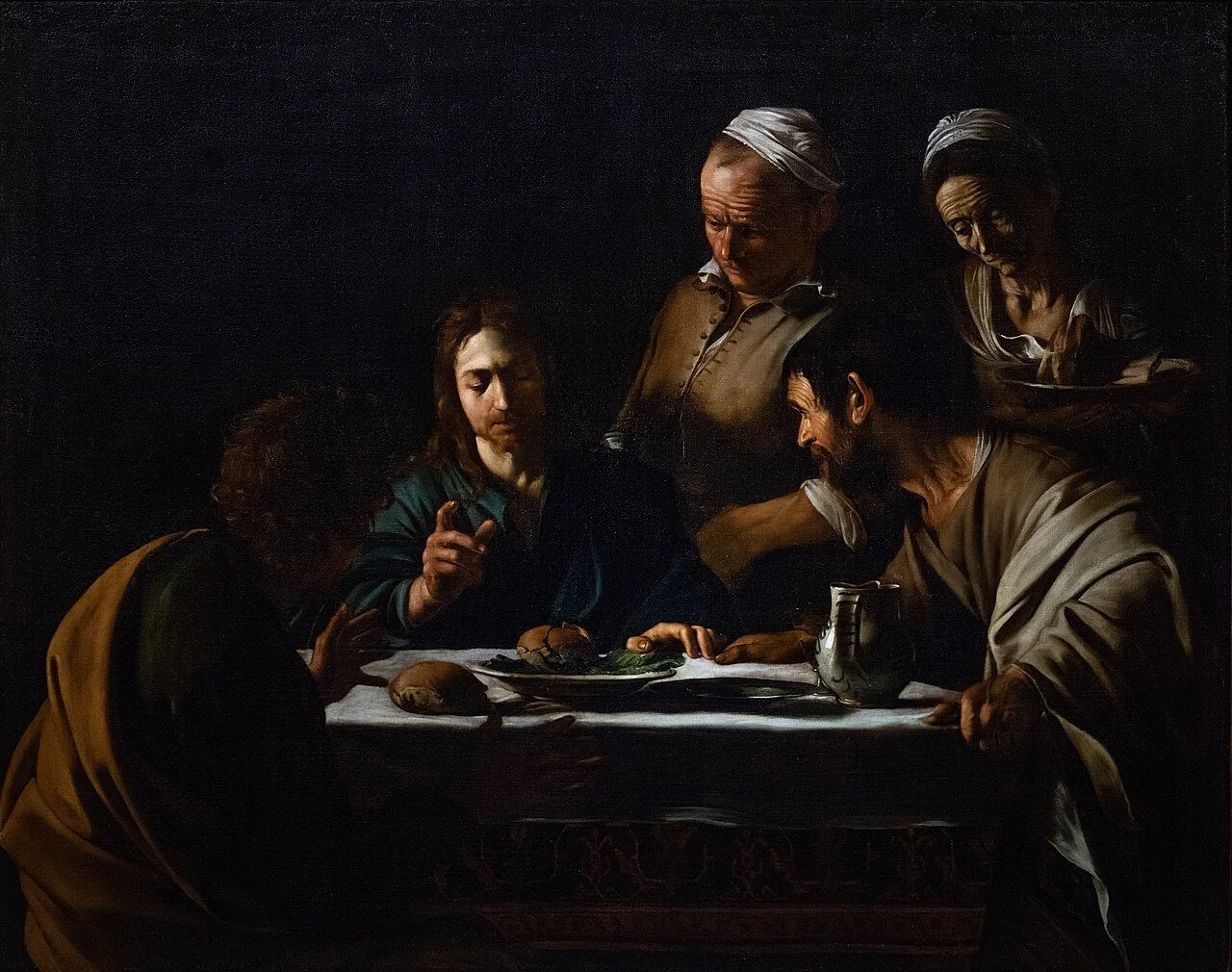
Caravaggio, Supper at Emmaus, 1606, Pinacoteca di Brera, Milan — the moment the disciples recognize Jesus.
“Like a weary child, I now want to rest
and I entrust my life to you.”
Pierluigi Banna - Awe, the Figure, Companionship: A Dialogue on the Heart of Christianity.
I. The Surprise That Defines the Christian
Not a habit, but a love that happens
Chiara. I'd like to start with the song we just heard. Have you ever had an extraordinary encounter in your life—one that changed you? And, if so, what was it like?
Don Pigi. On the holy card for my first Mass, I chose the phrase: "It is the Lord." Below it, I placed Caravaggio's painting of the disciples at Emmaus—the canvas now in the Pinacoteca di Brera, in Milan—caught at the very moment when they are taken by surprise and realize that the traveler is Jesus. In that surprise—John's exclamation by the lake, the burning hearts of the two who finally understand and ask themselves, "How could we not have recognized him?"—lies, for me, the essence of all Christianity. No one is a Christian except through that surprise and its continual recurrence: you open your eyes and discover him standing there in front of you, the love of your life.
If he is God-with-us, he is not far from our daily lives; yet what interests me most—and what I most often miss—is the surprise of seeing him here, alive. It is the difference, Pope Francis would say, between a person who is merely accustomed to something and a person who is in love. We can recite the Angelus a thousand times and go through the motions without anything stirring within us; or we can realize that Someone has come specifically for us, to seek us out, and then we cannot help but turn our faces toward him, to convert. Christianity is the proclamation of a present love that catches us off guard, and precisely for this reason it cannot be handed on except through an encounter. That is why, in order to speak to you about it, I cannot simply talk you into a tradition: I must retrace a history of encounters capable of piercing through my own perspective.
A teacher, a doubt, the northern lights
The first took place in Catania. It was a surprise around a table—just as it was for the two disciples on the road to Emmaus—the table of a teacher I looked up to, a woman everyone admired but who did not seem interested in me. A few days before my fourteenth birthday, I let slip a cynical remark: "You can't find true friends anymore." She stopped short. "How can you say something like that already?" Then she asked whether I had read Ibsen's Peer Gynt—as if a thirteen-year-old would have—and gave me a copy as a gift, telling me about the man who lives in the long darkness of the North until, after six months of gloom, the northern lights burst forth. "Who's to say," she told me, "that this doubt of yours isn't the darkness that's paving the way for a new possibility?" She put the whole dinner on hold for me; the next day, she wrote me a note reflecting on friendship.
She didn't resolve the issue; she didn't give me instructions: she simply reopened a possibility by taking an interest in me. That's why I call it an exceptional encounter. It is an encounter in which God makes himself present, because he meets you where you are and understands you completely, while at the same time taking you beyond your expectations; and yet he makes you feel at home, so much so that you think, "I've never found anything like this before, and I've always wanted it." If we don't want to reduce Christianity to a habit, we must keep returning to these encounters—never just one—in which love for his person is reborn. If I can say that I have encountered Christ, it is only because of the mysterious faithfulness with which such encounters have been repeated—not because of any merit of my own.
II. Why Say "It Is Jesus"
Neither deduction, nor tradition, nor morality
Lorenzo. These faces you've begun to name—from Catania to today—how do they speak of that One? I, too, encounter my mother, my friends, a thousand things that surprise me, and for the most part I simply say, "This is my mother." How is it that you, on the other hand, come to say, "This one who has set my heart ablaze is Jesus Christ"?
Don Pigi. Over time, I've discovered that it is not I who say this as the conclusion of a line of reasoning. I've studied logical deduction, and it doesn't get you there. Nor do I say it out of trust in a tradition, as if I were repeating it only because it has been repeated for two thousand years. And yet that tradition is precisely what I teach—patristics, the study of the Church Fathers—and I believe that nothing rivals Christianity for the greatness of its tradition, the beauty of its moral vision, or the astonishing rigor of its thought. And still, none of this is what makes me say, "It is Jesus." Because if we go back to the origins, and to every pinnacle Christianity has reached, it was not tradition, ritual, or morality that set a Saint John of the Cross—or, for me, a Don Giussani—ablaze.
Awe: mouth agape, heart open
Rather, it was something we all know from childhood: awe. We have all fallen in love; we have all experienced that encounter that made us feel at home. The problem is the next moment, when we are tempted to box the event into our own logic—like when, after meeting the teacher, I thought the next day, "I have to be with her," as if repeating the same dinners would repeat the spell. It doesn't work: the mystery of falling in love cannot be boiled down to a formula and run again. Rather than mastering it, reason allows itself to be swept away by this experience—what English speakers express with a simple "oh." This is what wonder is: not just an open mouth, but a heart and mind thrown open to something that is wholly present and is not you, while your entire being depends on what lies behind that face.
Ovid and St. John of the Cross: two ways of loving a figure
An image struck me as never before. On a recent trip to Greece with some fellow priests—priests far more learned than I am—we were reading, between one stop and the next, Ovid's Metamorphoses, which describes with great precision the dynamics of falling in love: one falls in love and immediately tries to capture the figure of the beloved. Apollo pursues Daphne to make her his own; but—and this is the great insight of a pagan—the very moment one tries to grasp the figure, it slips away, dissolves in one's hands, crumbles to dust. So it is with Narcissus and Echo: one seeks to possess, and in doing so, one loses.
Giuni Russo describes the opposite experience. She draws on St. John of the Cross—who in turn comments on the Song of Songs—and says, in essence: I do not want to make your image my own; I want your image to heal my pain. Here, wonder opens onto a further level, which is faith. I am so open to you that I understand I need you—not your ideas, but your presence—to understand myself; and the only path open to me is not to possess you, but to open myself to your being. It is at this level that the relationship with Christ enters into these exceptional encounters: not as a label to be affixed to them, but as the very depth of that wonder. Gregory of Nyssa said it long ago: the intellect, even the most refined, creates idols—things to be possessed. Only wonder truly knows, because only wonder opens us to a presence. Without it, faith shrinks into ideology.
III. Waiting and Faithfulness
Boredom, the infallible test
Chiara. I, too, have had that experience of wonder, and I wish it would happen to me again at every moment. But often, in my desire for it to return, I end up manufacturing it—and that bothers me. How do you live this waiting, without fabricating it with your own images?
Don Pigi. On the one hand, it's simple: all it takes—as Julián Carrón often reminds me—is to return to one of those encounters that brought us to faith, and to be true to ourselves. When you force the experience into your own ideas, you end up like Apollo, left holding a laurel branch: what good is that to him? We can rattle off rosaries and celebrate Masses, but are we truly recognizing a living presence? There is one infallible test, and that is boredom—the exact opposite of wonder, that suffocating feeling that everything is already determined by the limits of our expectations. All we need to do is be honest about that boredom to realize that we aren't truly opening ourselves up to the anticipation of something new.
Jesus' method: a question that unmasks
This is precisely what surprised me: that exceptional encounters—always signs of Christ's presence—have the power to provoke us to such honesty. In the Gospel, Jesus doesn't cut his disciples any slack, but he doesn't berate them either; he asks questions that unmask their closed-mindedness. "What are you looking for?" he asks the first two. "What did you go out to see?" he asks those who had run to the Baptist. And to the disciples in the boat who were anxious about the bread: "Why? How many loaves did I multiply last time?" If you were the Risen One and found two disheartened disciples, what would you do? He asks, "Why are you downcast?" There is such a love of freedom that this encounter always takes the form of a question—"And you, what did you see?"—and compels you to come to terms with the experience you have truly lived.
The field at sunset: looking at reality twice
Every time, in the presence of people like these, you discover that reality was greater than the way you had been reducing it. I was walking through the fields with a friend and said, "What a beautiful sunset." And he replied, "Take a second look. That light brown is a field lying fallow; that lighter brown is freshly plowed soil—do you see the tractor tracks? The darker corners are where the herbicide was applied, and the animals are returning to the barns after drinking." He was studying agriculture. But that's how we're roused from the narrowness of our expectations: by those who urge us to look again, more carefully, at precisely what we thought we were seeing. The more the years go by, the more I realize that we hardly look at anything and yet claim to have seen it all: certain things are hiding in plain sight, and we don't see them.
The anxiety of the thesis, and boundless tenderness
I experienced the same thing with Julián—another one of those encounters in which Jesus comes knocking at the door, saying, "I don't change my method; as I did with the apostles, so I do with you." I was about to finish my thesis and was driving him home; I confided in him that I didn't know how to square what I still had to do with what I was about to become. He replied, catching me off guard, "I'm the son of farmers; I don't understand such abstract talk." After a silence, I admitted, "In the morning, when I sit down to work on my thesis, I feel anxious because I'm afraid I won't make it." And he said, "Do you see how it takes you an hour to tell me the thing that's closest to your heart? Don't you have any tenderness toward yourself? Perhaps this anxiety is precisely the opportunity to ask yourself what you've learned over these five years."
He challenged me as no one ever had. Your self, your expectations, even your limitations—they are much more than what you've reduced them to; and that reality was not a problem to be dealt with, but an opportunity to rediscover those five years. He didn't write the thesis for me: he showed me the value of Christianity for life, which is to reopen our eyes to the mystery that you are and to the mystery at the heart of all things. That's why you can tell whether Christ has entered someone's heart by the sense of disproportion with which they stand before themselves and before reality: whatever you encounter, there is a certainty greater than yourself—there is Someone who is making it happen.
IV. Against Moralism: Are You What You Do, or Are You Made?
The bitter fruit of judgment
Lorenzo. You said that it's enough to be true to oneself. But is that an effort, a matter of skill? What is the crux of the matter, and what role does our freedom play? Why is it that, so often, we aren't true to ourselves out of fear?
Don Pigi. I believe we live in a society deeply marked by moralism: the claim that a person's worth consists in what they do, for better or for worse. All our efforts are directed toward determining whether we have acted well or poorly; and so we end up fearing the judgment of others more than anything else. When faced with our choices, we see ourselves as their consequence—"from now on, your life will be marked by that mistake"—and today, all it takes is a quick online search for a person to be labeled forever by their actions. Case closed. It's exactly the temptation described in Genesis: whoever wants to take control of the judgment of their own life ends up feeling judged more than ever. You've locked your self-judgment inside an action, believing you've become its master; and now that action condemns you—like someone who burns hours on social media and then writes himself off: "I'm a time-waster."
The great truth
But just as we're bent under this judgment, someone comes up behind us and says, "You're forgetting something. You say you're the result of your actions. But are you your own work, or are you a work? Are you what you do, or are you made?" Is it more evident that you've performed a right or wrong action, or that you are not self-made? It isn't even close. This face, this temperament, are a work you did not make—so much so that you would have wanted them to be different; and you continue to be created even when you make mistakes. We live in an optical illusion: we prefer the narrow perspective of our actions to the great truth that endures even in the face of our mistakes. This is what Jesus says: "While you reduce life to your own concerns, there is One who clothes the lilies and feeds the sparrows; and are you not, in his eyes, worth more than the lilies and the sparrows?" To have tenderness toward oneself is to recover that perspective. Chiara, you are made—and it's clear that right now you're not making yourself: do you want to start over from here, or keep seeing yourself as a consequence of your actions?
Who followed him most: freedom placed back in their hands
The most beautiful thing, Lorenzo, is that faced with this challenge, some are reborn and others get angry because their toy has been taken away. And who followed him most? It was those who were most true to their own need, the greatest sinners, those who knew they could not clothe themselves—those who saw their own powerlessness clearly. These clung to him, even to the point of drying his feet with their hair; the others looked at him with distaste. Freedom is challenged to the very end, precisely because he does not spare us the challenge, but places it back in our hands.
V. Crossing the Darkness: Companionship
"I entrust my life to you"
Chiara. In the face of wonder, it's easy to let myself be carried along; but when you provoked me about my anxiety, I froze, because I feared something bad might emerge from it. How do we get through even the hardest circumstances without getting stuck in that foreboding?
Don Pigi. The song from earlier contains a line I'd jotted down: "Like a weary child, I now want to rest and I entrust my life to you." Awe is reborn precisely where Julián invited me to look at my anxiety: in having encountered someone who isn't afraid of your anxiety and who restores to the center the certainty that you, in this very moment, are whole. It's like the father who enters the dark room where the child doesn't dare to go: the child says, "With him, I can," and finds a presence that doesn't take away the fear of the dark, but gives the child the certainty of who is walking beside him.
Testimonies: tugging at the Virgin Mary's skirt
Some testimonies have stayed with me. A young woman, facing an exam, prays with holy nerve: "Will you take responsibility for making me this way?"—and she faces her struggles without having to fix herself or shake off her fear, but knowing, like a child, whom to turn to. A mother, whose son is suffering a severe relapse of leukemia, told me, "I pray, and I know whom I'm asking. I'll keep asking Our Lady until I tear her skirt; and since she's modest and doesn't want it torn, sooner or later she'll listen to me." Without realizing it, she was echoing St. Anthony the Abbot, who explains that "the kingdom of God belongs to the bold": it belongs to those who, like a child who isn't the least bit shy, aren't afraid to tug at their father's sleeve until he listens. And another mother, who had lost a child, told me, "This lost motherhood is like a fire; my life is an extremely heavy cross, and yet from this pain a life so mysterious has been kindled that I do not want to fail it." It is on the strength of that exceptional experience that one enters every circumstance, as Don Giussani would say, "with a child who is certain and joyful."
The source of true companionship
My struggles pale in comparison to these, and it is precisely from them that I learn. But the certainty is the same: if you are there, I will face even the darkness. I do not fear those who throw my faults in my face: I enter every struggle, says the Letter to the Hebrews, surrounded by a cloud of witnesses, with my gaze fixed on Jesus. Without this love that fills us with wonder, all that remains is habit, ritual, morality, or fascinating intellectual systems that fail to convince life itself. We can only ask God to continue winning us back: with what Michelangelo, in his Rime, calls his "ineffable courtesy"—the unique method of winning us over while respecting our freedom, courting it like a lover.
And this never leaves you on your own: it is the source of true companionship. In a world that condemns individualism without knowing how to point the way out, your true friend is the one who introduces you to a relationship with this Father—as Julián did with me—constantly placing you before the evidence of a Father who, in this very moment, creates you and enables you to enter into every darkness. By following him, you discover that you are not alone, that many friends have gone ahead of you; and if, with humility, you look back, you see—unworthily—that others are following you as well, and that, through you, they are following him. This is Christian companionship.
Closing remarks
Lorenzo. Thank you, Don Pigi, for your friendship and for being with us. We threw out the questions we had prepared, because we knew you would amaze us. And you did.
Don Pigi. A sign that it is Another who amazes: otherwise, the amazement would be inexplicable.
-
Guarda qui.
«È il Signore»
Lo stupore, la figura, la compagnia: un dialogo sul cuore del cristianesimo
Incontro con don Pierluigi Banna
«Come un bambino stanco, ora voglio riposare
e lascio la mia vita a te.»
Giuni Russo, La sua figura
Nota di livello: versione editoriale pubblicabile. Il dialogo è organizzato in sezioni tematiche con titolo e sottotitoli; è rafforzata la coerenza concettuale e curato il ritmo stilistico, mantenendo la forma a domanda e risposta. Nessun contenuto è stato aggiunto: titoli e partizioni servono solo a chiarire la struttura del ragionamento già presente.
I. La sorpresa che fa il cristiano
Non un’abitudine, ma un amore che accade
Chiara. Vorrei partire dalla canzone che abbiamo appena ascoltato. Hai fatto, nella tua vita, un incontro eccezionale — un incontro che te l’ha cambiata? E, se sì, quali caratteristiche aveva?
Don Pigi. Sull’immaginetta della mia prima Messa ho scelto due parole: «è il Signore». Sotto avevo posto i discepoli di Emmaus dipinti da Caravaggio — la tela oggi a Brera — colti nell’istante in cui si sorprendono e riconoscono che quel viandante è Gesù. In quella sorpresa — l’esclamazione di Giovanni sul lago, il cuore ardente dei due che finalmente capisce e si chiede «come abbiamo fatto a non riconoscerlo?» — c’è per me il concentrato di tutto il cristianesimo. Non si è cristiani se non per quella sorpresa e per il suo continuo riaccadere: uno apre gli occhi e si scopre davanti a lui, davanti all’amore della vita.
Se è il Dio-con-noi, non è lontano dalle nostre giornate; eppure ciò che più mi interessa — e che spesso mi manca — è la sorpresa di vederlo qui, vivo. È la differenza, direbbe papa Francesco, tra una persona abituata e una persona innamorata. Possiamo recitare mille volte l’Angelus senza che nulla si muova in noi; oppure accorgerci che qualcuno è venuto proprio per noi, a cercarci, e allora siamo costretti a girare il volto, a convertirci. Il cristianesimo è l’annuncio di un amore presente che sorprende; e proprio per questo non può trasmettersi se non attraverso un incontro. Ecco perché, per parlartene, non posso convincerti di una tradizione: devo ripercorrere una storia di incontri capaci di trafiggere la mia posizione.
Catania: una professoressa, un dubbio, un’aurora boreale
Il primo risale a Catania. Fu una sorpresa attorno a un tavolo — come per i due di Emmaus — il tavolo di una professoressa che stimavo, apprezzata da tutti, ma che non mi pareva interessata a me. A pochi giorni dai miei quattordici anni lasciai cadere una battuta disincantata: «non si trovano più veri amici». Lei si fermò: «come fai già a dire una cosa simile?». Poi mi chiese se avessi letto il Peer Gynt di Ibsen — figuriamoci, a tredici anni — e me lo regalò, raccontandomi di quell’uomo che vive nel lungo buio del Nord finché, dopo sei mesi di oscurità, esplode l’aurora boreale. «Che ne sai — mi disse — che questo tuo dubbio non sia l’oscurità che prepara una nuova possibilità?». Bloccò l’intera cena per me; il giorno dopo mi scrisse un biglietto che tornava sull’amicizia.
Non risolse la questione, non mi diede istruzioni: riaprì una possibilità, semplicemente interessandosi a me. Ecco perché lo chiamo incontro eccezionale. È un incontro in cui Dio si fa presente, perché ti raggiunge e ti comprende fino in fondo e insieme ti porta oltre le tue previsioni; eppure ti fa sentire a casa, tanto che pensi: «non avevo mai trovato una cosa simile, e l’avrei sempre voluta». Se non vogliamo ridurre il cristianesimo a un’abitudine, dobbiamo tornare a questi incontri — mai uno soltanto — in cui rinasce l’amore per la sua figura. Se posso dire di aver incontrato Cristo, è solo per la fedeltà misteriosa con cui incontri simili si sono ripetuti: non per merito mio.
II. Perché dire «è Gesù»
Né deduzione, né tradizione, né morale
Lorenzo. Questi volti che hai cominciato a nominare, da Catania a oggi, come parlano di quell’unico? Anch’io incontro mia madre, i miei amici, mille cose che mi sorprendono, e per lo più dico soltanto: «questa è mia madre». Come mai tu arrivi a dire, invece: «questo che mi ha fatto ardere il cuore è Gesù Cristo»?
Don Pigi. Con il tempo ho scoperto che non sono io a dirlo come conclusione di un ragionamento. La deduzione logica l’ho studiata, e non muove nulla. E non lo dico neppure per fiducia in una tradizione, come se lo ripetessi solo perché lo si ripete da duemila anni. Eppure io insegno proprio quella tradizione — la patrologia, lo studio dei Padri — e credo che nulla, come il cristianesimo, possieda una tradizione tanto grande, una morale tanto entusiasmante, un pensiero di logica così strepitosa. E tuttavia non è nulla di tutto questo a farmi dire «è Gesù». Perché, se torniamo alle origini e a ogni vertice che il cristianesimo ha toccato, non sono stati la tradizione, il rito o la morale a far esplodere un san Giovanni della Croce — o, per me, un don Giussani.
Lo stupore: bocca aperta, cuore aperto
È stato piuttosto qualcosa che tutti, da bambini, conosciamo: lo stupore. Tutti ci siamo innamorati; tutti abbiamo vissuto quell’incontro che ci faceva sentire a casa. Il problema è l’istante successivo, quando si è tentati di rinchiudere l’evento dentro la propria logica — come quando, conosciuta la professoressa, il giorno dopo penso «devo stare con lei», quasi che ripetendo le stesse cene si ripetesse l’incantesimo. Non funziona: il mistero dell’innamoramento non si lascia incastrare in una formula da ripetere. Più che comprenderlo, la ragione si lascia trascinare da questa esperienza — quello che l’inglese dice con un semplice «oh». Lo stupore è questo: non solo bocca aperta, ma cuore e mente aperti a qualcosa che è tutto presente e non sei tu, mentre tutto il tuo essere dipende da ciò che sta dietro quel volto.
Ovidio e san Giovanni della Croce: due modi di amare una figura
Un’immagine mi ha colpito come non mai. In un recente viaggio in Grecia con alcuni confratelli — preti ben più dotti di me — leggevamo, tra una tappa e l’altra, le Metamorfosi di Ovidio, che descrive con precisione la dinamica dell’innamoramento: ci si innamora e subito si cerca di catturare la figura dell’amato. Apollo insegue Dafne per farla sua; ma — ed è la grande intuizione di un pagano — nell’istante in cui si cerca di afferrare la figura, questa sfugge, si smaterializza tra le mani, si sbriciola. Così Narciso con Eco: si pretende di possedere, e proprio così si perde.
Giuni Russo racconta l’esperienza opposta. Riprende san Giovanni della Croce — che a sua volta commenta il Cantico dei Cantici — e dice, in sostanza: non voglio fare mia la tua figura; voglio che la tua figura sani il mio dolore. Qui lo stupore apre a un livello ulteriore, che è la fede. Sono così aperto a te da capire che ho bisogno di te — non delle tue idee, ma della tua presenza — per comprendere me stesso; e l’unica via che ho non è possederti, ma aprirmi al tuo essere. È a questo livello che il rapporto con Cristo entra dentro gli incontri eccezionali: non come un marchio da apporvi sopra, ma come la profondità stessa di quello stupore. Gregorio di Nissa lo diceva già: l’intelletto, anche il più fine, genera idoli, cose da possedere. Solo lo stupore conosce davvero, perché solo lo stupore apre a una presenza. Senza di esso, la fede si riduce a ideologia.
III. L’attesa e la lealtà
La noia, test infallibile
Chiara. Anch’io ho fatto quell’esperienza di stupore, e vorrei che mi riaccadesse in ogni istante. Ma spesso, per il desiderio che torni, finisco per raccontarmela — e la cosa mi dà fastidio. Come vivi quest’attesa, senza fabbricarla con le tue immagini?
Don Pigi. Da un lato è semplice: basta avere — come mi ricorda spesso Julián Carrón — uno di quegli incontri che ci hanno generato alla fede; e basta essere leali con se stessi. Quando incastri l’esperienza nelle tue idee, «soffochi Apollo»: che cosa se ne fa, lui, di un ramo d’alloro? Possiamo sgranare rosari e celebrare messe: ma stiamo riconoscendo una presenza viva? C’è un test infallibile, ed è la noia — l’esatto opposto dello stupore, quel soffocamento per cui tutto è già determinato dal perimetro delle nostre previsioni. Basta essere leali con quella noia per capire che non ci stiamo davvero aprendo all’attesa di qualcosa di nuovo.
Il metodo di Gesù: una domanda che smaschera
Mi ha sorpreso proprio questo: che gli incontri eccezionali, sempre segni della presenza di Cristo, abbiano il potere di provocarci a tale lealtà. Nel Vangelo, Gesù non fa sconti ai discepoli e non li martella: pone domande che smascherano la loro chiusura. «Che cosa cercate?», ai primi due. «Che cosa siete andati a vedere?», a chi era corso dal Battista. E, ai discepoli che sulla barca si angustiano per il pane: «perché? quanti pani ho moltiplicato l’altra volta?». Se foste il Risorto e trovaste due discepoli affranti, che cosa fareste? Lui chiede: «perché siete tristi?». C’è un tale amore alla libertà che questo incontro si presenta sempre come una domanda — «tu, che cosa hai visto?» — e ti costringe a fare i conti con l’esperienza che hai davvero vissuto.
Il campo al tramonto: guardare due volte la realtà
Ogni volta, davanti a uomini così, scopri che la realtà era più grande di come la stavi riducendo. Camminavo nei campi con un amico e dissi: «che bel tramonto». E lui: «guarda meglio. Quel marroncino è un campo a riposo; quel marrone più chiaro è terra appena seminata — vedi le righe del trattore?; gli angoli più scuri sono il diserbante; e le bestie rientrano nelle stalle dopo aver bevuto». Faceva agraria. Ma è così che veniamo ridestati dalla chiusura dell’attesa: da chi ci spinge a riguardare, con più attenzione, proprio ciò che credevamo di vedere. Più passano gli anni, più mi accorgo che non guardiamo quasi nulla e pretendiamo di aver visto tutto: certe cose le abbiamo davanti, grandi come elefanti, e non le vediamo.
L’ansia della tesi, e una tenerezza sconfinata
Lo vidi con Julián — un altro di quegli incontri in cui Gesù viene a bussare alla porta dicendo: «io non cambio metodo; come con gli apostoli, faccio con te». Stavo per finire la tesi e lo accompagnavo in auto; gli confidai che non sapevo tenere insieme ciò che dovevo ancora fare e ciò che stavo per diventare. Mi rispose, spiazzandomi: «sono figlio di contadini, non capisco discorsi così astratti». Dopo un silenzio ammisi: «la mattina, davanti alla tesi, ho addosso un’ansia, perché temo di non farcela». E lui: «vedi che ci metti un’ora a dirmi la cosa che ti sta più a cuore? Non hai tenerezza verso te stesso? Forse quest’ansia è proprio l’occasione per chiederti che cosa hai imparato in questi cinque anni».
Mi rilanciò come non mai. Il tuo io, la tua attesa, perfino la tua riduzione, sono molto più di ciò a cui li hai ridotti; e quella realtà non era un problema da sbrigare, ma l’occasione per riscoprire quei cinque anni. Non scrisse la tesi al mio posto: mi mostrò la convenienza del cristianesimo per la vita, che è riaprire gli occhi sul mistero che sei e sul mistero in fondo a ogni cosa. Per questo capisci se Cristo è entrato nel cuore di qualcuno dal senso di sproporzione con cui sta davanti a sé e alla realtà: qualunque cosa incontri, c’è una certezza più grande di te — c’è Qualcuno che la sta facendo.
IV. Contro il moralismo: sei ciò che fai, o sei fatto?
Il frutto amaro del giudizio
Lorenzo. Dicevi che basta essere leali con se stessi. Ma è uno sforzo, una questione di bravura? Qual è il nocciolo, e che parte ha la nostra libertà? Perché, tante volte, per paura non siamo leali?
Don Pigi. Credo che viviamo in una società profondamente segnata dal moralismo: la pretesa di far consistere la persona in ciò che fa di buono o di cattivo. Tutti i nostri sforzi sono tesi a stabilire se abbiamo agito bene o male; e così finiamo per temere il giudizio altrui più di ogni cosa. Davanti alle nostre scelte ci consideriamo la loro conseguenza — «ormai la tua vita sarà segnata da quell’errore» — e oggi basta una ricerca in rete perché una persona resti catalogata per sempre dai suoi gesti. Spacciata. È esattamente la tentazione della Genesi: chi vuole impadronirsi del giudizio sulla propria vita finisce per sentirsi giudicato come non mai. Hai rinchiuso il giudizio su di te dentro un’azione, credendo di diventarne padrone; e ora quell’azione ti condanna — come chi perde ore sui social e poi si liquida: «sono un perditempo».
La grande evidenza
Ma proprio a noi, curvi sotto questo giudizio, qualcuno viene a bussare alle spalle: «stai dimenticando qualcosa. Dici di essere il frutto delle tue azioni. Ma tu sei la tua opera, o sei un’opera? Sei ciò che fai, o sei fatto?». È più evidente che hai compiuto un’azione giusta o sbagliata, o che non ti fai da te? Non c’è paragone. Questo volto, questo temperamento sono un’opera che non hai fatto — tanto che li avresti voluti diversi; e continui a essere generato anche quando sbagli. Viviamo in una distorsione ottica: preferiamo la prospettiva ridotta delle nostre azioni alla grande evidenza che resiste perfino ai nostri errori. È quanto dice Gesù: «mentre riducete la vita alle vostre preoccupazioni, c’è chi veste i gigli e nutre i passeri; e non valete, per lui, più dei gigli e dei passeri?». Avere tenerezza verso di sé è recuperare quello sguardo. Chiara, tu sei fatto — ed è evidente che in questo istante non ti fai da te: vuoi ripartire da qui, o continuare a guardarti come conseguenza delle tue azioni?
Chi lo seguì di più: la libertà rimessa nelle mani
La cosa più bella, Lorenzo, è che davanti a questa provocazione c’è chi rinasce e chi si arrabbia, perché gli si toglie il giocattolo. E chi lo seguì di più? Fu chi era più leale col proprio bisogno, il più peccatore, chi sapeva di non potersi vestire da sé — chi aveva la chiarezza della propria impotenza. Costoro gli si incollarono, fino ad asciugargli i piedi con i capelli; gli altri lo guardarono schizzinosi. La libertà è sfidata fino all’ultimo, proprio perché lui non ci sottrae alla sfida, ma ce la rimette nelle mani.
V. Attraversare il buio: la compagnia
«Lascio la mia vita a te»
Chiara. Di fronte allo stupore è facile lasciarsi attraversare; ma quando mi provocavi sull’ansia, io mi blocco, perché temo che ne emerga qualcosa di brutto. Come si attraversano anche le circostanze più dure senza fermarsi in quel presentimento?
Don Pigi. La canzone di prima dice una frase che mi ero annotato: «come un bambino stanco, ora voglio riposare e lascio la mia vita a te». Lo stupore rinasce proprio lì dove Julián mi invitava a guardare l’ansia: nell’aver incontrato qualcuno che non ha paura della tua ansia e rimette al centro la certezza che tu, in questo istante, sei fatto. È come il padre che entra nella stanza buia in cui il bambino non osa entrare: il bimbo dice «con lui posso», e trova una presenza che non gli toglie la paura del buio, ma gli dà la certezza di chi lo accompagna.
Testimoni: strappare la gonna alla Madonna
Alcune testimonianze mi hanno colpito. Una ragazza, davanti a una prova, prega con audacia sfrontata: «ti prenderai la responsabilità di avermi fatto così?» — e guarda le sue fatiche non dovendo mettersi a posto né togliersi la paura, ma sapendo, come un bambino, a chi rivolgersi. Una mamma, il cui figlio ha una grave recidiva di leucemia, mi diceva: «io prego, e so a chi chiedo. Chiederò alla Madonna fino a strapparle la gonna; e poiché è pudica e non se la vuole far strappare, prima o poi mi ascolterà». Senza saperlo, riprendeva sant’Antonio Abate, che spiega così «il regno di Dio è dei violenti»: è di chi non teme, come un figlio impertinente, di strattonare il padre finché non dà ascolto. E un’altra madre, che ha perso un figlio, mi ha detto: «questa maternità perduta è come un fuoco; la mia vita è una croce pesantissima, eppure da questo dolore si è accesa una vita così misteriosa a cui non voglio venir meno». È sull’onda di quell’eccezionalità che si entra in ogni circostanza, direbbe don Giussani, «con un bambino certo e lieto».
La sorgente della compagnia vera
Le mie fatiche non reggono il confronto con queste, e proprio da queste imparo. Ma con la stessa certezza: se tu ci sei, vado incontro anche al buio. Non temo chi mi accusa per le mie colpe: entro in ogni lotta, dice la Lettera agli Ebrei, circondato da una nube di testimoni, con lo sguardo fisso su Gesù. Senza questo amore che riempie di stupore restano solo abitudine, rito, morale, o sistemi intellettuali affascinanti che però non convincono la vita. Possiamo soltanto chiedere a Dio di continuare a riconquistarci: con quella che Michelangelo, nelle Rime, chiama la sua «ineffabile cortesia», il metodo unico di conquistare rispettando la libertà, corteggiandola come un amante.
E questo non ti lascia mai solo: è la sorgente della compagnia vera. In un mondo che denuncia l’individualismo senza saper indicare vie d’uscita, ti è davvero amico chi ti introduce al rapporto con questo padre — come Julián con me — rimettendoti ogni volta davanti all’evidenza di un padre che in questo istante ti fa e ti permette di entrare in ogni buio. Seguendolo, scopri di non essere solo, di avere molti amici davanti a te; e se, con umiltà, ti volti indietro, vedi — indegnamente — che altri seguono anche te, e che, attraverso te, stanno seguendo lui. Questa è la compagnia cristiana.
Congedo
Lorenzo. Grazie, don Pigi, della tua amicizia e di essere stato con noi. Avevamo cambiato le domande perché sapevamo che ci avresti stupiti. E così è stato.
Don Pigi. Segno che a stupire è un Altro: altrimenti lo stupore non si spiegherebbe.
Note non riviste dall'autore
-
«Es el Señor»
El asombro, la figura, la compañía: un diálogo sobre el corazón del cristianismo
Encuentro con don Pierluigi Banna
«Como un niño cansado, ahora quiero descansar
y te entrego mi vida».
Giuni Russo, Su figura
Nota editorial: versión editorial lista para su publicación. El diálogo se ha organizado en secciones temáticas con título y subtítulos; se ha reforzado la coherencia conceptual y se ha pulido el ritmo estilístico, manteniendo la forma de preguntas y respuestas. No se ha añadido ningún contenido: los títulos y las divisiones sirven únicamente para aclarar la estructura del razonamiento ya presente.
I. La sorpresa que experimenta el cristiano
No es una costumbre, sino un amor que surge
Chiara. Me gustaría partir de la canción que acabamos de escuchar. ¿Has tenido, en tu vida, un encuentro excepcional —un encuentro que te haya cambiado la vida? Y, si es así, ¿qué características tenía?
Don Pigi. En la estampa de mi primera misa elegí dos palabras: «Es el Señor». Debajo había colocado a los discípulos de Emaús pintados por Caravaggio —el lienzo se encuentra hoy en Brera— captados en el instante en que se sorprenden y reconocen que aquel caminante es Jesús. En esa sorpresa —la exclamación de Juan en el lago, el corazón ardiente de los dos que por fin comprenden y se preguntan «¿cómo es que no lo hemos reconocido?» —, ahí está para mí la esencia de todo el cristianismo. No se es cristiano sino por esa sorpresa y por su continuo repetirse: uno abre los ojos y lo descubre ante sí, ante el amor de la vida.
Si es el Dios-con-nosotros, no está lejos de nuestro día a día; sin embargo, lo que más me interesa —y lo que a menudo echo de menos— es la sorpresa de verlo aquí, vivo. Es la diferencia, diría el papa Francisco, entre una persona acostumbrada y una persona enamorada. Podemos recitar mil veces el Ángelus sin que nada se mueva en nuestro interior; o bien darnos cuenta de que alguien ha venido precisamente por nosotros, a buscarnos, y entonces nos vemos obligados a volver el rostro, a convertirnos. El cristianismo es el anuncio de un amor presente que sorprende; y precisamente por eso no puede transmitirse sino a través de un encuentro. Por eso, para hablarte de ello, no puedo convencerte de una tradición: debo repasar una historia de encuentros capaces de traspasar mi postura.
Catania: una profesora, una duda, una aurora boreal
El primero se remonta a Catania. Fue una sorpresa alrededor de una mesa —como les ocurrió a los dos de Emaús—, la mesa de una profesora a la que admiraba, apreciada por todos, pero que no parecía interesarse por mí. A pocos días de cumplir catorce años, solté un comentario desencantado: «Ya no se encuentran amigos de verdad». Ella se detuvo: «¿Cómo puedes decir ya algo así?». Luego me preguntó si había leído Peer Gynt de Ibsen —ni hablar, con trece años— y me lo regaló, contándome la historia de aquel hombre que vive en la larga oscuridad del norte hasta que, tras seis meses de tinieblas, estalla la aurora boreal. «¿Quién sabe —me dijo— si esa duda tuya no es precisamente la oscuridad que prepara una nueva posibilidad?». Interrumpió toda la cena por mí; al día siguiente me escribió una nota en la que volvía a hablar de la amistad.
No resolvió la cuestión, no me dio instrucciones: reabrió una posibilidad, simplemente interesándose por mí. Por eso lo llamo encuentro excepcional. Es un encuentro en el que Dios se hace presente, porque te alcanza y te comprende hasta lo más profundo y, al mismo tiempo, te lleva más allá de tus previsiones; y, sin embargo, te hace sentir como en casa, hasta el punto de que piensas: «Nunca había encontrado algo así, y siempre lo habría deseado». Si no queremos reducir el cristianismo a una costumbre, debemos volver a estos encuentros —nunca solo uno— en los que renace el amor por su figura. Si puedo decir que he encontrado a Cristo, es solo por la misteriosa fidelidad con la que se han repetido encuentros similares: no por mérito mío.
II. ¿Por qué decir «es Jesús»?
Ni deducción, ni tradición, ni moral
Lorenzo. Esos rostros que has empezado a nombrar, desde Catania hasta hoy, ¿cómo hablan de aquel único? Yo también me encuentro con mi madre, con mis amigos, con mil cosas que me sorprenden, y la mayoría de las veces solo digo: «esta es mi madre». ¿Cómo es que tú, en cambio, llegas a decir: «este que me ha hecho arder el corazón es Jesucristo»?
Don Pigi. Con el tiempo he descubierto que no soy yo quien lo dice como conclusión de un razonamiento. He estudiado la deducción lógica, y no aporta nada. Y tampoco lo digo por confianza en una tradición, como si lo repitiera solo porque se lleva repitiendo desde hace dos mil años. Y, sin embargo, yo enseño precisamente esa tradición —la patrología, el estudio de los Padres— y creo que nada, como el cristianismo, posee una tradición tan grande, una moral tan apasionante, un pensamiento de una lógica tan asombrosa. Y, sin embargo, no es nada de todo esto lo que me hace decir «es Jesús». Porque, si volvemos a los orígenes y a cada cumbre que ha alcanzado el cristianismo, no fueron la tradición, el rito ni la moral lo que hizo estallar a un san Juan de la Cruz —o, para mí, a un don Giussani—.
El asombro: boca abierta, corazón abierto
Fue más bien algo que todos, desde niños, conocemos: el asombro. Todos nos hemos enamorado; todos hemos vivido ese encuentro que nos hacía sentir como en casa. El problema es el instante siguiente, cuando uno se ve tentado a encerrar el acontecimiento dentro de su propia lógica —como cuando, tras conocer a la profesora, al día siguiente pienso «tengo que estar con ella», casi como si al repetir las mismas cenas se repitiera el hechizo. No funciona: el misterio del enamoramiento no se deja encasillar en una fórmula que se pueda repetir. Más que comprenderlo, la razón se deja llevar por esta experiencia —lo que en inglés se expresa con un simple «oh». El asombro es esto: no solo la boca abierta, sino el corazón y la mente abiertos a algo que lo abarca todo y que no eres tú, mientras todo tu ser depende de lo que hay detrás de ese rostro.
Ovidio y san Juan de la Cruz: dos formas de amar a una figura
Una imagen me ha impactado como nunca antes. En un reciente viaje a Grecia con algunos hermanos —sacerdotes mucho más eruditos que yo—, leíamos, entre una parada y otra, Las metamorfosis de Ovidio, que describe con precisión la dinámica del enamoramiento: uno se enamora e inmediatamente intenta capturar la figura del amado. Apolo persigue a Dafne para hacerla suya; pero —y esta es la gran intuición de un pagano— en el instante en que se intenta atrapar la figura, esta se escapa, se desmaterializa entre las manos, se desmorona. Así ocurre con Narciso y Eco: se pretende poseerla, y precisamente así se pierde.
Giuni Russo narra la experiencia opuesta. Retoma a san Juan de la Cruz —quien a su vez comenta el Cantar de los Cantares— y dice, en esencia: no quiero hacer mía tu figura; quiero que tu figura sane mi dolor. Aquí el asombro se abre a un nivel superior, que es la fe. Estoy tan abierto a ti que comprendo que te necesito —no tus ideas, sino tu presencia— para comprenderme a mí mismo; y el único camino que tengo no es poseerte, sino abrirme a tu ser. Es en este nivel donde la relación con Cristo se adentra en los encuentros excepcionales: no como una marca que hay que estampar sobre ellos, sino como la profundidad misma de ese asombro. Gregorio de Nisa ya lo decía: el intelecto, incluso el más refinado, genera ídolos, cosas que poseer. Solo el asombro conoce de verdad, porque solo el asombro se abre a una presencia. Sin él, la fe se reduce a ideología.
III. La espera y la lealtad
El aburrimiento, prueba infalible
Chiara. Yo también he vivido esa experiencia de asombro, y me gustaría que se repitiera en cada instante. Pero a menudo, por el deseo de que vuelva, acabo contándomela a mí misma —y eso me molesta. ¿Cómo vives esta espera, sin fabricarla con tus propias imágenes?
Don Pigi. Por un lado, es sencillo: basta con tener —como me recuerda a menudo Julián Carrón— uno de esos encuentros que nos han llevado a la fe; y basta con ser leal a uno mismo. Cuando encajas la experiencia en tus ideas, «sofocas a Apolo»: ¿qué va a hacer él con una rama de laurel? Podemos rezar rosarios y celebrar misas: pero ¿estamos reconociendo una presencia viva? Hay una prueba infalible, y es el aburrimiento —lo contrario exacto del asombro, esa opresión por la que todo está ya determinado por el perímetro de nuestras previsiones—. Basta con ser leales a ese aburrimiento para comprender que en realidad no nos estamos abriendo a la espera de algo nuevo.
El método de Jesús: una pregunta que desenmascara
Esto es precisamente lo que me ha sorprendido: que los encuentros excepcionales, siempre signos de la presencia de Cristo, tengan el poder de provocarnos a tal sinceridad. En el Evangelio, Jesús no hace concesiones a los discípulos ni les presiona: plantea preguntas que desenmascaran su cerrazón. «¿Qué buscáis?», a los dos primeros. «¿Qué habéis ido a ver?», a quienes habían acudido corriendo a ver al Bautista. Y, a los discípulos que en la barca se angustian por el pan: «¿Por qué? ¿Cuántos panes multipliqué la otra vez?». Si tú fueras el Resucitado y te encontraras con dos discípulos abatidos, ¿qué harías? Él pregunta: «¿Por qué estáis tristes?». Hay tal amor por la libertad que este encuentro se presenta siempre como una pregunta —«tú, ¿qué has visto?»— y te obliga a hacer balance de la experiencia que realmente has vivido.
El campo al atardecer: mirar dos veces la realidad
Cada vez, ante hombres así, descubres que la realidad era más grande de lo que la estabas reduciendo. Caminaba por los campos con un amigo y le dije: «Qué bonita puesta de sol». Y él: «Fíjate mejor. Ese tono marrón claro es un campo en reposo; ese marrón más claro es tierra recién sembrada —¿ves las marcas del tractor?—; los rincones más oscuros son el herbicida; y los animales vuelven a los establos después de haber bebido». Estudiaba agronomía. Pero así es como nos despierta el fin de la espera: gracias a quien nos empuja a volver a mirar, con más atención, precisamente lo que creíamos ver. Cuanto más pasan los años, más me doy cuenta de que casi no miramos nada y pretendemos haberlo visto todo: tenemos ciertas cosas delante, grandes como elefantes, y no las vemos.
La ansiedad de la tesis y una ternura sin límites
Lo vi con Julián —otro de esos encuentros en los que Jesús viene a llamar a la puerta diciendo: «No cambio de método; como hice con los apóstoles, así lo hago contigo». Estaba a punto de terminar la tesis y lo acompañaba en coche; le confesé que no sabía cómo conciliar lo que aún me quedaba por hacer y en lo que estaba a punto de convertirme. Me respondió, dejándome sin palabras: «Soy hijo de campesinos, no entiendo discursos tan abstractos». Tras un silencio, admití: «Por la mañana, frente a la tesis, me invade la ansiedad, porque temo no poder con ello». Y él: «¿Te das cuenta de que tardas una hora en decirme lo que más te preocupa? ¿No sientes ternura por ti mismo? Quizá esta ansiedad sea precisamente la ocasión para preguntarte qué has aprendido en estos cinco años».
Me lanzó un desafío como nunca antes. Tu yo, tu espera, incluso tu reducción, son mucho más de lo que tú has hecho de ellos; y esa realidad no era un problema que resolver, sino la ocasión para redescubrir esos cinco años. No escribió la tesis en mi lugar: me mostró la utilidad del cristianismo para la vida, que consiste en volver a abrir los ojos ante el misterio que eres y ante el misterio que hay en el fondo de todas las cosas. Por eso se comprende si Cristo ha entrado en el corazón de alguien por la sensación de desproporción con la que se presenta ante sí mismo y ante la realidad: sea lo que sea lo que encuentres, hay una certeza más grande que tú —hay Alguien que la está creando.
IV. Contra el moralismo: ¿eres lo que haces, o eres lo que eres?
El fruto amargo del juicio
Lorenzo. Decías que basta con ser leal a uno mismo. Pero, ¿es un esfuerzo, una cuestión de habilidad? ¿Cuál es el quid de la cuestión, y qué papel desempeña nuestra libertad? Porque, muchas veces, por miedo, no somos leales.
Don Pigi. Creo que vivimos en una sociedad profundamente marcada por el moralismo: la pretensión de que la persona se define por lo bueno o lo malo que hace. Todos nuestros esfuerzos se centran en determinar si hemos actuado bien o mal; y así acabamos temiendo el juicio ajeno más que nada. Ante nuestras decisiones, nos consideramos su consecuencia —«a partir de ahora tu vida quedará marcada por ese error»— y hoy basta con una búsqueda en Internet para que una persona quede catalogada para siempre por sus actos. Condenada. Es exactamente la tentación del Génesis: quien quiere hacerse con el control del juicio sobre su propia vida acaba sintiéndose juzgado como nunca. Has encerrado el juicio sobre ti mismo en una acción, creyendo convertirte en su dueño; y ahora esa acción te condena —como quien pierde horas en las redes sociales y luego se tacha a sí mismo: «soy un holgazán»—.
La gran evidencia
Pero precisamente a nosotros, encorvados bajo este juicio, alguien viene a tocarnos en la espalda: «te estás olvidando de algo. Dices que eres el fruto de tus acciones. ¿Pero eres tu tu propia obra, o eres una obra? ¿Eres lo que haces, o estás hecho?». ¿Es más evidente que hayas realizado una acción correcta o incorrecta, o que no te hayas hecho a ti mismo? No hay comparación. Este rostro, este temperamento son una obra que tú no has hecho —tanto es así que los habrías querido diferentes—; y sigues siendo creado incluso cuando te equivocas. Vivimos en una distorsión óptica: preferimos la perspectiva reducida de nuestras acciones a la gran evidencia que resiste incluso a nuestros errores. Es lo que dice Jesús: «Mientras reducís la vida a vuestras preocupaciones, hay quien viste a los lirios y alimenta a los gorriones; ¿y no valéis, para él, más que los lirios y los gorriones?». Tener ternura hacia uno mismo es recuperar esa mirada. Chiara, tú estás hecha —y es evidente que en este instante no te haces a ti misma—: ¿quieres volver a empezar desde aquí, o seguir viéndote como consecuencia de tus acciones?
Quién le siguió más: la libertad devuelta a las manos
Lo más bonito, Lorenzo, es que ante esta provocación hay quienes renacen y quienes se enfadan, porque les quitan el juguete. ¿Y quién le siguió más? Fueron los que se mostraron más fieles a su propia necesidad, los más pecadores, los que sabían que no podían vestirse por sí mismos —los que tenían clara su propia impotencia—. Estos se pegaron a él, hasta el punto de secarle los pies con el pelo; los demás lo miraron con repugnancia. La libertad se pone a prueba hasta el final, precisamente porque él no nos sustrae del desafío, sino que nos lo vuelve a poner en las manos.
V. Atravesar la oscuridad: la compañía
«Te entrego mi vida»
Chiara. Ante el asombro es fácil dejarse llevar; pero cuando me provocabas con la ansiedad, me bloqueaba, porque temía que surgiera algo malo. ¿Cómo se atraviesan incluso las circunstancias más duras sin quedarse estancado en ese presentimiento?
Don Pigi. La canción de antes dice una frase que me había apuntado: «como un niño cansado, ahora quiero descansar y te entrego mi vida». El asombro renace precisamente allí donde Julián me invitaba a mirar la ansiedad: en haber encontrado a alguien que no tiene miedo de tu ansiedad y que vuelve a poner en el centro la certeza de que tú, en este instante, estás hecho. Es como el padre que entra en la habitación a oscuras en la que el niño no se atreve a entrar: el niño dice «con él puedo», y encuentra una presencia que no le quita el miedo a la oscuridad, pero le da la certeza de quién le acompaña.
Testimonios: arrancarle la falda a la Virgen
Algunos testimonios me han llamado la atención. Una joven, ante un examen, reza con descarada audacia: «¿Te harás responsable de haberme hecho así?» — y afronta sus dificultades sin tener que arreglarse a sí misma ni quitarse el miedo, sino sabiendo, como un niño, a quién acudir. Una madre, cuyo hijo sufre una grave recaída de leucemia, me decía: «Rezo, y sé a quién le pido. Se lo pediré a la Virgen hasta arrancarle la falda; y como es pudorosa y no quiere que se la arranquen, tarde o temprano me escuchará». Sin saberlo, retomaba así las palabras de san Antonio Abad, quien explica que «el reino de Dios es de los violentos»: es de quienes no temen, como un hijo impertinente, tirar del padre hasta que les escuche. Y otra madre, que ha perdido a un hijo, me dijo: «Esta maternidad perdida es como un fuego; mi vida es una cruz muy pesada, y, sin embargo, de este dolor ha surgido una vida tan misteriosa a la que no quiero renunciar». Es en la estela de esa excepcionalidad como se afronta cada circunstancia, diría don Giussani, «con un niño seguro y alegre».
La fuente de la verdadera compañía
Mis esfuerzos no se pueden comparar con estos, y es precisamente de ellos de quienes aprendo. Pero con la misma certeza: si tú estás ahí, me adentro incluso en la oscuridad. No temo a quien me acusa por mis culpas: me lanzo a toda lucha, dice la Carta a los Hebreos, rodeado de una nube de testigos, con la mirada fija en Jesús. Sin este amor que llena de asombro, solo quedan la costumbre, el rito, la moral o sistemas intelectuales fascinantes que, sin embargo, no convencen a la vida. Solo podemos pedirle a Dios que siga reconquistándonos: con lo que Miguel Ángel, en las Rimas, llama su «inefable cortesía», el único método de conquistar respetando la libertad, cortejándola como un amante.
Y esto nunca te deja solo: es la fuente de la verdadera compañía. En un mundo que denuncia el individualismo sin saber señalar vías de salida, es verdaderamente tu amigo quien te introduce en la relación con este padre —como Julián conmigo—, poniéndote cada vez ante la evidencia de un padre que, en este instante, te hace y te permite entrar en cualquier oscuridad. Al seguirlo, descubres que no estás solo, que tienes muchos amigos delante de ti; y si, con humildad, miras atrás, ves —de forma indigna— que otros también te siguen a ti, y que, a través de ti, le están siguiendo a él. Esta es la compañía cristiana.
Despedida
Lorenzo. Gracias, don Pigi, por tu amistad y por haber estado con nosotros. Habíamos cambiado las preguntas porque sabíamos que nos sorprenderías. Y así ha sido.
Don Pigi. Signo de que quien sorprende es Otro: de lo contrario, el asombro no se explicaría.
-
« C’est le Seigneur »
L’émerveillement, la figure, la compagnie : un dialogue sur le cœur du christianisme
Rencontre avec don Pierluigi Banna
« Comme un enfant fatigué, je veux maintenant me reposer
et je te confie ma vie. »
Giuni Russo, Sa figure
Note de niveau : version éditoriale prête à être publiée. Le dialogue est organisé en sections thématiques avec titre et sous-titres ; la cohérence conceptuelle est renforcée et le rythme stylistique soigné, tout en conservant la forme question-réponse. Aucun contenu n’a été ajouté : les titres et les divisions servent uniquement à clarifier la structure du raisonnement déjà présent.
I. La surprise qui caractérise le chrétien
Non pas une habitude, mais un amour qui se manifeste
Chiara. J’aimerais partir de la chanson que nous venons d’écouter. As-tu fait, dans ta vie, une rencontre exceptionnelle — une rencontre qui t’a transformé ? Et, si oui, quelles étaient ses caractéristiques ?
Don Pigi. Sur l’image de ma première messe, j’ai choisi deux mots : « C’est le Seigneur ». En dessous, j’avais placé les disciples d’Emmaüs peints par le Caravage — la toile se trouve aujourd’hui à Brera — saisis à l’instant où ils sont surpris et reconnaissent que ce voyageur est Jésus. Dans cette surprise — l’exclamation de Jean au bord du lac, le cœur brûlant des deux qui comprennent enfin et se demandent « comment avons-nous pu ne pas le reconnaître ? » — se trouve pour moi l’essence même de tout le christianisme. On n’est chrétien que par cette surprise et par le fait qu’elle se renouvelle sans cesse : on ouvre les yeux et on le découvre devant soi, face à l’amour de la vie.
S’il est le Dieu-avec-nous, il n’est pas loin de notre quotidien ; pourtant, ce qui m’intéresse le plus — et qui me manque souvent —, c’est la surprise de le voir ici, vivant. C’est la différence, dirait le pape François, entre une personne habituée et une personne amoureuse. Nous pouvons réciter mille fois l’Angélus sans que rien ne bouge en nous ; ou bien nous rendre compte que quelqu’un est venu spécialement pour nous, à notre recherche, et alors nous sommes contraints de tourner notre visage vers lui, de nous convertir. Le christianisme est l’annonce d’un amour présent qui surprend ; et c’est précisément pour cela qu’il ne peut se transmettre que par une rencontre. Voilà pourquoi, pour t’en parler, je ne peux pas te convaincre d’une tradition : je dois retracer une histoire de rencontres capables de bouleverser ma position.
Catane : une professeure, un doute, une aurore boréale
La première remonte à Catane. Ce fut une surprise autour d’une table — comme pour les deux disciples d’Emmaüs —, la table d’une professeure que j’estimais, appréciée de tous, mais qui ne semblait pas s’intéresser à moi. À quelques jours de mes quatorze ans, j’ai laissé échapper une remarque désabusée : « On ne trouve plus de vrais amis. » Elle s’est interrompue : « Comment peux-tu déjà dire une chose pareille ? ». Puis elle m’a demandé si j’avais lu Peer Gynt d’Ibsen — bien sûr que non, à treize ans — et me l’a offert, en me racontant l’histoire de cet homme qui vit dans la longue nuit du Nord jusqu’à ce que, après six mois d’obscurité, l’aurore boréale éclate. « Qui sait — m’a-t-elle dit — si ce doute qui t’habite n’est pas justement l’obscurité qui prépare une nouvelle possibilité ? ». Elle a interrompu tout le dîner pour moi ; le lendemain, elle m’a écrit un petit mot qui revenait sur l’amitié.
Il n’a pas résolu la question, il ne m’a pas donné d’instructions : il a rouvert une possibilité, simplement en s’intéressant à moi. C’est pourquoi j’appelle cela une rencontre exceptionnelle. C’est une rencontre où Dieu se rend présent, car il vient à ta rencontre et te comprend jusqu’au plus profond de toi-même, tout en t’emmenant au-delà de tes prévisions ; et pourtant, il te fait te sentir chez toi, à tel point que tu penses : « Je n’avais jamais trouvé quelque chose de semblable, et je l’aurais toujours voulu. » Si nous ne voulons pas réduire le christianisme à une habitude, nous devons revenir à ces rencontres — jamais une seule — où renaît l’amour pour sa personne. Si je peux dire que j’ai rencontré le Christ, c’est uniquement grâce à la fidélité mystérieuse avec laquelle de telles rencontres se sont répétées : ce n’est pas mon mérite.
II. Pourquoi dire « c’est Jésus »
Ni déduction, ni tradition, ni morale
Lorenzo. Ces visages que tu as commencé à nommer, de Catane à aujourd’hui, comment parlent-ils de cet unique ? Moi aussi, je rencontre ma mère, mes amis, mille choses qui me surprennent, et la plupart du temps, je me contente de dire : « C’est ma mère ». Comment se fait-il que tu en arrives à dire, au contraire : « Celui qui a fait brûler mon cœur, c’est Jésus-Christ » ?
Don Pigi. Avec le temps, j’ai découvert que ce n’est pas moi qui le dis comme conclusion d’un raisonnement. J’ai étudié la déduction logique, et elle ne mène à rien. Et je ne le dis pas non plus par confiance en une tradition, comme si je le répétais simplement parce qu’on le répète depuis deux mille ans. Et pourtant, j’enseigne justement cette tradition — la patrologie, l’étude des Pères — et je crois que rien, comme le christianisme, ne possède une tradition aussi grande, une morale aussi enthousiasmante, une pensée d’une logique aussi époustouflante. Et pourtant, ce n’est rien de tout cela qui me fait dire « c’est Jésus ». Car, si nous revenons aux origines et à chaque sommet que le christianisme a atteint, ce ne sont pas la tradition, le rite ou la morale qui ont fait naître un saint Jean de la Croix — ou, pour moi, un don Giussani.
L’émerveillement : bouche bée, cœur ouvert
C’était plutôt quelque chose que nous connaissons tous, depuis notre enfance : l’émerveillement. Nous sommes tous tombés amoureux ; nous avons tous vécu cette rencontre qui nous faisait nous sentir chez nous. Le problème, c’est l’instant suivant, quand on est tenté d’enfermer l’événement dans sa propre logique — comme lorsque, après avoir fait la connaissance de la professeure, je me dis le lendemain « je dois être avec elle », presque comme si le fait de répéter les mêmes dîners faisait renaître la magie. Cela ne fonctionne pas : le mystère du coup de foudre ne se laisse pas enfermer dans une formule à répéter. Plutôt que de le comprendre, la raison se laisse emporter par cette expérience — ce que l’anglais exprime par un simple « oh ». L’émerveillement, c’est cela : non seulement la bouche ouverte, mais aussi le cœur et l’esprit ouverts à quelque chose qui est tout entier présent et qui n’est pas toi, tandis que tout ton être dépend de ce qui se cache derrière ce visage.
Ovide et saint Jean de la Croix : deux façons d’aimer un personnage
Une image m’a frappé comme jamais auparavant. Lors d’un récent voyage en Grèce avec quelques confrères — des prêtres bien plus érudits que moi —, nous lisions, d’une étape à l’autre, les Métamorphoses d’Ovide, qui décrivent avec précision la dynamique du coup de foudre : on tombe amoureux et on cherche aussitôt à capturer la figure de l’être aimé. Apollon poursuit Daphné pour la faire sienne ; mais — et c’est là la grande intuition d’un païen — à l’instant même où l’on tente de saisir la figure, celle-ci s’échappe, se dématérialise entre nos mains, s’effrite. Il en va de même pour Narcisse et Écho : on prétend posséder, et c’est précisément ainsi qu’on perd.
Giuni Russo raconte l’expérience inverse. Elle reprend saint Jean de la Croix — qui, à son tour, commente le Cantique des Cantiques — et dit, en substance : je ne veux pas faire mienne ta silhouette ; je veux que ta silhouette guérisse ma douleur. Ici, l’émerveillement ouvre la voie à un niveau supérieur, qui est la foi. Je suis tellement ouvert à toi que je comprends que j’ai besoin de toi — non pas de tes idées, mais de ta présence — pour me comprendre moi-même ; et la seule voie qui s’offre à moi n’est pas de te posséder, mais de m’ouvrir à ton être. C’est à ce niveau que la relation avec le Christ s’inscrit dans ces rencontres exceptionnelles : non pas comme une étiquette à apposer dessus, mais comme la profondeur même de cet émerveillement. Grégoire de Nysse le disait déjà : l’intellect, même le plus fin, engendre des idoles, des choses à posséder. Seul l’émerveillement connaît véritablement, car seul l’émerveillement ouvre à une présence. Sans lui, la foi se réduit à une idéologie.
III. L’attente et la loyauté
L’ennui, test infaillible
Chiara. Moi aussi, j’ai vécu cette expérience d’émerveillement, et j’aimerais qu’elle se reproduise à chaque instant. Mais souvent, par désir qu’elle revienne, je finis par me la raconter — et cela m’agace. Comment vis-tu cette attente, sans la fabriquer avec tes propres images ?
Don Pigi. D’un côté, c’est simple : il suffit d’avoir — comme me le rappelle souvent Julián Carrón — l’une de ces rencontres qui nous ont fait naître à la foi ; et il suffit d’être fidèle à soi-même. Quand tu enfermes l’expérience dans tes idées, « tu étouffes Apollon » : que ferait-il, lui, d’une branche de laurier ? Nous pouvons égrener des chapelets et célébrer des messes : mais reconnaissons-nous pour autant une présence vivante ? Il existe un test infaillible, et c’est l’ennui — l’exact opposé de l’émerveillement, cette étouffante impression que tout est déjà déterminé par le périmètre de nos prévisions. Il suffit d’être honnête face à cet ennui pour comprendre que nous ne nous ouvrons pas vraiment à l’attente de quelque chose de nouveau.
La méthode de Jésus : une question qui démasque
C’est précisément cela qui m’a surpris : que les rencontres exceptionnelles, toujours signes de la présence du Christ, aient le pouvoir de nous pousser à une telle loyauté. Dans l’Évangile, Jésus ne fait pas de concessions aux disciples et ne les martèle pas : il pose des questions qui démasquent leur fermeture. « Que cherchez-vous ? », aux deux premiers. « Qu’êtes-tu allé voir ? », à celui qui s’était précipité vers le Baptiste. Et, aux disciples qui, sur la barque, s’inquiètent pour le pain : « Pourquoi ? Combien de pains ai-je multipliés la dernière fois ? ». Si vous étiez le Ressuscité et que vous trouviez deux disciples abattus, que feriez-vous ? Lui, il demande : « Pourquoi êtes-vous tristes ? ». Il y a un tel amour de la liberté que cette rencontre se présente toujours comme une question — « toi, qu’as-tu vu ? » — et t’oblige à faire le point sur l’expérience que tu as réellement vécue.
Le champ au coucher du soleil : regarder deux fois la réalité
À chaque fois, face à de tels hommes, tu découvres que la réalité était plus grande que ce à quoi tu la réduisais. Je me promenais dans les champs avec un ami et j’ai dit : « Quel beau coucher de soleil ! ». Et lui : « Regarde mieux. Ce brun foncé, c’est un champ en jachère ; ce brun plus clair, c’est de la terre qui vient d’être ensemencée — tu vois les traces du tracteur ? ; les coins plus sombres, c’est le désherbant ; et les bêtes rentrent dans les étables après avoir bu ». Il faisait des études d’agronomie. Mais c’est ainsi que nous sommes tirés de l’engourdissement de l’attente : par ceux qui nous poussent à regarder à nouveau, avec plus d’attention, précisément ce que nous croyions voir. Plus les années passent, plus je me rends compte que nous ne regardons presque rien et que nous prétendons avoir tout vu : certaines choses sont devant nous, grandes comme des éléphants, et nous ne les voyons pas.
L’angoisse de la thèse, et une tendresse sans limites
Je l’ai vu avec Julián — une autre de ces rencontres où Jésus vient frapper à la porte en disant : « Je ne change pas de méthode ; comme avec les apôtres, je fais de même avec toi ». J’étais sur le point de terminer ma thèse et je l’accompagnais en voiture ; je lui ai confié que je ne parvenais pas à concilier ce qu’il me restait à faire et ce que j’étais sur le point de devenir. Il m’a répondu, me prenant au dépourvu : « Je suis fils de paysans, je ne comprends pas ces discours si abstraits. » Après un silence, j’ai admis : « Le matin, face à ma thèse, je suis envahi par l’angoisse, car j’ai peur de ne pas y arriver. » Et lui : « Tu vois, ça te prend une heure pour me dire ce qui te tient le plus à cœur ? N’as-tu donc aucune tendresse pour toi-même ? Peut-être que cette angoisse est justement l’occasion de te demander ce que tu as appris au cours de ces cinq années. »
Il m’a relancé comme jamais auparavant. Ton moi, ton attente, voire ta réduction, sont bien plus que ce à quoi tu les as réduits ; et cette réalité n’était pas un problème à régler, mais l’occasion de redécouvrir ces cinq années. Il n’a pas rédigé ma thèse à ma place : il m’a montré l’utilité du christianisme pour la vie, qui consiste à rouvrir les yeux sur le mystère que tu es et sur le mystère qui se cache au fond de chaque chose. C’est pourquoi tu comprends si le Christ est entré dans le cœur de quelqu’un à travers le sentiment de disproportion avec lequel il se tient face à lui-même et à la réalité : quoi que tu rencontres, il y a une certitude plus grande que toi — il y a Quelqu’un qui la réalise.
IV. Contre le moralisme : es-tu ce que tu fais, ou es-tu fait ?
Le fruit amer du jugement
Lorenzo. Tu disais qu’il suffit d’être loyal envers soi-même. Mais est-ce un effort, une question d’habileté ? Quel en est le cœur, et quel rôle joue notre liberté ? Pourquoi, si souvent, par peur, ne sommes-nous pas loyaux ?
Don Pigi. Je crois que nous vivons dans une société profondément marquée par le moralisme : la prétention de réduire la personne à ce qu’elle fait de bien ou de mal. Tous nos efforts visent à déterminer si nous avons bien ou mal agi ; et ainsi, nous finissons par craindre le jugement des autres plus que tout. Face à nos choix, nous nous considérons comme leur conséquence — « désormais, ta vie sera marquée par cette erreur » — et aujourd’hui, il suffit d’une recherche sur Internet pour qu’une personne soit cataloguée à jamais par ses actes. Condamnée. C’est exactement la tentation de la Genèse : celui qui veut s’approprier le jugement sur sa propre vie finit par se sentir jugé comme jamais auparavant. Tu as enfermé le jugement sur toi-même dans une action, croyant en devenir le maître ; et maintenant, cette action te condamne — comme celui qui perd des heures sur les réseaux sociaux et qui finit par se dire : « Je suis un bon à rien ».
La grande évidence
Mais c’est justement à nous, courbés sous ce jugement, que quelqu’un vient frapper dans le dos : « Tu oublies quelque chose. Tu dis que tu es le fruit de tes actions. Mais es-tu ton œuvre, ou es-tu une œuvre ? Es-tu ce que tu fais, ou es-tu fait ? ». Est-il plus évident que tu aies accompli une action juste ou erronée, ou que tu ne te fasses pas toi-même ? Il n’y a pas de comparaison. Ce visage, ce tempérament sont une œuvre que tu n’as pas faite — à tel point que tu les aurais voulus différents ; et tu continues d’être engendré même lorsque tu te trompes. Nous vivons dans une distorsion optique : nous préférons la perspective réductrice de nos actions à la grande évidence qui résiste même à nos erreurs. C’est ce que dit Jésus : « Tandis que vous réduisez la vie à vos préoccupations, il y a celui qui habille les lys et nourrit les moineaux ; et ne valez-vous pas, à ses yeux, plus que les lys et les moineaux ? ». Avoir de la tendresse envers soi-même, c’est retrouver ce regard. Chiara, tu es faite — et il est évident qu’en cet instant, tu ne te fais pas toi-même : veux-tu repartir d’ici, ou continuer à te considérer comme la conséquence de tes actions ?
Qui l’a le plus suivi : la liberté remise entre les mains
Le plus beau, Lorenzo, c’est que face à cette provocation, il y a ceux qui renaissent et ceux qui se mettent en colère, parce qu’on leur enlève leur jouet. Et qui l’a le plus suivi ? Ce sont ceux qui étaient les plus fidèles à leur propre besoin, les plus pécheurs, ceux qui savaient qu’ils ne pouvaient pas s’habiller seuls — ceux qui avaient la lucidité de leur propre impuissance. Ceux-là se sont collés à lui, jusqu’à lui sécher les pieds avec leurs cheveux ; les autres l’ont regardé avec dédain. La liberté est mise au défi jusqu’au bout, précisément parce qu’il ne nous soustrait pas à ce défi, mais nous la remet entre les mains.
V. Traverser les ténèbres : la compagnie
« Je te confie ma vie »
Chiara. Face à l’émerveillement, il est facile de se laisser traverser ; mais quand tu me provoquais sur l’angoisse, je me bloquais, car je craignais qu’il en ressorte quelque chose de mauvais. Comment traverser même les circonstances les plus dures sans s’arrêter à ce pressentiment ?
Don Pigi. La chanson de tout à l’heure contient une phrase que j’avais notée : « comme un enfant fatigué, je veux maintenant me reposer et je te confie ma vie ». L’émerveillement renaît précisément là où Julián m’invitait à regarder l’angoisse : dans le fait d’avoir rencontré quelqu’un qui n’a pas peur de ton angoisse et qui remet au centre la certitude que toi, en cet instant, tu es fait. C’est comme le père qui entre dans la pièce sombre où l’enfant n’ose pas pénétrer : l’enfant dit « avec lui, j’y arrive », et trouve une présence qui ne lui enlève pas sa peur du noir, mais lui donne la certitude de celui qui l’accompagne.
Témoignages : arracher la jupe de la Vierge Marie
Certains témoignages m’ont marqué. Une jeune fille, face à une épreuve, prie avec une audace effrontée : « Tu vas assumer la responsabilité de m’avoir faite comme ça ? » — et elle affronte ses difficultés sans avoir à se ressaisir ni à se débarrasser de sa peur, mais en sachant, comme un enfant, vers qui se tourner. Une maman, dont le fils souffre d’une grave récidive de leucémie, me disait : « Je prie, et je sais à qui je m’adresse. Je supplierai la Vierge Marie jusqu’à lui arracher sa jupe ; et comme elle est pudique et ne veut pas qu’on la lui arrache, tôt ou tard elle m’écoutera ». Sans le savoir, elle reprenait les paroles de saint Antoine l’Abbé, qui explique ainsi que « le royaume de Dieu appartient aux violents » : il appartient à ceux qui n’ont pas peur, comme un enfant impertinent, de tirer sur la manche de leur père jusqu’à ce qu’il les écoute. Et une autre mère, qui a perdu un enfant, m’a dit : « Cette maternité perdue est comme un feu ; ma vie est une croix très lourde, et pourtant, de cette douleur s’est allumée une vie si mystérieuse à laquelle je ne veux pas renoncer. » C’est dans le sillage de cette exceptionnalité que l’on aborde chaque circonstance, dirait don Giussani, « avec un enfant sûr et joyeux ».
La source de la véritable compagnie
Mes efforts ne tiennent pas la comparaison avec ceux-là, et c’est justement d’eux que j’apprends. Mais avec la même certitude : si tu es là, j’avance même dans l’obscurité. Je ne crains pas ceux qui m’accusent de mes fautes : j’entre dans chaque combat, dit la Lettre aux Hébreux, entouré d’une nuée de témoins, le regard fixé sur Jésus. Sans cet amour qui remplit d’émerveillement, il ne reste que l’habitude, le rituel, la morale, ou des systèmes intellectuels fascinants qui, pourtant, ne convainquent pas la vie. Nous ne pouvons que demander à Dieu de continuer à nous reconquérir : avec ce que Michel-Ange, dans les Rimes, appelle sa « courtoisie ineffable », la seule méthode pour conquérir en respectant la liberté, en la courtisant comme un amant.
Et cela ne te laisse jamais seul : c’est la source de la véritable compagnie. Dans un monde qui dénonce l’individualisme sans savoir indiquer d’issues, celui qui t’introduit à la relation avec ce Père — comme Julián l’a fait avec moi — en te remettant à chaque fois face à l’évidence d’un Père qui, en cet instant, te façonne et te permet d’entrer dans toute obscurité, est vraiment ton ami. En le suivant, tu découvres que tu n’es pas seul, que tu as de nombreux amis devant toi ; et si, avec humilité, tu te retournes, tu vois — indigne que tu sois — que d’autres te suivent aussi, et que, à travers toi, ils le suivent lui. Telle est la compagnie chrétienne.
Conclusion
Lorenzo. Merci, don Pigi, pour ton amitié et pour avoir été parmi nous. Nous avions modifié les questions car nous savions que tu allais nous surprendre. Et c’est ce qui s’est passé.
Don Pigi. Signe que c’est un Autre qui surprend : sinon, l’étonnement ne s’expliquerait pas.