Pope Leo and Human Dignity
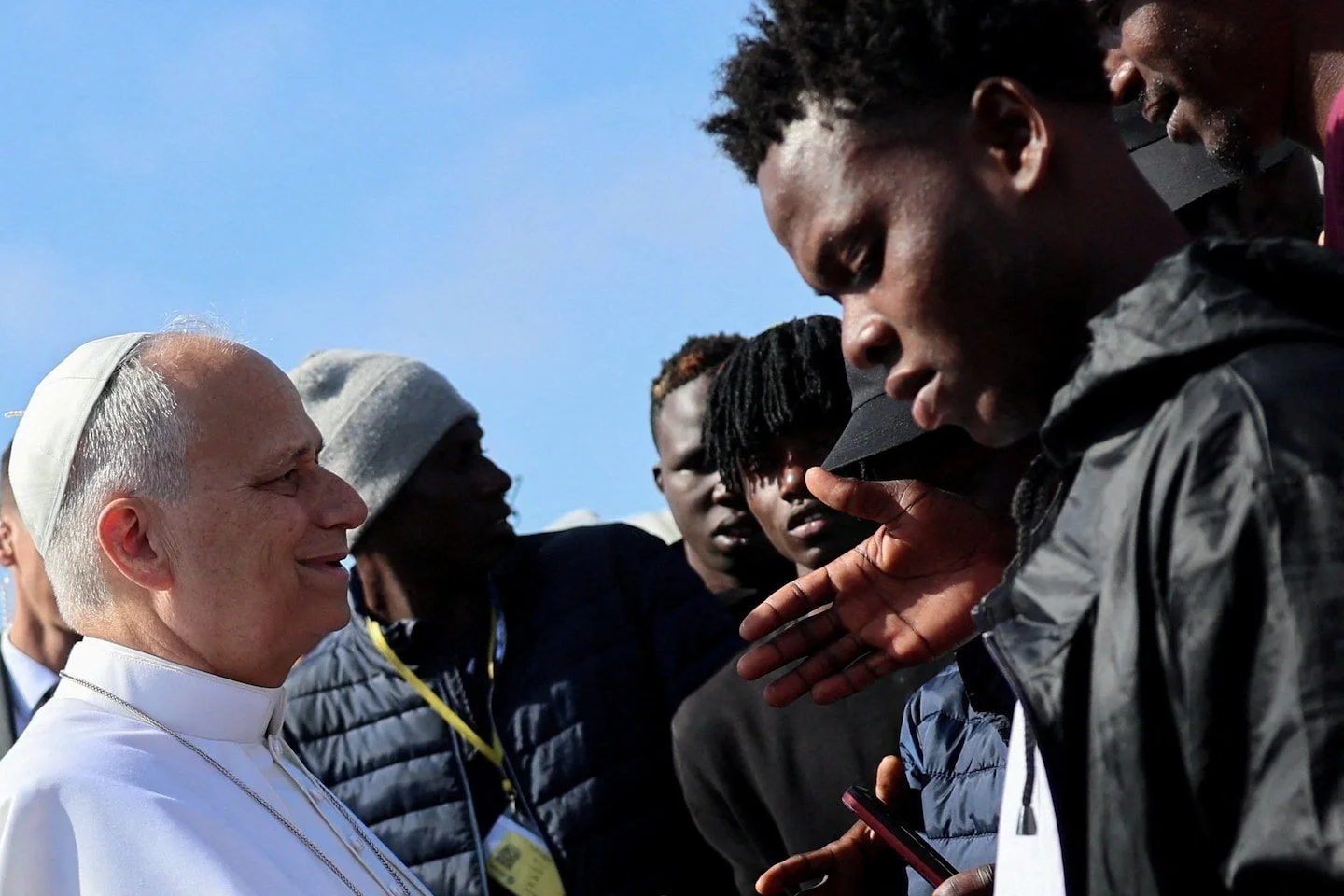
Pope Leo XIV stands face to face with migrants during his visit to Spain, in an image that captures the article’s themes of human dignity, encounter, compassion, listening, and the Church’s non-imposing witness.
“A Presence that does not impose itself is the witness most to the point for the problems of our time.”
Julián Carrón - We are republishing Julián Carrón’s article from Corriere della Sera on the occasion of Leone XIV’s visit to Spain.
The singular tenderness with which Jesus bent down over the dignity of the men and women of his time could be, today, a pious memory of the past. By now, only the echo of a pious memory. It would be no more than a fairy tale—were it not that we see that same gaze happen again. Were it not happening in our own time. Were it not that the need to seek him still persists in the human heart—those crowds, so mixed, who came running, caught off guard by the “unforeseen” of a visit.
We had it before our eyes for a week, in the days of Leo XIV’s intense journey through Spain. In one encounter after another, in the words—and in the gestures that filled those words with meaning. The gestures made the words happen.
The reach of the witness the Pope gives us lies entirely in the disarming way he is present. How he carried himself at every turn of the visit is a challenge to the Church, to the whole world. And Leo XIV challenges us through the way he looks at reality: in those days, even with the plainest gestures, he uncovered—behind the analyses, behind the hottest issues in public debate—the face of the human person.
In the headlong rush to settle what counts as “human,” as anthropological definitions multiply and the alarms sound over a history that is crumbling faster and faster, the Pope catches us all off balance: he stops in front of the human person. He reveals the person by looking at him.
“The affirmation of human dignity cannot remain abstract,” he told the Spanish Parliament. And he said it to everyone by choosing to “bow down” before the dignity of each person—as he did with the migrants in Tenerife—without changing his method in front of politicians and artists, nonbelievers, bishops, the young. We watched a man affirm dignity by recognizing the longing that stirs in exactly these plural, secularized societies of ours: “Many men and women of our time do not simply reject God; often they carry in their hearts a deep thirst for meaning, for truth, for belonging, and for hope, even when they cannot give it a name.” Not through generic appeals, which would leave us powerless, but by drawing us in with his own heart, alive to the other’s need, he showed us what he takes to be the task handed to us: “The Catholic Church stands at the service of this thirst of the human heart. Not by imposing, but through the witness of the Gospel.”
A Presence that does not impose itself—however paradoxical that sounds today—is the witness most to the point for the problems of our time. For the wrenching reality of migration, for the many strains of our multicultural societies, for the deepest forms of loneliness, for the polarizations, the divisions, the sovereigntist and authoritarian temptations, the conflicts past counting. Because without “recognizing the desire of the human person,” without “listening to it with respect,” without discovering the priceless worth of what the other brings us—his history, his wound, his faith, his culture—there is no way to grasp what is unique in the person, much less to give an answer equal to the challenges.
So we can no longer take for granted how real change comes about. To see it, we need only step inside the Pope’s gaze. A gaze that starts from concrete need and arrives at the fullness without which there is no intervention, no solution to the problems, no success that can truly change a life. A Presence that came “for the sick, not the healthy,” that seeks the heart of the human person and wakes it again to its most radical need. Like Jesus, it knows that “man does not live by bread alone.” He told the Spanish bishops: “Even when she offers material aid, education, assistance, or human development, the Church never stops offering what is her own: the love of God revealed in Christ. […] So every act of Christian charity born of the Gospel carries within it a greater promise—to give the person back the certainty of being loved.”
To serve the dignity of the person is, first of all, to recognize that the person is made with a boundless need. “Amid the joys, the successes, and the defeats, we realize we need another water to quench a deeper thirst. Our desire for truth and for happiness needs a wider horizon. And this restlessness is a gift God himself has given us: we are made to the measure of the infinite.”
And again: “It is in this world that we must cultivate the restlessness, not in some other one.” Cultivate it, and “make room for it.”
What regard for the way we are made—and for freedom. Knowing what he shares, the “treasure” of faith, the Pope offers it to human freedom and reason. He submits it to them, so that anyone searching for an answer to live by can weigh whether it measures up, among the countless hypotheses on hand.
What Leo XIV bore witness to is the decisive key to the life of the Church. The Pope is not frightened by the complexity of our society; he asked us instead to “learn not to deny it, and to inhabit it as a blessing.” He is convinced this complexity is crucial for showing what is original about Christianity. Christianity does not need a particular setting as its precondition. We forget, often, that Jesus did not enter history in a situation any simpler than ours. What is at stake—today as then—is the nature of Christianity itself. It is not a power, not an inspiration, not a list of rites and formulas, not a set of social or ethical recipes too small for the challenge. It is an encounter you can verify and touch, one that carries inside it a possible answer to the irreducibility of the human person, to the search that irreducibility sets loose. A gaze that demands nothing and shares the gift it has received.
Only by going on receiving this gaze, only out of gratitude for this gift, can an openness and a gratuitousness none of us could engineer come to be. Leo XIV was awaited and welcomed—by the people in the streets and by the seven-minute ovation from the members of parliament. So that this does not stay an emotion, so that none of it resets to zero, the way forward is simple: each of us can go along with the way of looking at reality we see in him. It seems like almost nothing. It is everything. Looking at the Pope challenges, like nothing else, the mindset we are steeped in—the one that “always tends,” as Don Giussani said, “to subsume particulars under an abstract universal. The new mindset, by contrast, is not born from a process of analytical deduction starting from certain principles or criteria that are then applied, but from An Event, from something that has happened and that is happening.”
-
Le sfide di Leone per la dignità umana
Julián Carrón
L’articolo sul Corriere della sera qui.
Ripubblichiamo dal Corriere della Sera l'articolo di Julián Carrón in occasione della visita di Leone XIV in Spagna.conelpapa.es
La commozione unica con cui Gesù si è piegato sulla dignità degli uomini e delle donne del suo tempo potrebbe essere oggi un devoto ricordo del passato. Anzi, ormai solo l’eco di un devoto ricordo. Sarebbe soltanto una favola, se non fosse per il fatto di veder riaccadere quello stesso sguardo. Se non fosse contemporaneo. E se nel cuore dell’uomo non persistesse il bisogno di cercarlo — quelle folle, così variegate, accorse, sorprese dall’«imprevisto» di una visita.
Lo abbiamo avuto davanti agli occhi per una settimana, nei giorni dell’intenso viaggio di Leone XIV in Spagna. Nel susseguirsi degli incontri, delle parole — e dei gesti, che hanno riempito quelle parole di significato. Le hanno fatte succedere.
La portata della testimonianza che il Papa ci dona è tutta nella modalità disarmante della sua presenza. Il modo in cui si è posto, in ogni frangente della visita, è una sfida alla Chiesa, al mondo intero. E Leone XIV ci sfida attraverso il suo sguardo sulla realtà: in quei giorni, anche con gesti semplicissimi, ha svelato — dietro alle analisi e ai temi più brucianti del dibattito pubblico — il volto dell’uomo.
Nella corsa impellente a stabilire cosa è «umano», nel moltiplicarsi delle definizioni antropologiche e degli allarmi di fronte allo sgretolarsi della storia che accelera, il Papa ci spiazza tutti, perché si ferma davanti all’uomo. Lo rivela, guardandolo.
«L’affermazione della dignità umana non può rimanere astratta», ha detto al Parlamento spagnolo. E lo ha comunicato a tutti volendosi «inchinare» sulla dignità di ogni persona, come ha fatto con i migranti a Tenerife, e senza cambiare metodo davanti a politici e artisti, non credenti, vescovi, giovani. Abbiamo visto un uomo affermare la dignità riconoscendo l’anelito che vibra proprio nelle nostre società plurali e secolarizzate: «Molti uomini e donne del nostro tempo non rifiutano semplicemente Dio, spesso portano nel cuore una profonda sete di senso, di verità, di appartenenza e di speranza, anche quando non sanno darle un nome». Non attraverso appelli generici, che ci lascerebbero impotenti, ma coinvolgendoci con il suo cuore vibrante davanti al bisogno dell’altro, ci ha mostrato quello che per lui è il compito che ci è affidato: «La Chiesa cattolica è al servizio di questa sete del cuore umano. Non in forma impositiva, ma con la testimonianza evangelica».
Una presenza che non si impone — per quanto oggi possa sembrare paradossale — è la testimonianza più pertinente ai problemi del nostro tempo. Al drammatico fenomeno delle migrazioni, alle tante difficoltà delle nostre società multiculturali, alle solitudini più profonde, alle polarizzazioni, le divisioni, le tentazioni sovraniste e autoritarie, i conflitti che non si contano. Perché senza «riconoscere il desiderio dell’uomo», senza «ascoltarlo con rispetto», e senza scoprire il valore inestimabile della ricchezza che l’altro ci porta — con la sua storia, la sua ferita, la sua fede, la sua cultura — non è possibile cogliere la natura unica della persona, tanto meno dare una risposta all’altezza delle sfide.
Per questo, non possiamo più dare per scontato come accade il vero cambiamento. Per capirlo basta immedesimarsi nello sguardo del Papa. Uno sguardo che parte dal bisogno concreto per arrivare a quella pienezza senza la quale non c’è intervento, non c’è soluzione ai problemi, non c’è successo, che possa veramente cambiare la vita. Una presenza venuta «per i malati, non per i sani», che cerca il cuore dell’uomo, e lo ridesta al suo bisogno più radicale. Come Gesù, sa che «non di solo pane vive l’uomo». Lo ha detto ai Vescovi spagnoli: «Persino quando offre aiuto materiale, istruzione, assistenza o promozione umana, la Chiesa non smette mai di offrire ciò che le è proprio: l’amore di Dio rivelato in Cristo. […] Così ogni gesto di carità cristiana che nasce dal Vangelo porta in sé una promessa più grande: restituire alla persona la convinzione di essere amata».
Servire la dignità della persona è, innanzitutto, riconoscere questo suo essere fatta con una esigenza sconfinata. «Tra le gioie, i successi e le sconfitte, ci rendiamo conto che abbiamo bisogno di un’altra acqua per dissetarci più profondamente. Il nostro desiderio di verità e di felicità ha bisogno di un orizzonte più ampio. E questa inquietudine è un dono che Dio stesso ci ha dato: siamo fatti su misura per l’infinito».
E ancora: «È in questo mondo che dobbiamo coltivare l’inquietudine, non in un altro». Coltivarla e «farle spazio».
Che stima per come siamo fatti! E per la libertà. Consapevole del dono che condivide, del «tesoro» della fede, il Papa lo propone alla libertà e alla ragione dell’uomo: ad esse lo sottomette, perché chiunque sia alla ricerca di una risposta per vivere possa valutare se è all’altezza, in mezzo alla miriade di ipotesi a disposizione.
Quello che Leone XIV ci ha testimoniato è la chiave decisiva per la vita della Chiesa. Il Papa non si spaventa della complessità della nostra società, anzi ha chiesto di «imparare a non negarla e ad abitarla come benedizione». È convinto che questa complessità sia cruciale per mostrare l’originalità del cristianesimo. Non ha bisogno, come condizione, di un contesto particolare. Spesso dimentichiamo che Gesù non è venuto nella storia in una situazione meno complessa della nostra. La posta in gioco — oggi come allora — è la natura stessa del cristianesimo. Non è un potere, né un’ispirazione, un elenco di riti e formule o ricette sociali, etiche, inadeguate all’altezza della sfida. Ma un incontro sperimentabile, toccabile, che porta dentro un’ipotesi di risposta alla irriducibilità dell’uomo, alla ricerca che essa scatena. Uno sguardo che non pretende nulla, ma condivide il dono ricevuto.
Solo continuando a ricevere questo sguardo, solo per la gratitudine di questo dono, possono nascere una apertura e una gratuità impensabili. Leone XIV è stato atteso e accolto, dalla gente per le strade come dai sette minuti di applauso dei parlamentari. Perché questo non resti un’emozione, perché tutto non si azzeri, il cammino è semplice: ciascuno può assecondare lo sguardo sulla realtà che vediamo in lui. Sembra poco. È tutto. Guardare il Papa sfida come nient’altro la mentalità in cui siamo immersi che «tende sempre — diceva don Giussani — a sussumere i particolari all’interno di un universale astratto. La mentalità nuova, invece, non nasce per un processo di deduzione analitica a partire da certi principi o criteri che poi si applicano, ma da un avvenimento, da qualcosa che è successo e che accade».
-
Los retos de León en defensa de la dignidad humana
Julián Carrón
La conmoción única con la que Jesús se inclinó sobre la dignidad de los hombres y mujeres de su tiempo hoy podría ser un piadoso recuerdo del pasado. Menos: solo el eco de un piadoso recuerdo. Sería solo una fábula si aquella mirada no fuese contemporánea, si no viéramos que vuelve a suceder; y si en el corazón del hombre no persistiera la necesidad de buscarla- como esas multitudes tan variadas que acudían, sorprendidas por el «imprevisto» de una visita-.Hemos tenido esa mirada ante nuestros ojos durante una semana, en los días del intenso viaje de León XIV a España: en la sucesión de encuentros, de palabras y de gestos, que han llenado esas palabras de significado y que han hecho que acontecieran.
Todo el alcance del testimonio que el Papa nos ofrece reside en la modalidad desarmante de su presencia. Su modo de estar ante cada momento de la visita constituye un desafío para la Iglesia y para el mundo entero. León XIV nos desafía a través de su mirada sobre la realidad: durante esos días, incluso en gestos sencillísimos, ha revelado el rostro del hombre que hay detrás de los análisis y de los temas más candentes del debate público.
En la exigente carrera por establecer qué es «humano», en la proliferación de definiciones antropológicas y de alarmas ante el desmoronamiento de una historia que se acelera, el Papa nos desconcierta a todos porque se detiene ante el hombre. Lo revela mirándolo.
«La afirmación de la dignidad humana no puede permanecer en un plano abstracto», dijo ante el Parlamento español. Y lo comunicó a todos queriendo «inclinarse» ante la dignidad de cualaquier persona, como hizo con los migrantes en Tenerife, sin cambiar de método ante políticos y artistas, no creyentes, obispos o ante los jóvenes. Hemos visto a un hombre afirmar la dignidad al reconocer el anhelo que vibra precisamente en nuestras sociedades plurales y secularizadas: «Muchos hombres y mujeres de nuestro tiempo no rechazan simplemente a Dios; con frecuencia llevan en el corazón una profunda sed de sentido, de verdad, de pertenencia y de esperanza, aunque no sepan darle un nombre». Lo ha hecho no mediante llamamientos genéricos, que nos dejarían impotentes, sino implicándonos con su corazón que vibra ante la necesidad del otro. Nos ha mostrado cuál es, para él, la tarea que se nos ha confiado: «La Iglesia católica está al servicio de esta sed del corazón humano. No de manera impositiva, sino mediante el testimonio evangélico».
El testimonio más pertinente para los problemas de nuestro tiempo es una presencia que no se impone —por paradójico que hoy pueda parecer— ante el dramático fenómeno de las migraciones, las muchas dificultades de nuestras sociedades multiculturales, las soledades más profundas, las polarizaciones, las divisiones, las tentaciones soberanistas y autoritarias, y los innumerables conflictos. Porque sin «reconocer el deseo del hombre», sin «escucharlo con respeto» y sin descubrir el valor inestimable de la riqueza que el otro nos aporta —con su historia, su herida, su fe y su cultura—, no es posible captar la naturaleza única de la persona, y mucho menos ofrecer una respuesta a la altura de los desafíos.
Por eso, ya no podemos dar por supuesto cómo se produce el verdadero cambio. Para comprenderlo basta con identificarse con la mirada del Papa. Una mirada que parte de la necesidad concreta para llegar a esa plenitud sin la cual no existe acción, no hay solución a los problemas ni éxito alguno que pueda cambiar verdaderamente la vida.
Es una presencia que ha venido «para los enfermos y no para los sanos», que busca el corazón del hombre y lo despierta en su necesidad más radical. Como Jesús, sabe que «no solo de pan vive el hombre». Así se lo dijo a los obispos españoles: «Incluso cuando ofrece ayuda material, educación, asistencia o promoción humana, la Iglesia nunca deja de ofrecer aquello que le es propio: el amor de Dios revelado en Cristo. […] De este modo, cada gesto de caridad cristiana que nace del Evangelio lleva en sí una promesa más grande: devolver a la persona la convicción de que es amada».
Servir a la dignidad de la persona es, ante todo, reconocer que está hecha con una exigencia ilimitada. «Entre las alegrías, los éxitos y las derrotas, nos damos cuenta de que necesitamos otra agua para saciar más profundamente nuestra sed. Nuestro deseo de verdad y de felicidad necesita un horizonte más amplio. Y esta inquietud es un don que Dios mismo nos ha dado: estamos hechos a la medida del infinito».
Y añadía: « Debemos cultivar la inquietud en este mundo es donde, no en otro». Cultivarla y «hacerle espacio».
¡Qué estima por nuestra condición humana! Y qué estima por la libertad. El Papa, consciente del don que comparte, del «tesoro» de la fe, lo propone a la libertad y a la razón del hombre: a estas lo somete para que cualquiera que busque una respuesta para vivir pueda juzgar si, entre la miríada de hipótesis disponibles, está a la altura.
Lo que León XIV nos ha testimoniado es la clave decisiva para la vida de la Iglesia. El Papa no se asusta ante la complejidad de nuestra sociedad; al contrario, ha pedido «aprender a no negarla y a habitarla como una bendición». Está convencido de que esta complejidad es crucial para mostrar la originalidad del cristianismo. No necesita, como condición previa, un contexto particular. A menudo olvidamos que Jesús no vino a la historia en una situación menos compleja que la nuestra.
Lo que está en juego —hoy como entonces— es la naturaleza misma del cristianismo. No es un poder, ni una inspiración, ni una lista de ritos y fórmulas, ni recetas sociales o éticas incapaces de responder a la magnitud del desafío. Es, en cambio, un encuentro que puede experimentarse y tocarse, que lleva consigo una hipótesis de respuesta a la irreductibilidad del hombre y a la búsqueda que esta suscita. Una mirada que no pretende nada, que comparte el don recibido.
Solo cuando se continua recibiendo esta mirada, solo desde la gratitud por este don, pueden nacer una apertura y una gratuidad impensables. A León XIV le han esperado y acogido tanto la gente en las calles como el aplauso de siete minutos de los parlamentarios.
Para que todo no quede reducido a una emoción, para que todo quede en nada, el camino es sencillo: todos podemos secundar la mirada sobre la realidad que vemos en él. Parece poco. Es todo.
Mirar al Papa desafía, como pocas cosas, la mentalidad en la que estamos inmersos, una mentalidad que «tiende siempre —decía don Giussani— a subsumir lo particular dentro de un universal abstracto. La mentalidad nueva, en cambio, no nace de un proceso de deducción analítica a partir de ciertos principios o criterios que luego se aplican, sino de un acontecimiento, de algo que ha sucedido y que sigue sucediendo».
El artículo en el Corriere della sera aquí.
-
Les défis de Léon XIV pour la dignité humaine
Julián Carrón
Nous republions, tiré du Corriere della Sera, l’article de Julián Carrón à l’occasion de la visite de Léon XIV en Espagne.conelpapa.es
L’émotion unique avec laquelle Jésus s’est penché sur la dignité des hommes et des femmes de son temps pourrait aujourd’hui n’être qu’un souvenir pieux du passé. Ou plutôt, désormais, seulement l’écho d’un souvenir pieux. Ce ne serait qu’un conte de fées, si ce n’était le fait de voir ce même regard réapparaître. S’il n’était pas contemporain. Et si, au cœur de l’homme, ne persistait pas le besoin de le rechercher — ces foules, si hétéroclites, accourues, surprises par l’« imprévu » d’une visite.
Nous l’avons eu sous les yeux pendant une semaine, au cours du voyage intense de Léon XIV en Espagne. Dans la succession des rencontres, des paroles — et des gestes, qui ont donné tout leur sens à ces paroles. Qui les ont fait s’enchaîner.
La portée du témoignage que le Pape nous offre réside entièrement dans le caractère désarmant de sa présence. La manière dont il s’est comporté, à chaque instant de la visite, est un défi lancé à l’Église, au monde entier. Et Léon XIV nous met au défi à travers son regard sur la réalité : ces jours-là, même par des gestes des plus simples, il a révélé — au-delà des analyses et des thèmes les plus brûlants du débat public — le visage de l’homme.
Dans cette course effrénée pour définir ce qui est « humain », dans la multiplication des définitions anthropologiques et des alertes face à l’effritement accéléré de l’histoire, le Pape nous déconcerte tous, car il s’arrête devant l’homme. Il le révèle, en le regardant.
« L’affirmation de la dignité humaine ne peut rester abstraite », a-t-il déclaré devant le Parlement espagnol. Et il l’a fait savoir à tous en voulant « s’incliner » devant la dignité de chaque personne, comme il l’a fait avec les migrants à Ténérife, et sans changer de méthode face aux responsables politiques et aux artistes, aux non-croyants, aux évêques, aux jeunes. Nous avons vu un homme affirmer la dignité en reconnaissant l’aspiration qui vibre au cœur même de nos sociétés plurielles et sécularisées : « Beaucoup d’hommes et de femmes de notre temps ne rejettent pas simplement Dieu ; souvent, ils portent dans leur cœur une soif profonde de sens, de vérité, d’appartenance et d’espoir, même lorsqu’ils ne savent pas lui donner un nom. » Ce n’est pas par des appels généraux, qui nous laisseraient impuissants, mais en nous impliquant avec son cœur vibrant face au besoin de l’autre, qu’il nous a montré ce qui, pour lui, est la mission qui nous est confiée : « L’Église catholique est au service de cette soif du cœur humain. Non pas de manière imposante, mais par le témoignage évangélique ».
Une présence qui ne s’impose pas — aussi paradoxal que cela puisse paraître aujourd’hui — est le témoignage le plus pertinent face aux problèmes de notre temps. Face au phénomène dramatique des migrations, aux nombreuses difficultés de nos sociétés multiculturelles, aux solitudes les plus profondes, aux polarisations, aux divisions, aux tentations souverainistes et autoritaires, aux conflits innombrables. Car sans « reconnaître le désir de l’homme », sans « l’écouter avec respect », et sans découvrir la valeur inestimable de la richesse que l’autre nous apporte — avec son histoire, sa blessure, sa foi, sa culture —, il n’est pas possible de saisir la nature unique de la personne, et encore moins d’apporter une réponse à la hauteur des défis.
C’est pourquoi nous ne pouvons plus tenir pour acquis la manière dont s’opère le véritable changement. Pour le comprendre, il suffit de se mettre à la place du Pape. Un regard qui part du besoin concret pour aboutir à cette plénitude sans laquelle il n’y a pas d’intervention, pas de solution aux problèmes, pas de réussite, qui puisse véritablement changer la vie. Une présence venue « pour les malades, non pour les bien portants », qui cherche le cœur de l’homme et le réveille à son besoin le plus radical. Comme Jésus, elle sait que « l’homme ne vit pas seulement de pain ». Il l’a dit aux évêques espagnols : « Même lorsqu’elle offre une aide matérielle, une éducation, une assistance ou une promotion humaine, l’Église ne cesse jamais d’offrir ce qui lui est propre : l’amour de Dieu révélé en Christ. […] Ainsi, chaque geste de charité chrétienne qui naît de l’Évangile porte en lui une promesse plus grande encore : redonner à la personne la conviction d’être aimée ».
Servir la dignité de la personne, c’est avant tout reconnaître qu’elle est faite d’un besoin sans limites. « Entre les joies, les succès et les échecs, nous nous rendons compte que nous avons besoin d’une autre eau pour étancher notre soif plus profondément. Notre désir de vérité et de bonheur a besoin d’un horizon plus vaste. Et cette inquiétude est un don que Dieu lui-même nous a fait : nous sommes faits sur mesure pour l’infini ».
Et encore : « C’est dans ce monde-ci que nous devons cultiver l’inquiétude, pas dans un autre ». La cultiver et « lui faire de la place ».
Quelle estime pour ce que nous sommes ! Et pour la liberté. Conscient du don qu’il partage, du « trésor » de la foi, le Pape le propose à la liberté et à la raison de l’homme : il le soumet à celles-ci, afin que quiconque soit en quête d’une réponse pour vivre puisse évaluer s’il est à la hauteur, parmi la myriade d’hypothèses disponibles.
Ce dont Léon XIV nous a témoigné est la clé décisive pour la vie de l’Église. Le Pape ne se laisse pas intimider par la complexité de notre société ; au contraire, il a demandé « d’apprendre à ne pas la nier et à l’habiter comme une bénédiction ». Il est convaincu que cette complexité est cruciale pour montrer l’originalité du christianisme. Elle n’a pas besoin, comme condition préalable, d’un contexte particulier. Nous oublions souvent que Jésus n’est pas venu dans l’histoire dans une situation moins complexe que la nôtre. L’enjeu — aujourd’hui comme alors — est la nature même du christianisme. Ce n’est ni un pouvoir, ni une inspiration, ni une liste de rites et de formules, ni des recettes sociales ou éthiques, inadaptées à la hauteur du défi. Mais une rencontre que l’on peut vivre, toucher, et qui porte en elle une hypothèse de réponse à l’irréductibilité de l’homme, à la quête qu’elle déclenche. Un regard qui ne prétend rien, mais qui partage le don reçu.
Ce n’est qu’en continuant à recevoir ce regard, ce n’est que par la gratitude pour ce don, qu’une ouverture et une gratuité inimaginables peuvent naître. Léon XIV a été attendu et accueilli, tant par la foule dans les rues que par les sept minutes d’applaudissements des parlementaires. Pour que cela ne reste pas une simple émotion, pour que tout ne retombe pas à zéro, le chemin est simple : chacun peut se laisser guider par le regard qu’il porte sur la réalité que nous voyons en lui. Cela semble peu. C’est tout. Regarder le Pape remet en question comme rien d’autre la mentalité dans laquelle nous sommes plongés et qui « tend toujours — disait don Giussani — à subsumer les détails dans un universel abstrait. La nouvelle mentalité, en revanche, ne naît pas d’un processus de déduction analytique partant de certains principes ou critères que l’on applique ensuite, mais d’un événement, de quelque chose qui s’est produit et qui se produit ».
