No Other Method Than Experience
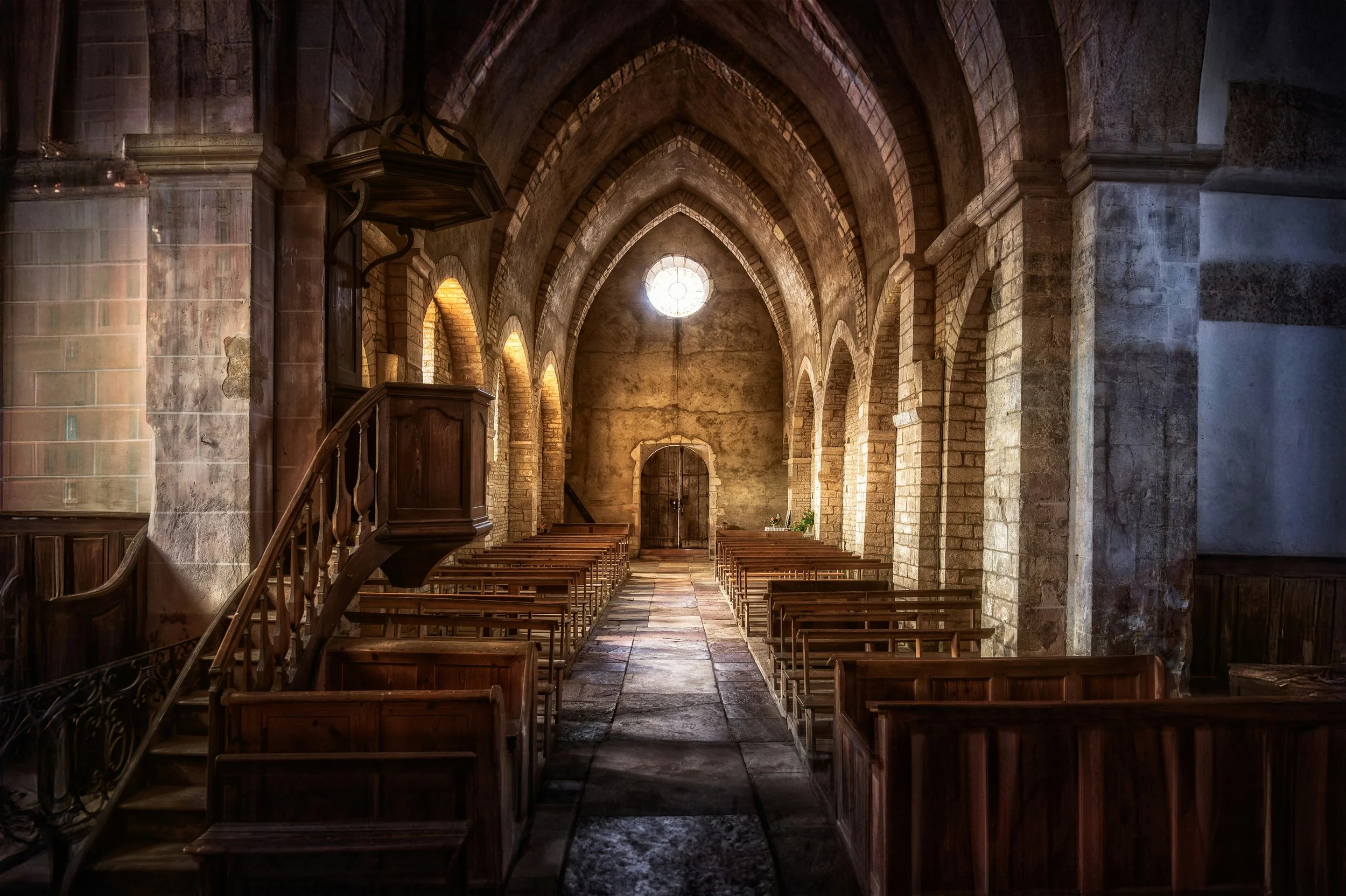
Interior view of an ancient European stone church illuminated by natural light, showcasing vaulted Romanesque and Gothic stone arches, rows of dark wooden pews, and a carved wooden pulpit along the aisle.
“Christianity, because it is a present reality, has no method of knowledge other than the evidence of experience.”
Julián Carrón - Mary carried Him in silence; John leaped. Christianity begins where experience, not argument, does.
The very being of each of us is awakened by a presence that draws out our full humanity. Without our humanity, we could not grasp the full significance of the presence in front of us; it is in our humanity that the significance of that presence is revealed. And the more it is revealed, the more our humanity comes awake; the more awake it is, the more discerning it becomes—that is, the more capable of grasping the value of what stands before it. We see this when someone falls in love, when an encounter comes along that makes life feel exalted! What we so often strive for—and fail to achieve, for all our effort—happens just like that. We are the first to be surprised that it is so simple. Yet often, failing to grasp this, we keep struggling instead of going along with the way our whole self awakens and comes to awareness.
This is the method God had to adopt when He wanted to reveal what truly makes us who we are. He had no way better suited to our humanity, to our nature, than to become flesh—so that we might grasp, just as we do in human encounters, the uniqueness of our encounter with Him: an encounter charged with the very power that makes us who we are, a power we could never achieve by our own efforts.
This is what we heard in the Gospel, in all its simplicity: the child Mary was carrying in her womb made Himself known to Elizabeth—not through a speech, not through a theory or a course of formation, but through that "leap" of the child she herself was carrying, John. Without this event, an ultimate alienation from being remains. The Word became flesh precisely so that we might experience who He is, and the kind of exaltation to which He wants to raise our lives through that encounter we recognize by the "leap."
This is why Fr. Giussani says, "If this vibration is not present, no religious discourse carries any weight."
This is what we celebrate today. To introduce us to the mystery of the Assumption, the Church sets before us a fact that is nothing other than the experience Mary had when she realized who she was carrying in her womb: "For at the moment the sound of your greeting reached my ears," Elizabeth tells her, "the infant in my womb leaped for joy. Blessed are you who believed that what was spoken to you by the Lord would be fulfilled." Christianity, because it is a present reality, has no method of knowledge other than the evidence of experience. You can see this in Mary's response: "My soul proclaims the greatness of the Lord; my spirit rejoices in God my Savior."
We know we have grasped this if something like what happened to Mary happens to us: when it does, life brims with such fullness that we cannot help but thank God—life fills up with gratitude. "My spirit rejoices in God my Savior, for He has looked upon His handmaid's lowliness [her nothingness]."
This first response of Mary's after the angel's announcement is the beginning of what comes to fulfillment in her Assumption, body and soul. The immortality of the soul on its own would not be enough, since it would not take in the totality of our humanity; if the presence of the Risen Christ did not fill us with life, it would not be enough to save the whole of us. This is why, on today's feast, the Church gives us the passage from the second reading: "Christ has been raised from the dead, the firstfruits of those who have fallen asleep." First Christ rose as the firstfruits; then those who belong to Christ will rise. The first to share in this victory of Christ over death—a victory that takes in the body as well—is the Blessed Virgin Mary. And so, on the feast of the Assumption, we celebrate what our destiny is: what we already experience now is nothing other than the first "glimpse" of the salvation for which we are destined—that our whole life may share in Christ's victory, just as the Blessed Virgin Mary's does.
She, being one of us, leads us to this certainty: it is not only Christ, the Son of God, who reaches fullness, but His Mother too—one like us, with the very same human frailty—so much so that the Church celebrates her with such exultation. This is why no dragon will ever be able to triumph, no evil will ever be able to devour the newness that is the presence of this Child, so long as our soul keeps rejoicing in the fullness He lets us experience, so long as, for all our frailty, we recognize Him.
It is remarkable that God has drawn so close to us as to reveal the greatest mysteries of life through experience: starting from the most basic human experience and then using that same method to bring us into true fullness. Were it otherwise, everything would turn abstract, and Jesus would remain a "mere name"—which is not enough to make us rejoice, or to help us understand what Christianity really is.
If we are not attentive to this way in which He reveals Himself, we lose our bearings and let everything else take center stage, instead of giving more and more room to the "thrill" with which He shows Himself to our eyes through experience.
Notes not reviewed by the author
Assumption of the Blessed Virgin Mary - August 15, 2026
(First Reading: Rev 11:19a; 12:1-6a, 10ab; Psalm: 44 (45); Second Reading: 1 Cor 15:20-27a; Gospel: Lk 1:39–56)
-
-
No hay otro método que la experiencia
Asunción de la Santísima Virgen María
Apuntes de la homilía de don Julián Carrón
15 de agosto de 2026
(Primera lectura: Ap 11,19a; 12,1-6a.10ab; Salmo: 44 (45); Segunda lectura: 1 Cor 15,20-27a; Evangelio: Lc 1,39-56)
El ser de cada uno de nosotros se despierta a través de una presencia que hace aflorar toda nuestra humanidad. Sin nuestra humanidad, no podríamos captar todo el alcance de la presencia que tenemos ante nosotros. Es en esta nuestra humanidad donde se revela el alcance de esa presencia. Y cuanto más se revela, más consciente se vuelve; cuanto más consciente es, más crítica se vuelve, es decir, más capaz de captar el valor. Lo vemos cuando alguien se enamora, cuando vive un encuentro en el que la vida se exalta. Por eso, aquello por lo que tantas veces nos afanamos y que no logramos alcanzar por más que lo intentemos, ocurre así, sencillamente. Somos los primeros en sorprendernos de que sea tan sencillo. Pero, a menudo, es como si, al no captarlo, siguiéramos esforzándonos en vano en lugar de dejarnos llevar por la forma en que todo nuestro yo despierta y toma conciencia de sí mismo.
Este es el método al que Dios tuvo que someterse cuando quiso comunicarnos qué es lo que realmente nos hace ser nosotros mismos. ¡No había una forma más acorde con nuestra humanidad, con nuestra naturaleza, que hacerse carne! ¡Para que podamos comprender, tal y como nos ocurre en los encuentros humanos, la singularidad del encuentro con Él! Que está lleno de ese poder que nos hace ser nosotros mismos, algo imposible solo con nuestras propias energías.
Es lo que, en su sencillez, hemos sentido en el Evangelio: el niño que María lleva en su vientre se ha dado a conocer, se ha dado a conocer a Isabel, no a través de un discurso, ni de una teoría, ni de un entrenamiento, sino a través de ese «sobresalto» que sintió el niño que ella llevaba en su vientre, Juan. Sin que esto ocurra, persiste una extrañeza última con respecto al ser. El Verbo se hizo carne precisamente para que pudiéramos experimentar quién es Él y a qué tipo de exaltación quiere llevar nuestra vida a través de ese encuentro que reconocemos en el «sobresalto».
Por eso, como dice don Giussani: «Si no hay esta vibración, ningún discurso religioso tiene sentido».
Esto es lo que celebramos hoy: la Iglesia, para introducirnos en el misterio de la Asunción, nos presenta este hecho, que no es otra cosa que la experiencia vivida por María cuando comprendió a quién llevaba en su seno: «Tan pronto como tu saludo llegó a mis oídos [le dice Isabel], el niño dio un respingo de alegría en mi seno. Y bienaventurada aquella que ha creído en el cumplimiento de lo que le dijo el Señor». El cristianismo, al ser una realidad presente, no tiene otro método de conocimiento que la evidencia de una experiencia. Y esto se ve en la respuesta de María. «Entonces María dijo: “Mi alma glorifica al Señor y mi espíritu se regocija en Dios, mi salvador”».
Sabemos que lo hemos comprendido si nos ocurre algo similar a lo que le sucedió a María: cuando esto ocurre, la vida se llena de tal plenitud que no podemos sino dar gracias a Dios; la vida se llena de gratitud: «Mi espíritu se regocija en Dios, mi salvador, porque ha mirado la humildad [la nada] de su sierva».
Así pues, esta primera reacción que María experimenta tras el anuncio del Ángel es el comienzo de lo que se cumple con su Asunción en cuerpo y alma. La inmortalidad del alma no sería suficiente si no abarcara la totalidad de nuestra humanidad; si la presencia de Cristo resucitado no nos llenara de vida, no bastaría para salvarnos por completo. Por eso, en la fiesta de hoy, la Iglesia nos presenta, con la segunda lectura, el pasaje en el que se afirma: «Cristo ha resucitado de entre los muertos, como primicia de los que han muerto». Primero resucitó Cristo como primicia; después resucitarán los que son de Cristo. La primera en participar de esta victoria de Cristo sobre la muerte, que también abarcó al cuerpo, es la Virgen María. Por eso, en la fiesta de la Asunción, celebramos cuál es nuestro destino: lo que ya experimentamos no es más que el primer «destello» de aquella salvación a la que estamos destinados, para que toda nuestra vida pueda participar de la victoria de Cristo, como la de la Virgen María.
Ella, al ser una de nosotras, nos lleva a esta certeza: no solo Cristo, como Hijo de Dios, alcanza la plenitud, sino también su Madre, una como nosotras, con nuestra misma fragilidad humana. Tanto es así que la Iglesia la celebra con este júbilo. Por esta razón, ningún dragón podrá vencer jamás, ningún mal podrá devorar jamás la novedad que supone la presencia
de este Niño, si nuestra alma se regocija constantemente por la plenitud que nos hace experimentar; si, a pesar de toda nuestra fragilidad, lo reconocemos.
Es impresionante cómo Dios se ha acercado tanto a nosotros como para hacernos conocer los misterios más grandes de la vida a través de la experiencia: empezando por la experiencia humana más elemental, hasta llegar a utilizar el mismo método para introducirnos en la verdadera plenitud. Si no fuera así, todo se volvería abstracto y Jesús seguiría siendo un «nombre puro», que no basta para hacernos exultar ni para hacernos comprender cuál es la verdadera naturaleza del cristianismo.
Si no prestamos atención a esta forma en que Él se nos revela, nos dispersamos y dejamos que prevalezca cualquier otra cosa, en lugar de dejar que prevalezca cada vez más esa «sacudida» con la que Él se nos revela ante nuestros ojos en la experiencia.
Apuntes no revisados por el autor
-
Il n’y a pas d’autre méthode que l’expérience
L’Assomption de la Bienheureuse Vierge Marie
Notes tirées de l’homélie de don Julián Carrón
15 août 2026
(Première lecture : Ap 11,19a ; 12,1-6a.10ab ; Psaume : 44 (45) ; Deuxième lecture : 1 Co 15,20-27a ; Évangile : Lc 1,39-56)
L’être de chacun de nous s’éveille grâce à une présence qui fait émerger toute notre humanité. Sans notre humanité, nous ne pourrions pas saisir toute la portée de la présence qui se trouve devant nous. C’est dans cette humanité qui est la nôtre que se révèle la portée de cette présence. Et plus elle se dévoile, plus elle devient consciente ; plus elle est consciente, plus elle devient critique, c’est-à-dire plus capable d’en saisir la valeur. Nous le voyons quand on tombe amoureux, quand on fait une rencontre où la vie s’exalte ! Ainsi, ce pour quoi nous nous efforçons si souvent et que nous ne parvenons pas à atteindre malgré tous nos efforts, se produit ainsi, tout simplement. Nous sommes les premiers à nous étonner que ce soit si simple. Mais, souvent, c’est comme si, ne le saisissant pas, nous continuions à nous agiter au lieu de suivre la manière dont tout notre moi s’éveille et prend conscience de lui-même.
C’est la méthode à laquelle Dieu a dû se plier lorsqu’il a voulu nous révéler ce qui fait véritablement de nous ce que nous sommes. Il n’avait pas de moyen plus adapté à notre humanité, à notre nature, que de s’incarner ! Afin que nous puissions saisir, tout comme cela nous arrive dans nos rencontres humaines, la singularité de la rencontre avec Lui ! Qui est pleine de cette puissance qui fait de nous ce que nous sommes, ce qui est impossible à réaliser par nos seules forces.
C’est ce que, dans sa simplicité, nous avons ressenti dans l’Évangile : l’enfant que Marie porte en son sein s’est révélé, s’est fait connaître à Élisabeth, non pas par un discours, ni par une théorie, ni par un entraînement, mais par ce « sursaut » qu’a éprouvé l’enfant qu’elle portait en son sein, Jean. Sans que cela ne se produise, il subsiste une aliénation ultime par rapport à l’être. Le Verbe s’est fait chair précisément pour que nous puissions faire l’expérience de qui il est, et vers quelle sorte d’exaltation il veut conduire notre vie à travers cette rencontre que nous reconnaissons à ce « sursaut ».
C’est pourquoi, comme le dit don Giussani : « S’il n’y a pas cette vibration, aucun discours religieux ne tient la route ».
C’est ce que nous célébrons aujourd’hui : l’Église, pour nous initier au mystère de l’Assomption, nous présente ce fait qui n’est autre que l’expérience vécue par Marie lorsqu’elle a compris qui elle portait en son sein : «Dès que ta salutation a frappé mes oreilles [lui dit Élisabeth], l’enfant a tressailli de joie dans mon sein. Et heureuse celle qui a cru à l’accomplissement de ce que le Seigneur lui a dit». Le christianisme, en tant que réalité présente, n’a d’autre méthode de connaissance que l’évidence d’une expérience. Et cela transparaît dans la réponse de Marie. «Alors Marie dit : “Mon âme magnifie le Seigneur et mon esprit exulte en Dieu, mon Sauveur”».
Nous savons que nous l’avons saisi, si quelque chose de semblable à ce qui est arrivé à Marie nous arrive : la vie, lorsque cela se produit, se remplit d’une telle plénitude qu’il est impossible de ne pas rendre grâce à Dieu ; la vie se remplit de gratitude : «Mon esprit exulte en Dieu, mon Sauveur, car il a jeté les yeux sur l’humilité [le néant] de sa servante».
Ainsi, ce premier élan que Marie reçoit après l’annonce de l’Ange est le début de ce qui s’accomplit avec son Assomption, corps et âme. L’immortalité de l’âme ne suffirait pas si elle n’englobait pas la totalité de notre humanité ; si la présence du Christ ressuscité ne nous comblait pas de vie, elle ne serait pas suffisante pour nous sauver tout entiers. C’est pourquoi, en cette fête d’aujourd’hui, l’Église nous présente, dans la deuxième lecture, le passage où il est dit : «Le Christ est ressuscité d’entre les morts, prémices de ceux qui sont morts». Le Christ est d’abord ressuscité en tant que prémices, puis ressusciteront ceux qui appartiennent au Christ. La première à prendre part à cette victoire du Christ sur la mort, qui a également concerné le corps, est la Vierge Marie. C’est pourquoi, lors de la fête de l’Assomption, nous célébrons ce qui est notre destin : ce dont nous faisons déjà l’expérience n’est rien d’autre que le premier « sursaut » de ce salut auquel nous sommes destinés, afin que toute notre vie puisse prendre part à la victoire du Christ, à l’instar de celle de la Vierge Marie.
Elle, qui est l’une des nôtres, nous conduit à cette certitude : non seulement le Christ, en tant que Fils de Dieu, atteint la plénitude, mais aussi sa Mère, une femme comme nous, avec notre même fragilité humaine. À tel point que l’Église la célèbre avec cette exultation. C’est pour cette raison qu’aucun dragon ne pourra jamais vaincre, qu’aucun mal ne pourra jamais dévorer la nouveauté qu’est la présence
de cet Enfant, si notre âme exulte constamment devant la plénitude qu’Il nous fait vivre ; si, malgré toute notre fragilité, nous Le reconnaissons.
Il est impressionnant de voir à quel point Dieu s’est rendu si proche de nous qu’Il nous fait connaître les plus grands mystères de la vie à travers l’expérience : en commençant par l’expérience humaine la plus élémentaire, jusqu’à utiliser cette même méthode pour nous initier à la véritable plénitude. S’il n’en était pas ainsi, tout deviendrait abstrait et Jésus resterait un « simple nom », ce qui ne suffit pas à nous faire exulter ni à nous faire comprendre quelle est la véritable nature du christianisme.
Si nous ne sommes pas attentifs à cette manière dont Il se manifeste, nous nous dispersons et laissons prévaloir n’importe quoi d’autre, au lieu de laisser prévaloir de plus en plus ce « sursaut » par lequel Il se révèle à nos yeux dans l’expérience.
Notes non relues par l’auteur
