
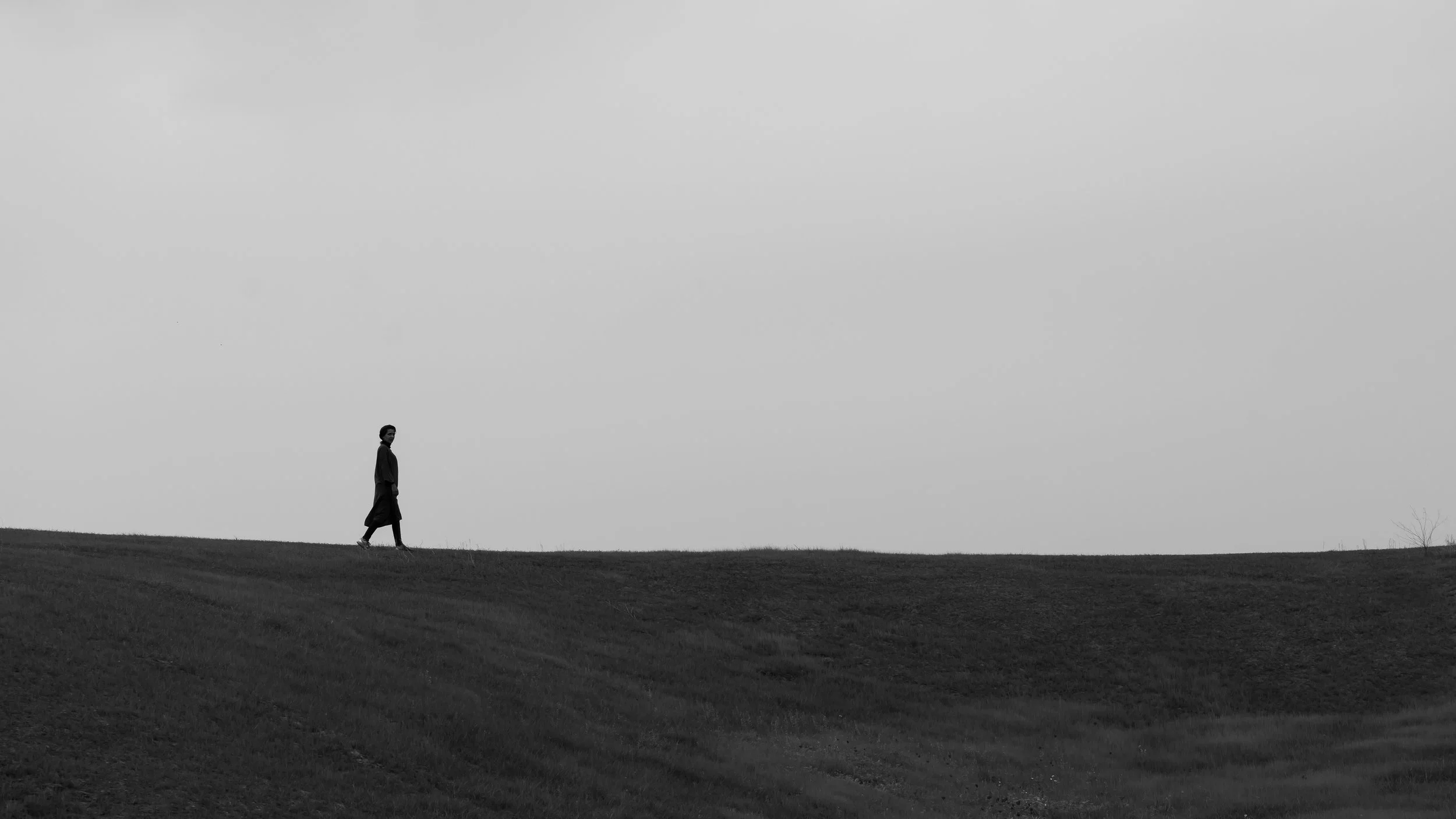
Lone Figure on a Ridge – Solitude and Advent Waiting
“Perhaps the deepest problem of our time is not that we desire too much, but that we have resigned ourselves to desiring too little.”
Julián Carrón - Advent only matters to those who feel the need. The real question is: do we still?
The gathering opened with the song “Be Still My Heart” by Jacqui Treco. (*)
Moderator: Thank you for this song, which leads us in, and first of all, welcome to all of you to this retreat of San Dionigi Parish. A very warm welcome and a heartfelt thank-you, full of fraternity, to Fr. Julián, who for the third year in a row is giving us the gift of his presence. Thank you. It truly is a gift for all of us. We asked him, and he is always so generous in saying yes. When we sat down to think about the theme—we did a bit of discernment—we decided to take up the theme of joy, “so that your joy may be complete,” which is also more or less the theme and title of our patronal feast, and which we hope will be something like the soundtrack of our community this year. Starting from this title, the specific theme we gave Fr. Julián for this gathering is “The Restless Heart and the Discovery of Christ: St. Augustine and the Search for Happiness.” We know how well Fr. Julián knows St. Augustine. We know that the Lord made us in His image and likeness, but He gave us a restless heart. And so, starting from this prompt too, let us allow Fr. Julián to help us today.
Fr. Julián Carrón: Thank you so much, Fr. Gianni, for your warm and constant invitation to this gathering, which I always accept with great joy. As it does every year, with the season of Advent the Church knocks at our door. As with every celebration, each of us is called to take a position. It’s unavoidable. Like it or not, this fact provokes us. We can reduce it to a habit—the usual ritual before Christmas, something we take for granted. Or we can see it as a chance to look inside ourselves, a provocation to our life. The arrival of Advent makes us come to terms with where each of us stands. All of us, at one moment or another in our lives, are forced to recognize our expectant awaiting. No one has said it with as much awareness as Pavese, in words familiar to so many: “How great is the thought that truly nothing is owed to us. Has anyone ever promised us anything? Then why do we wait?” he writes in his diary.
First Point: The Challenge of Waiting
Faced with the surprise of catching ourselves waiting, each of us can react differently. I can treat this waiting as a push to go along with, live it as a condemnation, or try to neutralize it. Freedom is always at stake in front of any provocation from reality.
Those who lack the courage to recognize it and go along with it, because at times it feels demanding—and who can’t reduce it to a condemnation either, because what would they do without waiting?—often try to neutralize it, working to convince themselves that they don’t really feel its urgency. Instead of asking myself whether the life I lead corresponds to my deepest needs, I begin to regard those needs as unreasonable, childish, or excessive.
The search for fullness we carry inside becomes naïveté; the desire for true love, an illusion; the search for truth, an impossible claim; destiny, an abstract problem to be left to the naive. This is the mechanism of settling for less.
Yet we have not solved the problem of waiting, or of the disproportion between our desires and our capacities. We have only learned to ignore them. Settling for less can look like mature realism: Don’t expect too much. Lower your expectations. Don’t ask life for more than it can give you. Learn to limit your demands, to resign yourself. That’s just how life is.
But this realism hides a renunciation. Why would a person shrink his own desire? Not always out of superficiality or indifference; sometimes because truly desiring leaves us vulnerable. Whoever desires a great love risks suffering. Whoever seeks the truth has to be ready to question his own certainties. Whoever desires justice has to reckon with injustice. To desire means exposing ourselves to something we can’t fully control. So settling for less can become a form of protection. If we desire less, we will suffer less. But this strategy leads to a paradox. To avoid being disappointed, we end up renouncing our desires, silencing them. We don’t simply give up a few of life’s possibilities; we renounce a constitutive dimension of ourselves: the capacity to await a fullness greater than what we already know or can imagine, that heart that presses from within.
Settling for less has changed its face in our time: it no longer presents itself as a humble choice, but as a kind of anesthetized self-defense. When a person can’t bear the distance between desire and its fulfillment, he may try to eliminate the tension by reducing the desire itself. Settling for less doesn’t concern only what a person does; it also concerns the conception he forms of himself and of his own possibilities. Renouncing fullness sometimes becomes our wisdom. Perhaps the deepest problem of our time is not that we desire too much, but that we have resigned ourselves to desiring too little. Our thirst for the infinite has died down, not because it has vanished from the human soul, but because we have gradually learned to defend ourselves against it.
The disproportion between what we desire and what we manage to obtain often looks to us like a condemnation to be avoided: we would like to get rid of it. And so settling for less can become a renunciation of the greatness of our humanity. Everything around us is complicit, tending to lull to sleep the most essential traits of our nature. In his Pensées, Pascal speaks of divertissement, understood not as simple amusement but as distraction from one’s own condition. People throw themselves headlong into activities and relationships not only for the pleasure they get out of them, but also to avoid being alone with themselves. In the Spanish daily El País, a journalist confesses to her constant rushing ahead, which was really running away from herself. After months of traveling around the world, for the first time she found herself at home for weeks on end.
“There was no need to think about planes, trains, hotels, or time zones,” she says. “I wrote, edited, took care of my plants, cooked, clearing my days of every commitment except these, like a gardener protecting his garden.” Then she adds: “Yet deep down I felt uneasy. It was like owning a treasure without knowing how to use it. In the middle of any activity, whether writing a prologue or finishing a bowl of soup, an alarm would go off: you should be doing something else. But what? One day I went to the website of the airline I fly most often. I opened my profile and discovered that since 2016 I had circled the globe eleven times. And I understood everything: my unease came from having spent years running from something that was now catching up with me—time.” Having time, and finding ourselves face to face with ourselves.
Sooner or later, reality hands us the bill. Why can solitude become so unbearable that we want to run? Because in the silence, the questions we usually manage to keep at bay come to the surface: Who am I? What do I truly desire? What is the meaning of what I do? The activities that fill our days can become tools for escaping the question about our destiny. Distraction works for as long as it manages to occupy our consciousness completely.
But it doesn’t solve the problem it tries to hide. And the question the singer Madame throws in our faces in one of her songs is brutal: she asks whether you ever wonder who you are without what you do. Here the real issue comes clearly into view. Settling for less can be the result of a continual distraction from what we can’t manage to obtain. We organize our lives so that this desire no longer shows itself. Each of us can verify in his own life what happens when we try to fill this void with things that give us no peace. The list is endless.
Orwell had already noticed this in his famous novel 1984: it struck Winston that what truly characterized modern life was not its cruelty or its insecurity, but “its bareness, its dinginess, its listlessness.” Gray days, sometimes full of activity, but empty and flattened at bottom. What the French novelist Houellebecq calls a mechanical, repetitive, and frustrating life, which we are often forced to endure, marks us more deeply than we think. This could lead us to conclude that, in the end, Advent is an illusion for the naive. If the Church knocks at the door of people who feel no need for Advent, who would care? Who would be interested in her call? That is why we can’t begin Advent without facing this question.
Second Point: The Conditions for Being Interested in Advent
“If I give the solution to a problem or an equation that no one has put to me, who is interested?” Giussani asks. “No one. For them my answer is equal to zero. It has nothing to do with their lives, and so my answer does not exist.” He made this brilliant observation after coming across a line from the American Protestant theologian Reinhold Niebuhr, which he went on to repeat often: “Nothing is so incredible as an answer to an unasked question.” The situation we are living in, in which we settle for less, distract ourselves, and run from ourselves by taking on a thousand activities, can help us grasp the reach of Niebuhr’s insight. If I don’t have a question, the answer doesn’t interest me.
In the same way, I can’t be interested in a call to an awaiting I don’t feel. This means we can’t take for granted that Advent interests us just because the season has begun, because the time has come, if we don’t first feel the need for it! The more I feel a problem, the more even the faintest echo that hints at an answer makes me prick up my ears, makes me curious, makes me slow down if I’m driving, makes me stop if I’m on foot: I prick up my ears. The more I feel a problem, the more the answer interests me. This is the great premise.
How can we describe this great premise? Interest in oneself, the taste of oneself, sadness about oneself, melancholy about oneself, pain about oneself, anguish about oneself, fear of tomorrow, everything we try to shake off, the disaster that strikes a friend, an acquaintance, a stranger we read about in the paper. The more a person is interested in man, that is, in himself, in himself (because “man” can just as easily end up as a neutral abstraction: “man”! Instead, it is each one of us), the more a person feels in himself, for himself, about himself, what presses, his humanity, what presses within him—the more he feels it, the more an answer interests him, and the more every answer, wherever it comes from, gets his attention, and never in vain, never!
Something that happened many years ago helped me understand this. An Italian woman got into a taxi in Madrid. The driver asked her the reason for her trip. She answered that she had come to see a physical therapist, and at that point the driver began asking her for information, details, the symptoms of her illness. The more she told him, the more his curiosity grew. The woman wondered why he was so interested. Then he asked whether that physical therapist would see anyone. As soon as she said yes, the driver confided the reason for his insistence: he had a friend with the same symptoms she was describing, who had not been able to get well.
If it hadn’t been for his sick friend, the driver would never have taken an interest in that stranger.
You can see why we can’t tire of repeating that the more a person feels a problem, or a friend’s problem, the more he strains to listen to any stranger who appears on his horizon and in whom he might find an answer. The more a child is aware of his mother’s absence and the need for her bursts out in him—it’s simple, it’s pre-intellectual [check the audio: the transcript reads “it is not pre-intellectual”]—the more he screams and cries.
So the first condition is to feel our humanity, to take our humanity seriously, to take ourselves seriously. In fact, for Giussani the number one obstacle is this: distraction. Only distraction, as Pascal said. The opposite of taking ourselves seriously.
Etty Hillesum puts it beautifully: “Here is the beginning, the very first beginning: to take oneself seriously.” But, as the episode of the taxi driver shows, how necessary awareness is if we are to be interested! What can reawaken those who have settled for less, those who have distracted themselves with a thousand things just to avoid thinking about themselves, about their own human problem? What can rouse them from their torpor and move them to take an interest in Advent? Only the impact with reality!
Just as the impact with his friend’s illness had made the driver attentive to anything that happened, so we too are constantly prodded by reality. No preparation of any kind is needed; it’s enough simply to pay attention to how it happens.
You all know the singer Ultimo, who, after a concert in July at Tor Vergata, where he set the all-time Italian record for paying attendance, 250,000 people, wrote a song called “Tutto” (“Everything”). He himself told how the song was born: “It hurts me and does me good at the same time. I finished writing it at dawn, after coming home from this summer’s big concert. When you get to the point of having everything, you sit down on the couch, you look outside. It’s as if you had no more excuses for feeling any kind of lack.” This is the point!
He thinks he shouldn’t feel any kind of lack after such a spectacular success. Instead he feels all of it, so much that he starts to cry. “Someone I love very much,” he continues, “looked at me and said: ‘You’re crying—you, who have everything?’” After that resounding success. “From that moment, that sentence opened a crack inside me. And anyway, what is everything?” In the song that came of it, he describes his dream: a concert of his own, the crowd below, his voice at the center. And then what happened? His dream came true! Now, the song says, everything is here, but the cold remains. And turning to that person, he says he knows she may find it absurd now, but he feels cold, even if, to her, he has everything.
Not even getting everything he desires and reaching the greatest success he aspires to is enough for him. When he realizes he has no excuse left for feeling any lack, he bursts into tears. But what makes it all even more dramatic is the loneliness of not feeling understood by her; she doesn’t grasp what he is going through. That is why he tells her he knows she may find it absurd. This dialogue shows the estrangement between them. Not even the affection that unites them manages to overcome the solitude. It is possible to be together and be alone, experiencing an ultimate, radical incommunicability.
It documents what the most important theologian of the last century, von Balthasar, says about the solitary individual of our time. I quote: “What he—this solitary one—knows with certainty about this stranger, that is, about himself, is that he is alone, that it belongs to his nature to be alone; and so it is an unforgivable superficiality on the part of psychology simply to send the man who has this experience back to the community, because what he meets there is nothing but an individual like himself, always and again the same lonely and perplexed man who, in his perplexity, asks directions from others who are perplexed.”
“Today’s solitary person does nothing but meet himself in the other. Two solitary people always find in each other their own inalienable solitude.”
How true it is that the more we discover our needs, the more we realize that we can’t resolve them on our own, and neither can others, people like us. A sense of powerlessness accompanies every serious experience of humanity. It is this sense of powerlessness […] that generates solitude. I may love him, but it seems absurd to me that someone would weep when he has everything. True solitude doesn’t come from being physically alone, but from discovering that a fundamental problem of ours can’t find its answer in us or in others.
We can very well say that the sense of solitude is born in the very heart of every serious commitment to one’s own humanity. It can be someone like Ultimo, who, living his commitment to his own humanity seriously in the attempt of the great concert, finds himself face to face with himself.
Faced with our powerlessness to answer our own problems and other people’s, faced with this deep solitude, our attempts to distract ourselves prove pathetic. Each of us can see it in days spent running from ourselves and looking elsewhere, as if we could unload this onto something else.
And so we can see that this unease is spreading in our time. Faced with the protests that have swept through European cities, some with episodes of destruction, the singer Madame, 24, wrote a post to give voice to the cry of so many young people: “The way we see sex, relationships, money, and power is violent; our desire to rebel is violent. […] We are lost. We don’t know which way to turn. We don’t know what right and left are […]. Only the few who study know […]. Everyone else is lost. I, Francesca, am among the lost.”
And she challenges us: “What if, instead of being disgusted by certain reactions—because that is what we are talking about, a reaction—we tried asking ourselves why? The world we were born into is violent, the way we conceive of existence is violent, but no one notices.”
This is the perception. Many of us can feel lost without anyone understanding our problem. Only this solitude can make us interested in the awaiting that characterizes Advent.
The condition for my being interested in an answer is that I perceive the problem. Because, as Chesterton says, the trouble with the learned, with those who think they are intelligent, is not that they can’t see the solution; it is that they can’t see the riddle. They can’t see the problem.
That is why, if Christ is the answer to human need, the problem of Christ becomes interesting if I realize what the problem is, if I feel what presses within me. The more human I am, the more it interests me.
That is why, Giussani insists, the first condition for understanding anything about Christ as a proposal is to make room for the importance of the heart—heart in the biblical sense of the word—the place of man’s ultimate, constitutive needs, of that original urgency that nature, the very thing that brought you into being, has placed at your root: it is the seed of your “I.”
The more seriously a person says “I,” the more Christ, as the answer to what this “I” lacks, can be interesting.
Anyone who has followed what has been said so far can see that listening to oneself is fundamental for understanding the value of the awaiting Advent speaks of. Awaiting, awareness of our own needs, and existential urgency are essential if we are to live it fully, without reducing it to something taken for granted and useless for our lives, to a ritual for insiders or at most a social event, irrelevant to most people—and to us as well.
Someone writes to me: “Maybe it’s turning 50, maybe it’s that all the certainties I had have crumbled, maybe it’s that this world is testing me hard with its relentless evil, but never as in this period have I perceived the contingency of life, to the point of not sleeping at night, to the point of terror and tears. What does my existence rest on? I can’t live on what I have seen, on the pain, on the sweet memory of what happened to me, or on words I know to be true. I can’t, because it isn’t enough; it isn’t enough for me now; it doesn’t fill this sense of emptiness and solitude. ‘Who are you who fill my heart with your absence?’” And what if this very bewilderment were the occasion to understand the drama that constitutes us, to feel the urgent need of Him?
The singer Elisa tells of it when she speaks of separating from her husband after 17 years together: “It was an extremely strong bond that I never expected to end. This upheaval led me to look inside myself mercilessly and to ask myself questions I had never asked.” Reality cuts us no slack. Anyone who realizes this won’t think he can get by simply by banding together: “strength in numbers” isn’t enough, because it makes the attempt even more pathetic.
So we come back to the great premise. “The answer the Christian message gives to the question about human existence presupposes,” says Ratzinger, “precisely that question. The Christian message [and therefore Advent, Christmas] can be understood in this way, and can be experienced in its authenticity, only where the question about the human condition has first been suffered as a question.”
The vitality of the Christian answer therefore fundamentally requires the vital experience of the question. This vital experience of the question can never be left behind, as if faith in Christ made it superfluous. It is the permanent point of contact in the dialogue God establishes with man, that is, with each of us.
Faith does not make the richness and depth of human questioning superfluous; on the contrary, it asks us to take it seriously. And the more a person takes himself seriously, the more the question churns inside him, and the more attentive he will be to the answer. And so, when someone is alone in the desert, the only thing he can do is wait for someone to come.
Only this lived need can intercept the announcement of Christmas. That is why it is crucial to realize that so often the reason people no longer believe, or believe without believing, in a ritualistic, formal way, is that they don’t live their own humanity; they are not engaged with their own humanity, with their own sensitivity, with their own conscience, and therefore with their own humanity. That is why, after so many attempts, St. Augustine understood that the answer was not a matter of consistency, strength, or willpower, but of knowledge of oneself, of one’s own nature.
“You have made us for Yourself, O Lord”—this is our nature—“and our heart is restless until it rests in You.” And You show so clearly how great You have willed the rational creature to be, because nothing less than You can suffice for its blessed rest, for its happiness.
Those who are aware of the nature of their need can do nothing but wait for someone to come, and cry out while they wait. We are expectant awaiting.
Third Point: Christmas. “I Proclaim to You Good News of Great Joy”
To this awaiting Christianity responds today, reaching each person, with the announcement of a fact. Someone has answered our awaiting. Only a fact can respond adequately to those who perceive the drama of existence and feel lost. Discourses are not enough. Lessons are not enough. What is needed is a fact equal to the drama, to the feeling of being lost.
Today as at the beginning, this announcement reaches us in the situation in which we find ourselves. It doesn’t require favorable conditions; it shows itself in reality and in the world as they are, as we are. It’s hard to find anything that says this as well as Péguy does—he couldn’t be left out: “There was the wickedness of the times under the Romans too, at that height of Roman domination. But Jesus did not shy away at all, did not withdraw at all, did not waste his three years, did not use them to whine and accuse the wickedness of the times. Yet there was the wickedness of the times, of his time. He cut it short, in a very simple way: by making Christianity. He did not indict, he did not accuse anyone: he saved. He did not indict the world: he saved the world.”
But we, drowsy and lost, distracted or busy shrinking our desire—how can we intercept it, welcome it, and rejoice? How can God pull this off in a situation like ours? Because if God wants to show His passion, the love He has for the world, for us, the world has to be able to know it.
Von Balthasar says again: “In spite of, and precisely in, His absolute otherness.” And to introduce us to this mystery, von Balthasar starts from the simplest thing we can start from. He says it is like the mother who has smiled at her child for days and weeks on end, until the day comes when the child answers with a smile.
There is no other method. Why? Because the mother has awakened love in the child’s heart. And the child, waking to love, wakes to knowledge. This is how God shows Himself to man: as love. It is God who illuminates love and makes it shine, kindling in the human heart the light of love, the very light that is able to see this absolute love. Just as no child wakes to love unless he is loved, so no human heart can wake to the understanding of God without the free gift of His grace, in the image of His Son. In the Incarnation, God used no other method than this one of the child, of the mother with her child.
God bent down to the only way man could understand. As the child’s relationship with his mother shows, the emergence of the human person, giving man back his identity, is possible not through reasoning, not through self-reflection, but only by running into a living reality, a qualitative difference, a difference of life.
Only the encounter with a human difference, with a gaze able to understand Ultimo’s tears, to answer those who are lost, like Madame, and to rouse us from our torpor and flatness, can awaken our interest in Christianity.
We see it in the Gospel: Christ’s gaze was enough to reach Zacchaeus in his situation. It was so real that Zacchaeus felt full of joy. That is how he could understand a statement that might have remained abstract: “For the Son of Man has come to seek and to save what was lost.” But what had Zacchaeus lost? Not only his moral respectability, but the capacity to understand and fully live his own humanity and his relationship with himself and with others. That is why, when Jesus entered his life, he grasped that sentence clearly: “Today salvation has come to this house.” It is precisely the encounter with a human reality like this that awakens and calls forth the awareness of one’s own person, as the mother does with her child.
The encounter doesn’t generate the person; the person was generated by God, who gives us life through a father and a mother. But it is in an encounter that I become aware of being myself. The mother awakens her little girl to the awareness of herself.
The outcome of an encounter is the calling forth of the person; it brings the person out of torpor to become aware of himself and answer with another smile.
How can we not recall the unforgettable encounter Manzoni describes in The Betrothed between the Unnamed and Cardinal Federigo Borromeo?
“As soon as the Unnamed was shown in, Federigo went to meet him with a solicitous and serene face and with open arms, as to someone long desired […]. But [the Unnamed], raising his eyes to that man’s face, felt himself more and more penetrated by a feeling of veneration at once commanding and gentle […]. [Federigo] held out his hand to take the Unnamed’s. ‘No!’ the man cried, ‘no! Away, away from me; do not soil that innocent and generous hand. You do not know all that this one you want to clasp has done.’ ‘Let me,’ said Federigo, taking it with loving violence, ‘let me clasp this hand that will repair so many wrongs, that will scatter so many kindnesses, that will lift up so many of the afflicted, that will stretch out unarmed, peaceful, humble to so many enemies’ […]. The Unnamed, freeing himself from that embrace, […] exclaimed: ‘God truly great! God truly good! I know myself now.’”
“I understand who I am”—now! Without this deeply human experience, we don’t know ourselves. We are like stones swept along by the torrent, looking for something that answers. And what does the Unnamed experience? “My iniquities stand before me; I loathe myself; and yet…! and yet I feel a relief, a joy—yes, a joy such as I have never felt in all this horrible life of mine!”
It’s easy: all it takes is letting a presence in. When a person finds himself again, he feels filled with a joy that is not simply the consequence of a life finally sorted out and settled. It is the sign of a presence that has reached him at the deepest point of his need. So much for absurd!
The person meets someone who understands his humanity all the way down. We too, each caught up in our own worries, our own torments, can notice any small sign that might announce a possible answer only when we become aware of our need.
Like the Unnamed, we too can be amazed that it is a man, one single man, who is the keystone for resolving our torments, our bewilderment. But how can we experience it? By the same method through which Zacchaeus and the Unnamed experienced it: through the presence of Jesus of Nazareth, who entered history and remains among us. “And behold, I am with you always, until the end of the age.”
Why did He come? Because He knew our nature. God entered history as a man, according to the human form, so that thought, imagination, affection, and dream were, so to speak, stopped short and magnetized by that Presence. Because our “I” can be touched, moved, only if Christ is perceived as an event. This is the great question. Not only a memory of the past, but something happening now, a presence happening now, because outside this “now” there is nothing interesting.
It is in this encounter that a person can see all of his humanity embraced. The only answer to solitude is the encounter with this gaze of Jesus, which saves the human, gives breadth back to our needs, and introduces us to the relationship with the Father. A direct, exclusive relationship with God. In this embrace, solitude is eliminated. The companionship is in the “I.” This is how someone like St. Paul lives it, with his familiarity with this Presence that has seized his life: “I live, no longer I, but Christ lives in me.” That is, I am no longer alone, with my limits, my tensions, my fears.
When I say “I,” I say: “I am Christ’s.” This is the true self-awareness of someone who has been seized by Christ.
It is the new content of the sense of self: my “I” is You. You are my true “I.” And for this reason we can’t ignore the drama of living, we can’t neglect becoming aware of our own need, if we are to verify whether there is a real presence that makes us say: “Thank goodness You’re here. Thank goodness You’re here, Christ, and that You came to answer the drama of life.”
“In recent years,” someone writes to me, “I found myself going through very serious family and personal difficulties, which caused acute suffering. A whole series of certainties I had considered fundamental for my life fell away.
Last week I happened to teach a class on a text by Romano Guardini in which, at a certain point, Guardini says that at the root of the person one discovers the presence of the Mystery as the constitutive relationship of the person itself.
“A student asked me to clarify the nature of this Mystery. I tried to give her a little more without going too deep. Another student raised her hand to ask whether the Mystery Guardini speaks of has anything to do with the historical figure of Jesus. I realized that I couldn’t dodge this question, and, using Guardini’s language, I found myself, without meaning to, telling her who Jesus is for me. Not just a name or a devotional reference, but the all-embracing affective center of my life. As I was answering this student, I realized that all my human preference, all my reason, all my affection, all my freedom are drawn to this man, and that I feel for him a love greater than what I feel for anyone else, including my children. Obviously this isn’t a vision that excludes anyone. By the end of the class I was so moved that I couldn’t speak anymore and had to run to the restroom, where I began to sob, because I realized that through these years of extreme deprivation and grave suffering I have been completely taken hold of by Him.
“Once all my certainties, and many relationships too, had fallen away, the one presence that never abandons me emerged—not as consolation for a life gone wrong, but as an affective center that gives me back a human fullness I had never enjoyed before.”
That is why we can understand what Giussani says: “I had become deeply convinced that a faith that could not be discovered and found in present experience, confirmed by it and able to respond to its needs, would not have been a faith able to hold up in a world where everything, everything, said and says the opposite.” This is what can answer so many of the questions that have come up. How can one avoid the post-baptismal void?
That is the question a newly baptized woman asked in her testimony before the Pope in Paris. The void of the woman who has lost her husband, of the woman whose husband has left her, and of the one who has everything and weeps, like Ultimo. Why? What is “everything,” after all? Christ. It is the name that points to a reality I have encountered in my life—that I have encountered. I had heard about Him before, as a child. The word is familiar, but for so many people Christ is not encountered, is not really experienced as present. And so He doesn’t answer. But when Christ is experienced as a presence, we can’t help exclaiming, full of gratitude: “Who are You?” and “I live, no longer I, but Christ lives in me.”
You, Christ, are the only hope in this global landscape of bewilderment, provided You are perceived as a real presence. In this world of “the lost,” nothing else has the power to attract.
Not even those who come back manage to keep the post-baptismal void from prevailing after a while. They too heard the Pope ask, in his homily at the Mass in Paris: “Through baptism we have received the living water the Gospel speaks of. But have we truly encountered Christ personally?” Because the Gospel, Christ, becomes credible, Ratzinger says again, where there are people who let themselves be completely seized by Him and where the experiment of life becomes its confirmation.
We don’t need recipes—there are too many already—but people who are struck by Christ and follow Him. This is the joy that entered the world with Christmas, and that Jesus wants to share with us. “I have told you this so that my joy may be in you and your joy may be complete.”
The Christian can rejoice even now, because the good he awaits has already begun to be present in his life.
And I’ll end here: Christian joy is the experience of those who recognize that the salvation they were awaiting has arrived and has already begun to change their lives. As it does every year, Christmas offers us the chance to verify whether our celebration of it is the joyful feast of Christ’s living, real presence, or the sad confirmation of His absence. As at the first Christmas, the distinguishing sign is joy. Thank you.
Moderator: Thank you. Fr. Julián has left us an invitation to the freedom that is always at stake, an invitation to an Advent that takes us deep into knowing ourselves, into being engaged with our humanity, into going down to the depths of ourselves, because that is where we meet Christ, as St. Augustine told us: “in interiore homine habitat veritas”—truth dwells in the person who knows how to enter into his own life, into his own depths, who questions himself.
San Dionigi Parish (Oratorio Pratocentenaro) · Transcript not reviewed by the author. Editing by the staff of Epochal Change. In the coming weeks, as soon as the full official text is available, it will also be translated into Spanish and French and published in Italian.
